
More than just racks - solutions for safe and attractive bicycle parking
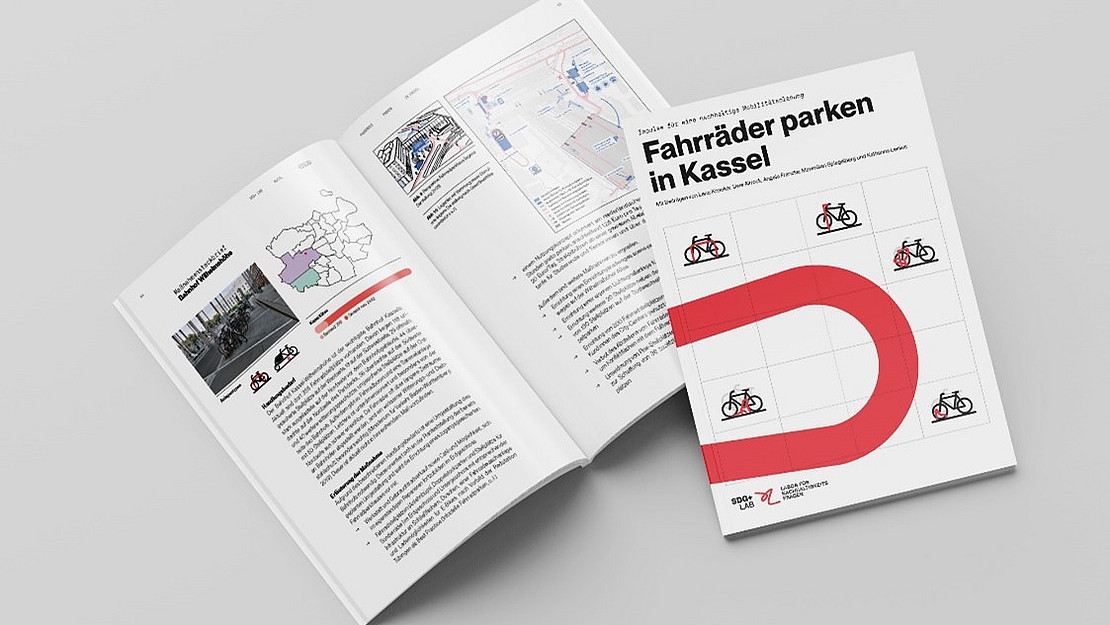 Image: Simeon Uhl
The students found that although the current bicycle parking infrastructure in Kassel is well developed in parts, it has considerable deficits. The quality of the existing facilities is particularly critical: many locations still have outdated front wheel holders that do not hold the bike securely and can damage the rims. There is also a lack of adequate weather protection, lighting and theft protection - especially at bus stops and in residential areas. "The acceptance of bicycles also depends on them being able to be parked safely and properly in urban areas," emphasizes Prof. Uwe Altrock, Head of the Department of Urban Regeneration and Planning Theory. "This requires a further expansion of the infrastructure based on a city-wide concept. This publication provides an objective impetus for this."
Concrete proposals for practice
The students developed concrete proposals for the individual districts:
In Kirchditmold and Harleshausen: overloaded facilities and wildly parked bicycles were documented at schools and daycare centers. The students therefore suggest converting car parking spaces into secure, covered facilities with crossbars that can also easily accommodate cargo bikes and e-bikes.
At the Jungfernkopf RT stop: The existing frame racks were identified as unsuitable for children's and special bikes. The proposed solution is to replace them with crossbars, increase capacity and set up a repair station.
At Wilhelmshöhe station: An urgent need for an access-secured bicycle parking garage with a workshop, charging facilities and a café was identified here. The students proposed a model based on best practice examples from Tübingen.
In the front west: At the Friedenskirche stop and at the future Technical Town Hall, parking facilities are not only intended to increase capacity, but also to improve the quality of stay through design, lighting and services.
Lena Knacker from the Department of Urban Regeneration and Planning Theory points out that "bicycle parking facilities can contribute to attractive urban spaces if they are designed to be multifunctional and offer other uses such as seating, various forms of mobility or cultural activities. The students' work clearly shows the areas for improvement in Kassel."
Sustainable solutions for a climate-neutral city
The results of the survey "How do you park your bike? What makes an attractive bicycle parking space for you?" among 349 participants confirm the study findings: the majority of cyclists value proximity to their destination and ease of use as important. At the same time, the lack of protection from the weather and the lack of theft protection are seen as the biggest problems. If the facilities were better, respondents would also park more expensive bikes overnight and leave accessories such as helmets or bags behind.
"The results clearly show that improved, secure and weather-protected bicycle parking facilities would significantly change parking behavior," says Prof. Dr. Angela Francke, Professor of Cycling and Urban Mobility at the University of Kassel. "Public participation in our survey and the cooperation of students on site were crucial in order to tailor the proposed solutions to the actual needs of users. Together, we can improve cycling and shape the mobility of the future."
The role of the SDG+ Lab as a connector
The programs of the SDG+ Lab, the sustainability laboratory of UniKassel Transfer, played a central role as an innovation and dialogue platform that brings together science, politics, business and society to jointly develop sustainable solutions for regional challenges. The idea for this interdisciplinary project arose when working on the question: How can Kassel become an attractive, energy-sovereign model region? "The project "Parking bicycles in Kassel" shows that cooperation between the university and society can lead to practice-oriented solutions for real places and real everyday challenges, even for large, strategic issues. We will continue to actively work to create spaces for objective dialog in change processes," say Katharina Leinius and Dr. Maximilian Spiegelberg from the SDG+ Lab.
The publication will be presented - participation is encouraged
The results of the project will be presented to the public on May 5, 2026, from 10:00 to 12:00 at UNI:Lokal, Wilhelmsstraße 21, Kassel. The authors will present important findings from the publication in a small panel discussion and then enter into an exchange with the audience. The event is part of the "Kassel Bicycle Weeks", which invites you to actively participate in shaping a bicycle-friendly city. Further information and the opportunity to register can be found at: https: //sdgpluslab.de/fahrraeder-parken
Contact for queries:
Gianna Dalfuß (Press & Public Relations) and Katharina Leinius (Head of Operations SDG+ Lab)
University of Kassel
Email: presse.sdgpluslab[at]uni-kassel[dot]de
Tel: +49 561 804-3567