This page contains automatically translated content.
A step towards sustainable hydrogen production with cyanobacteria
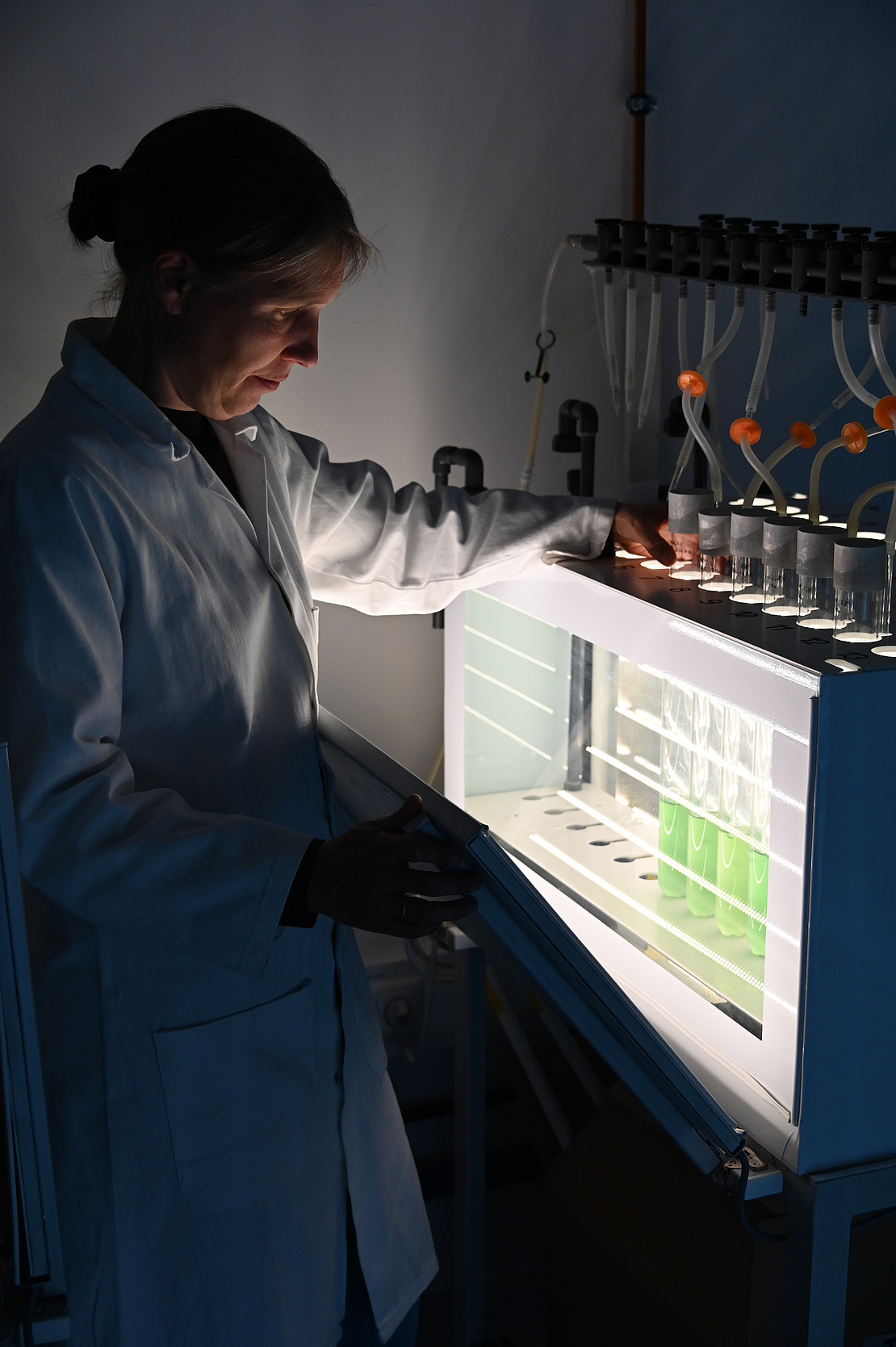 Image: Stefan Weydert
Under certain conditions, cyanobacteria (also known colloquially as "blue-green algae") are able to produce hydrogen using photosynthesis - a promising approach for generating clean energy. However, the oxygen produced during photosynthesis inhibits the activity of certain enzymes, so-called hydrogenases, which are necessary for hydrogen production. Previous approaches to oxygen removal were either inefficient or required the use of additional chemicals and carbohydrates, which impaired the sustainability of the process.
Electrochemical protection enables continuous hydrogen production
The team led by Prof. Dr. Wolfgang Schuhmann from Bochum, Prof. Dr. Kirstin Gutekunst from Kassel and Dr. Felipe Conzuelo from Lisbon have now found a solution: By integrating cyanobacteria mutants into a special redox polymer deposited on an electrode, the cells can be protected from oxygen. The polymer contains viologen groups that are reduced by applying an electrical potential and thus efficiently break down the oxygen in the cells' environment.
The system creates an oxygen-free microenvironment directly around the cells so that the hydrogenases remain active and can continuously produce hydrogen. "This is an important step towards sustainable and scalable biotechnological hydrogen production," says the research team.
Genetically optimized cyanobacteria increase efficiency
The use of genetically modified cyanobacteria was particularly successful. In these mutants, the hydrogenase is genetically linked directly to the so-called photosystem I of photosynthesis. These mutants showed significantly longer and more stable hydrogen production compared to wild-type cells in the polymer.
Future prospects: biophotovoltaics for the production of green hydrogen
The results of the study open up new possibilities for the development of biophotovoltaic systems that convert sunlight directly into hydrogen. "Our approach combines the advantages of living cells - such as self-repair and longevity - with the precision of electrochemical systems," says Prof. Gutekunst.
In addition to the research group leaders, the research team also included Dr. Panpan Wang from Bochum and Florian Paul, Dr. Marko Böhm and Dr. Jens Appel from Kassel. The research was funded by the German) Federal Ministry of Education and Research (BMBF) and the Dietmar Hopp Foundation.
Original publication: Wang, P., Paul, F., Boehm, M., Appel, J., Gutekunst, K., Schuhmann, W., Conzuelo, F. (2026). Electrochemical Protection of Cyanobacterial Cells against Molecular Oxygen Enables Sustainable Photo-H₂ Production. Angewandte Chemistry International Edition, 65, e202422882.
onlinelibrary.wiley.com/doi/10.1002/anie.202519077
Parts of this text were created using artificial intelligence and reviewed by humans before publication.
Contact:
Prof. Dr. Kirstin Gutekunst
University of Kassel
Department of Plant Physiology
E-mail :kirstin.gutekunst@uni-kassel.de
https://www.uni-kassel.de/fb10/institute/biologie/fachgebiete/molekulare-pflanzenphysiologie-bioenergetik/prof-dr-kirstin-gutekunst.html
Press contact:
Sebastian Mense
University of Kassel
E-mail: presse[at]uni-kassel[dot]de
www.uni-kassel.de
What does this mean in summary?
- Cyanobacteria can produce hydrogen under certain conditions
- However, the oxygen produced during photosynthesis inhibits the activity of certain important enzymes
- By integrating cyanobacteria mutants into a special redox polymer, the cells can be protected from oxygen
- This study involving the University of Kassel could contribute to the production of clean energy
Press contact
Service für Presse und Medien (Press inquiries, requests and expert referrals)
- Telephone
- +49 561 804-1961
- presse[at]uni-kassel[dot]de
- Website
- Communications Office