
Low-Carbon Concrete in Rail Construction: Pilot Project Launched at the “Kassel Curve”
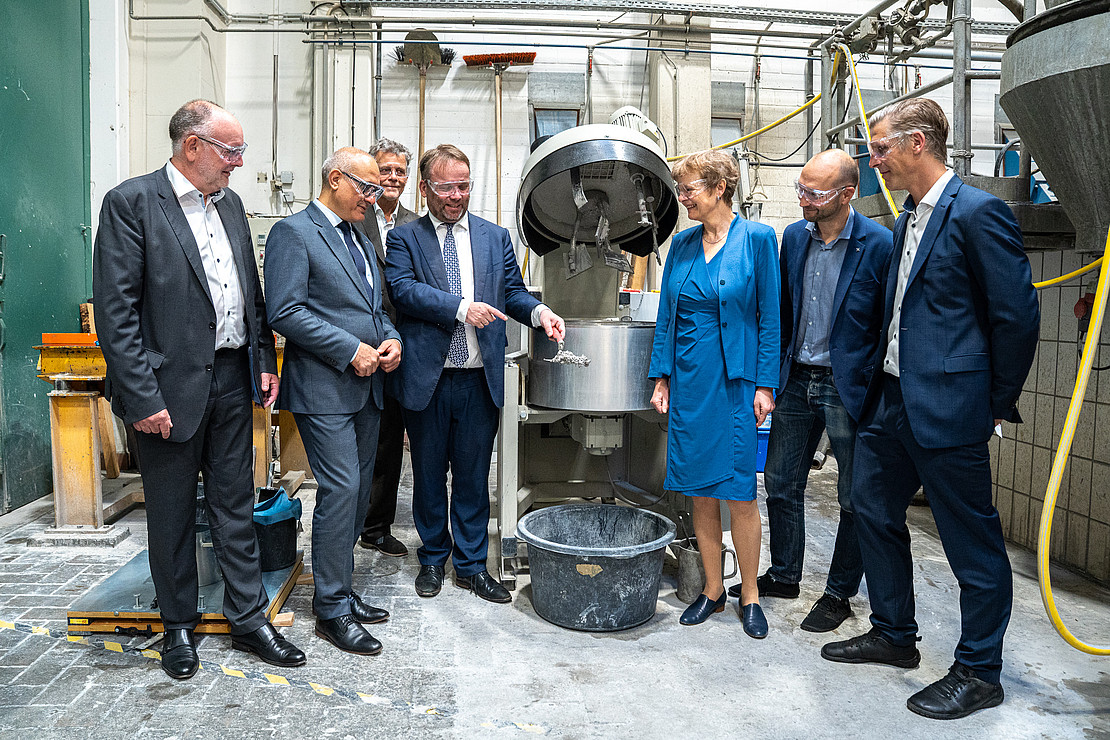 Image: Deutsche Bahn
“We are pleased with our excellent collaboration with the University of Kassel. Together with the Federal Ministry of Transport, we want to drive forward innovations in environmentally friendly construction for the railways. This also includes testing these innovations in practical applications. The goal is to create the conditions necessary for the inclusion of such‘low-CO₂’ concretes in DB’s technical regulations,” said Ismail Ertug, Deutsche Bahn AG’s corporate representative for Hesse. Currently, technical standards and DB regulations exclude the use of innovative low-CO₂ concretes in railway construction for many applications. To change this, the pilot project is receiving scientific support—including from the University of Kassel, the Federal Ministry of Transport, experts and engineers, and the Federal Railway Authority. With this project, DB InfraGO aims to demonstrate that thelow-CO₂ concretes used meet the requirements for safety, durability, and technical feasibility. The results will be incorporated into the further development of the company’s internal regulations.
Hesse’s Minister of Science, Timon Gremmels, commented: “The project demonstrates how important close collaboration between research and practice is. It’s about sustainable construction, new materials, technical safety, and the question of how innovations from research can find their way into widespread application. The collaboration between the University of Kassel and DB InfraGO brings together scientific expertise, technical know-how, and a major infrastructure project. This openness toward the region and the practical world is of great value.”
Prof. Dr. Ute Clement, President of the University of Kassel, added: “The University of Kassel is conducting highly successful research on innovative materials, ranging from concrete and plastics to novel metals. This project is an excellent example of how these results are put into practice. In doing so, we’re making the world a little more sustainable and Germany a little more innovative.”
Thelow-carbon concretes used differ from conventional concretes primarily in that they are produced without cement, which is responsible for a large portion of CO₂ emissions. To achieve the same or better properties—particularly in terms of strength and durability—special processes are used in their production. The Federal Ministry of Transport is funding the project as part of the “Kurve Kassel” rail project. “It is important to us that we take the right steps now toward compliant,low-carbon concrete construction in infrastructure projects, and that we move beyond that to zero-emission concretes and evenCO₂-storing concretes,” says Dr. Joachim Hugo of the Federal Ministry of Transport.
“Research onlow-CO2 concrete is being conducted in many places. What’s missing is a cross-scale analysis—from the microstructure all the way to implementation at the construction site: How and what needs to be tested to further improve quality and ensure it in the long term?” explains Prof. Dr. Bernhard Middendorf. “We can do all of that at the University of Kassel.” The university in northern Hesse focuses one of its research priorities on the study of materials of the future. With the Department of Construction Materials and Construction Chemistry—led by Prof. Middendorf and part of the Faculty of Civil and Environmental Engineering—the university possesses outstanding expertise in the development, production, and testing of novel concretes, as well as in scaling such projects.
This year, DB InfraGO is installing various concrete mixes in a retaining wall south of the Kassel-Wilhelmshöhe ICE station, which will then be analyzed. The goal is for the material to be incorporated into DB’s standards and used in other construction projects. In addition, researchers are examining the extent to which low-emission building materials are also more cost-effective. Cement substitutes such as blast furnace slag, calcined clays, crushed concrete sand, etc., are less expensive than traditional cement. Furthermore, rising prices in the EU Emissions Trading System are expected to lead to higher construction costs in the long term, making climate-friendly solutions essential.
The pilot project is part of the “Kurve Kassel” initiative, which aims to eliminate bottlenecks in the rail network and improve the infrastructure’s capacity. As part of this, a connecting curve is being built north of Kassel between the Warburg–Kassel and Hann. Münden–Kassel lines. DB InfraGO is driving forward the eco-concrete pilot project as part of the “Kurve Kassel” initiative.
Further information on the project is available at www.kurve-kassel.de
Contact:
Sebastian Mense
University of Kassel
Communications and Marketing
Tel.: +49 561 804-1961
Email:presse@uni-kassel.de
www.uni-kassel.de
Deutsche Bahn
Frankfurt Press Office
Tel. +49 69 265-24911
Email: presse[at]deutschebahn[dot]compresse@deutschebahn.com
www.deutschebahn.com/de/presse/presse-regional/9916750-9916750
Prof. Dr.-Ing. Bernhard Middendorf
University of Kassel
Department of Construction Materials and Construction Chemistry
Tel.: +49 561 804-2601
Email: middendorf[at]uni-kassel[dot]de