Study structure

This page contains automatically translated content.

General

A degree programme consists of modules that are defined in the examination regulations and described in more detail in the study and examination plan. It makes sense to study these modules in a certain order in terms of content and time. There is a sample study plan for each degree program, which shows you an ideal course of study. If you study in this way, you can complete your studies within the standard period of study. This is not always possible, so there may be individual deviations from the suggested course. When planning, you should bear in mind that not every module is offered in the winter and summer semesters and that some modules build on each other or have other participation requirements. The Student Advisory Service will help you to plan your studies individually.

What is the teaching degree program about?

  1. Acquire specialist knowledge
    Prospective teachers need specialist knowledge in order to be able to teach well later on. To this end, it is important to become familiar with the current state of research in the subject and to acquire knowledge of scientific work, which will help them to classify future developments in the subject later in their careers.

  2. Acquiring subject-specific didactic skills, lesson planning and implementation
    In addition to subject-specific knowledge, you need pedagogical and didactic skills to be able to plan and organize lessons effectively and successfully. The focus is always on promoting and supporting students' learning processes. Some things work, others don't - so it is also important that prospective teachers deepen their ability to reflect and critically question and continuously optimize methods and concepts.

  3. Educational content and skills
    Looking at the big picture is also part of this: schools are subject to societal conditions and changes. Cross-cutting topics such as the integration of students with other native languages, inclusion, media education and digitalization or sustainability are therefore also topics of teacher education.

The degree program for the teaching profession at elementary school comprises

  • the core study program in educational and social sciences including the modules in primary school didactics and aesthetic education
  • the subjects German and mathematics
  • as well as at least one further subject from the following range of subjects: English, Protestant religion, French, Catholic religion, art, music, physical education, sport.

Long subject - Short subject - Credits

One of the three subjects must be studied as a long subject worth 50 credits. If art, music or sport are chosen as teaching subjects, these must be studied as long subjects.

In addition, the University of Kassel offers the following subjects as both short and long subjects: German, English, Protestant Religion, French, Catholic Religion, Mathematics, General Studies.

What are credits?
For each module that you successfully complete with an examination, you receive a certain number of credits (also known as credit points). The examination regulations of the subject provide information about the credits that can be earned in each module.

What is the difference between a long and a short subject?
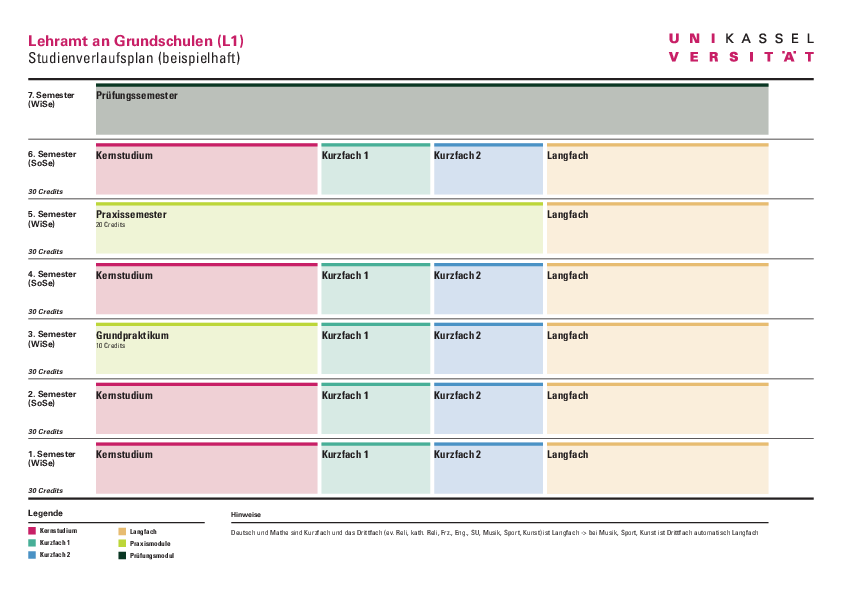
This can be easily seen from the credits: 180 credits are required for admission to the First State Examination. Of these, 60 credits are allocated to the educational and social science core course, 50 credits to the long subject and 35 credits each to the two short subjects. A long subject is therefore studied "more intensively" than a short subject.

The sample study plan below shows the ratio of long and short subjects for the entire degree program.

Sample study plan

Practical school phases

The practical phases as part of the degree course are a compulsory component of the teacher training courses and consist of a basic internship in the first half of the course and a practical semester in the second half. The basic internship is also about reflecting on aptitude for the teaching profession and gaining a first impression of subject didactics and pedagogical action.