
Career prospects
The content on this page was translated automatically.
The innovative Environmental Engineering course combines highly topical environmental issues with scientific and technological engineering know-how.
What do environmental engineers do?
The job description is closely linked to the disciplines of civil engineering and process engineering. Environmental engineers work in research, industry, engineering offices and public administration. They deal with a wide variety of engineering tasks that require an in-depth understanding of all environmentally relevant areas and develop environmentally relevant solutions in the interests of sustainable development.
Possible fields of work are...
- Waste management - e.g. disposal, recovery, recycling, landfill technology and contaminated site disposal
- Urban water management - e.g. drinking water production, wastewater disposal and treatment
- Hydraulic engineering - e.g. flood protection, watercourse restoration
- Energy generation from renewable sources- e.g. sun, wind, water, biomass, geothermal energy
- Environmental management- e.g. water and soil protection
- Environmental management- e.g. energy-efficient production, simulation of material cycles, life cycle assessment of processes and production, simulation of environmental risks
- Mobility and transportation- e.g. measures to reduce pollutants
- Consulting- e.g. energy, water, waste, environmentally friendly construction
Activities carried out by environmental engineers...
- Management, operation, production in environmental engineering companies, in particular plant construction and waste disposal, as well as environmental management
- Approval, monitoring and control of environmental facilities (e.g. sewage treatment plants, waste treatment plants) by and in public administration or participation in environmental associations)
Design, planning and construction supervision of environmental facilities in engineering and planning offices
Research and teaching in universities, research and further education institutions and work in environmental associations.
Labor market demand
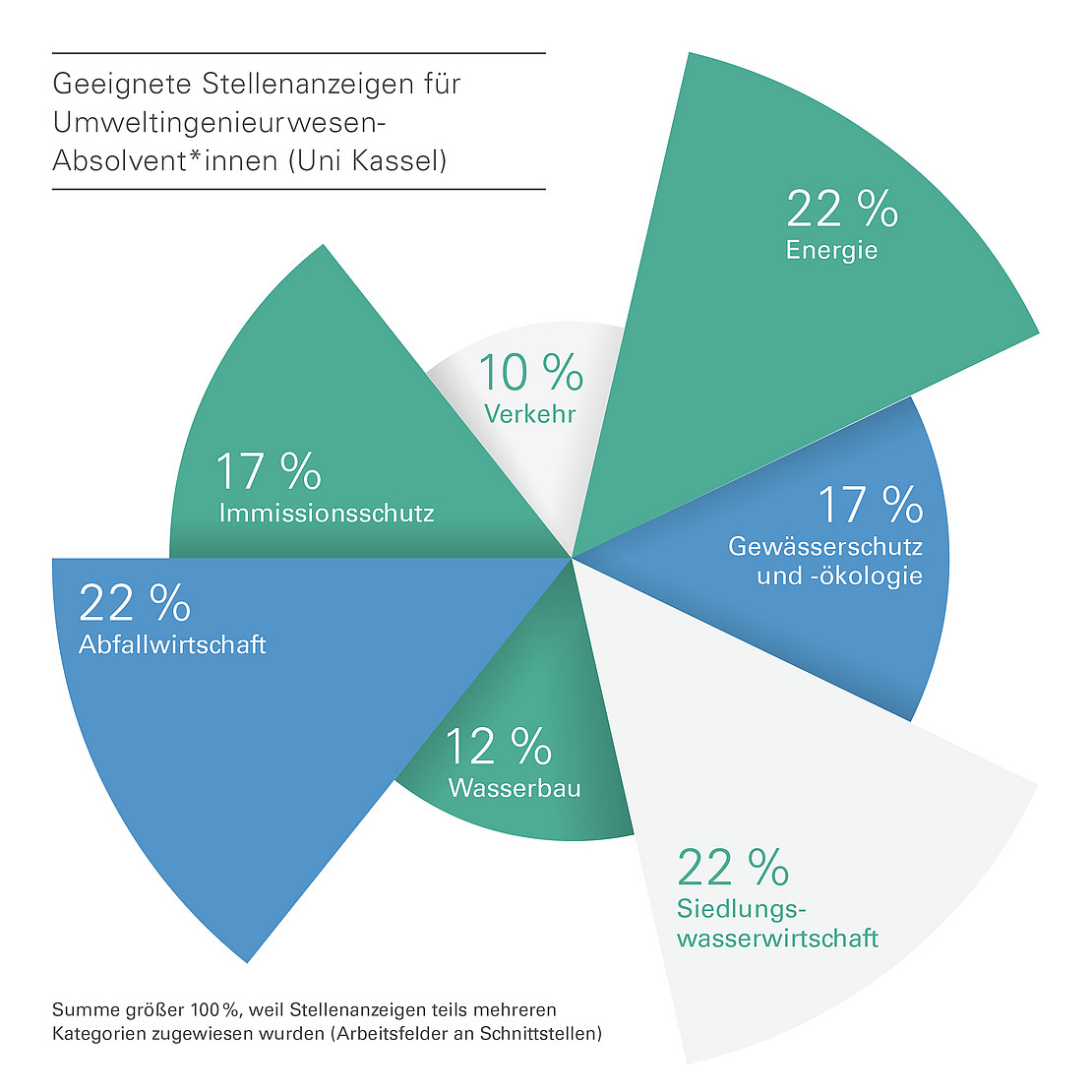
Environmental engineering graduates are slightly more frequently sought after by public companies and authorities than by private companies. Demand comes from the fields of waste management (22%), urban water management (22%), energy (22%), immission control (17%), water protection and ecology (17%), hydraulic engineering (12%) and transport (10%).
75% of job advertisements suitable for environmental engineers are also aimed at or exclusively address Bachelor's graduates. Nevertheless, 75% of Bachelor's graduates from the University of Kassel follow their Bachelor's degree with a Master's degree, partly due to the better working conditions (see below).
Fields of work for Kassel graduates
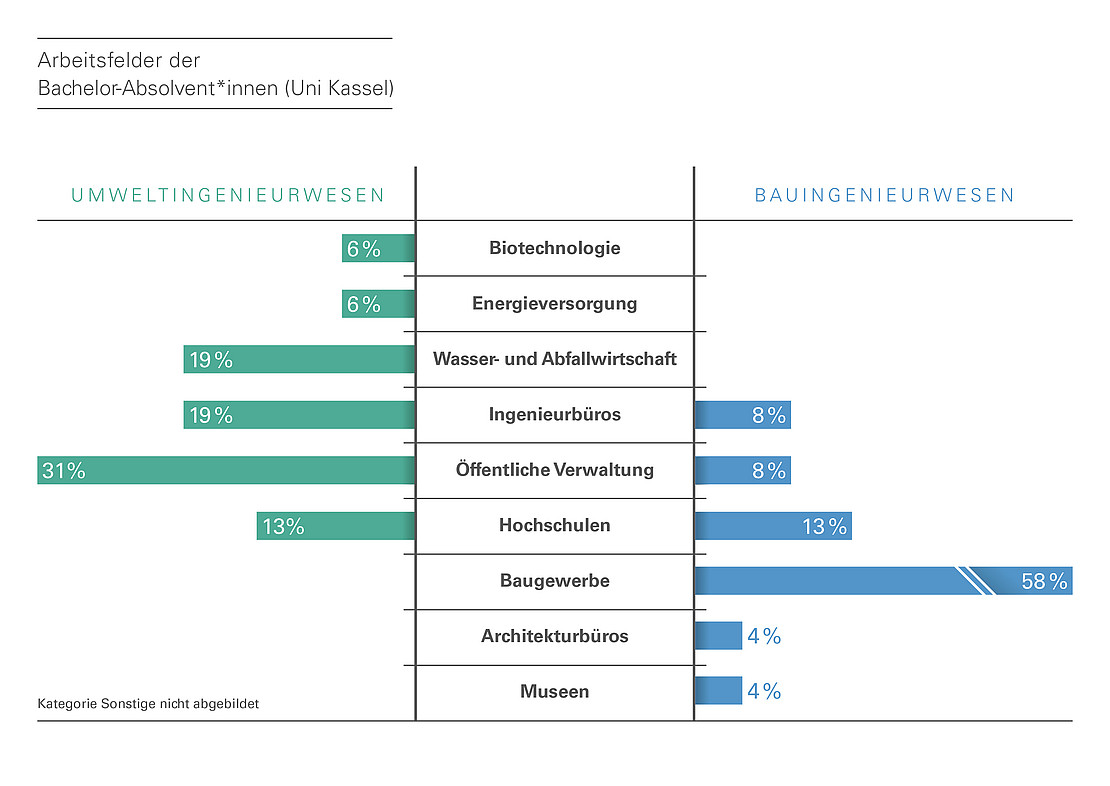
In line with labor market demand (see above), the majority of Bachelor's graduates (67%) work in the public sector. 31% cite public administration, 19% water and waste management, 19% engineering firms and 13% the university as their employer. The construction industry is only added as a significant employer (17%) after completing a Master's degree. At 28%, almost a third of Bachelor's graduates work in research.
Working conditions of Kassel graduates
Even if graduates with a bachelor's degree in environmental engineering have no trouble finding a suitable job, it is worthwhile completing a master's degree, which 75% of bachelor's graduates do. This is because the working conditions of Master's graduates are better than those of Bachelor's graduates, particularly in environmental engineering: One and a half years after graduating, Master's graduates in environmental engineering have a higher chance of obtaining a permanent employment contract (58% compared to 38%) and a management position (26% compared to 0%) than Bachelor's graduates.