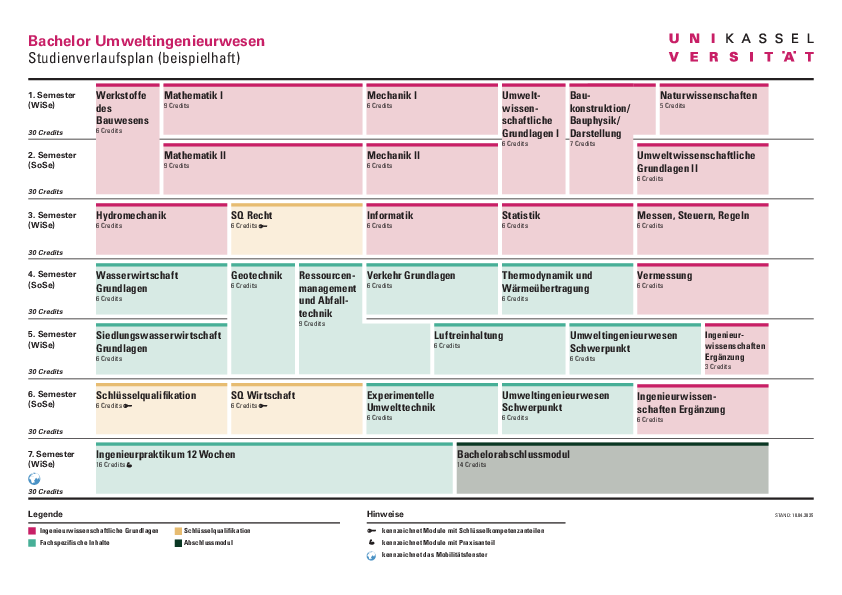
Study structure
This page contains automatically translated content.
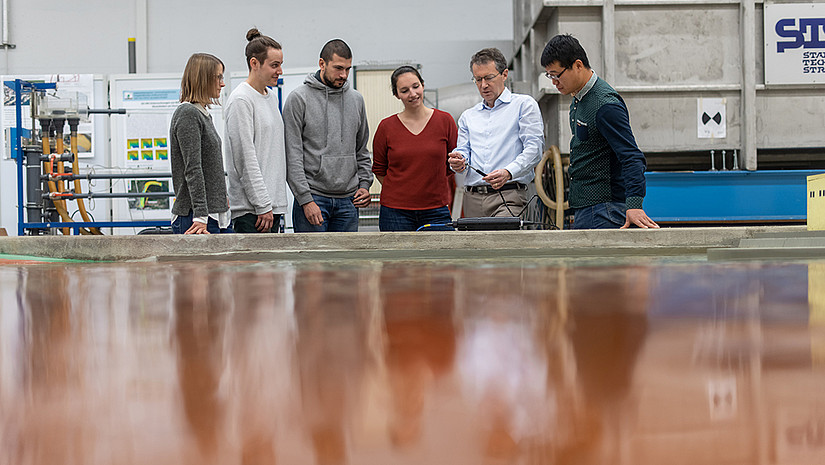
The degree program offers students the opportunity to acquire detailed knowledge and competent skills in the field of environmental engineering and combines ecological aspects with the economic and practice-oriented tasks of engineering. It is designed to appeal to students who are interested in civil engineering systems on the one hand and who would like to play an active role in environmental protection by contributing to sustainable developments in infrastructure and civil engineering on the other. The aim is to prepare students for a career in planning, administration, industry and national and international organizations in the field of environmental engineering. Environmental engineers deal with technical solutions for all tasks in the environmental sector, such as water supply, wastewater disposal, waste recycling and disposal, soil protection and remediation, traffic, ecological and economic water management, renewable energy production, air pollution control, socio-ecological and socio-economic contexts, environmentally friendly construction, environmental and quality management.
The course teaches students the skills to understand environmentally relevant procedures, processes, methods and plants, to calculate, design, evaluate, compare and further develop them using scientific methods; to document and communicate this knowledge and the knowledge acquired. The aim is to convey the competence to acquire the above-mentioned understanding independently by means of an exemplary procedure.