
How is the course structured?
The content on this page was translated automatically.
The master’s program in Industrial Engineering spans four semesters (120 credits). What makes it unique is that students can tailor their course of study to their individual needs. In addition to further deepening their mathematical knowledge, students have a wide range of options in both the economic and technical fields.
In the technical field, students can select modules totaling 30 credits from the following areas:
- Civil Engineering
- Mechanical Engineering
- Electrical Engineering
In the engineering field, the elective modules allow students to set their own individual areas of focus based on their interests and desired specializations.
In the field of economics, students can also develop an individual profile by selecting one of the five areas of specialization (30 credits):
MW1: Finance, Accounting, Controlling, and Taxation (FACT)
MW2: Management and Marketing (MuM)
MW3: Digital Business (DiB)
MW4: Sustainability Management (Specification of options)
MW5: Economic Behavior and Governance (EBGO)
Further information can be found in the module handbooks for the M.Sc. in Business Studies, the M.Sc. in Sustainable Business, and the M.Sc. in Economic Behavior & Governance. For this, it is best to consult the course catalog in His-Pos. Within one of the specializations listed above, you can take all modules from both the required and elective categories.
In addition, the interdisciplinary nature of the program is complemented by a comprehensive range of integration courses (e.g., project and quality management) and key competencies (e.g., foreign languages) to prepare students for the professional challenges faced by industrial engineers.
In terms of content, the master’s program thus offers the opportunity to specialize in various future-oriented topics—such as digitalization, Industry 4.0, or sustainable business practices.
The study planfor selecting the technical elective modules is available for download and is based on the current examination regulations.
Sample study plan
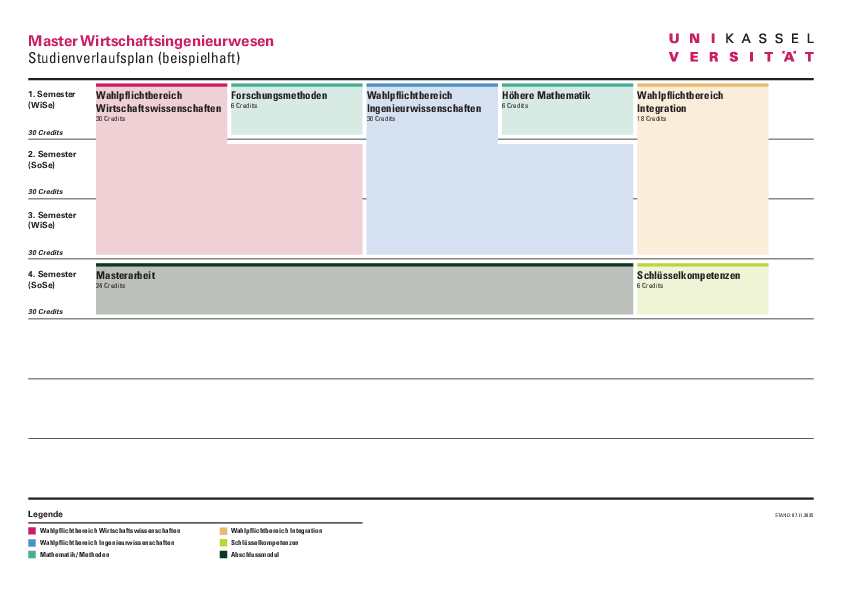
Process of course planning from 01.01.2026:
In order to select the compulsory engineering elective modules for the B.Sc. in Industrial Engineering and Management, the student must submit a study plan to the professor responsible for the subject area in the supervising engineering department. Further information can be found in the diagram below.

- List of required technical elective modules for the Civil Engineering track: When selecting required technical elective modules in the Civil Engineering track, the rules set forth in the examination regulations and the Industrial Engineering module handbook apply. The descriptions in the Civil Engineering module handbook may be consulted when selecting courses.
- List of required technical elective modules for the Electrical Engineering track: When selecting required technical elective modules in the Electrical Engineering track, the rules specified in the examination regulations and the Industrial Engineering module handbook apply. The list of technical elective modules in Electrical Engineering may be consulted when selecting courses. Documents or inquiries should be directed to wing-et[at]uni-kassel[dot]de.
- List of technical elective modules for the Mechanical Engineering specialization (Only technical modules at the master’s level from the MB specializations in Production Engineering and Industrial Engineering; Materials and Design; and Energy Engineering may be selected. Non-technical modules are marked with (I) in the list and may not be selected.)
- List of technical elective modules for the Mechanical Engineering program, specialization in Production Engineering and Industrial Engineering
- List of technical elective modules for the Mechanical Engineering major with a specialization in Materials and Design
- List of technical elective modules for the Mechanical Engineering major, specialization in Energy Engineering
You can find the current list of key competencies here. It is valid starting in the summer semester of 2026.
In the specialization area of the integration modules, students acquire in-depth knowledge in the subject areas that combine business-related professional and research content with technical content. To this end, students choose various modules according to their interests from the four main research areas of the Institute of Ergonomics and Process Management (IfA) as well as from the courses offered by the Department of Technology and Innovation Management, the Department of Business Technology Management and the Department of Digital Transformation Management:
- Work and Organizational Psychology
- Man - Machine - Systems Engineering
- project management
- Quality and process management
- Technology and innovation management and entrepreneurship
- Management of digital transformation
Further information on the range of integration subjects can be found on the website of the Institute of Ergonomics and Process Managementand on the homepage of the Department of Technology and Innovation Management and the Department of Digital Transformation Management .
Building on the methodological knowledge acquired in the Bachelor's degree program, students should learn the advanced tools for empirical work on economic issues. Since computer-aided analysis is now standard, the use of special software is essential. An outstanding learning objective is to enable students to select and apply scientifically sound, adequate economic methods in an empirical analysis of business and economic problems. This enables students to interpret and critically evaluate solutions at a scientific level.
The current range of research methods includes
- Research Methods for Business
- Qualitative Research Methods
- Foundations of Experimental Economics
- Time Series Econometrics
- Intermediate Econometrics
The Master's thesis and the Master's colloquium form the Master's degree module. The Master's thesis should be submitted in the 3rd semester at the earliest. The prerequisite for registering for the Master's thesis is proof of at least 72 credits.
The processing time for the Master's thesis is 22 weeks and begins on the day the topic is announced. The Master's thesis must be presented in a Master's colloquium. In addition to the candidate, the first assessor and an assessor take part in the colloquium. The Master's colloquium should take place no later than ten weeks after submission of the Master's thesis. Participation in the Master's colloquium requires that at least the grade "sufficient" (4.0) has been achieved in the Master's thesis. The duration of the entire colloquium is 30 to a maximum of 60 minutes.
Current resolution on teaching and examinations for the Industrial Engineering and Management degree program (Bachelor's and Master's) as of 27.10.21.
1) The obligation to repeat examinations for the Bachelor's and Master's degree (PO14, §5(6)) is suspended for all examinations until the PO 2014 expires.