
This page contains automatically translated content.
The future of hydrogen: small atom, big challenge
Hydrogen is seen as a beacon of hope for the energy transition: a clean energy source that only releases water when used. In industry, transportation and the energy sector, it could supplement or even replace fossil fuels. However, one of its greatest strengths also harbors a risk: its high reactivity. This makes hydrogen a challenge for steel of all things - the backbone of modern infrastructure. "Hydrogen atoms have a strong desire to find atomic friends," explains Prof. Dr.-Ing. "Where they bond with other atoms, many more bonds are quickly formed - a little party in the metal." However, this "party" can cause cracks at critical points, making the material brittle in the short and long term. The phenomenon is known as hydrogen embrittlement and poses a significant safety risk, for example in pressure tanks, pipes or vehicle components.
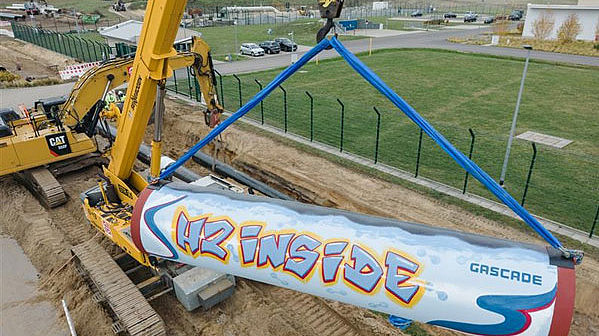 Image: Gascade GmbH
From atomic detail to industrial component
Song, who has been Professor of Granularity of Structural Information in Materials Engineering since 2023, and her team are researching how hydrogen interacts with metallic materials - and how this can be specifically influenced. Their work is bottom-up: In the atomic dimension, they analyze the position and bonding of individual atoms. On the nanometer scale, three-dimensional images of the chemical elements inside the metal are created - with almost atomic resolution. On the micrometer scale, the team investigates how phase distributions and fine grain structures in the interior affect the strength and resistance of metals. And finally, concrete components can be tested on a millimeter scale - as they are used in the automotive industry, aviation or for hydrogen transport.
"Over 15 years, I have built up a toolbox of correlative analysis methods on various size scales," says Song. So far, some of these methods can only be used at international synchrotron or neutron research facilities. In future, she also wants to establish suitable equipment in Kassel - in the new building for natural sciences at the North Campus. Together with other research groups, she plans to use atom probe tomography there. This complex, high-resolution device for analyzing materials is a new cutting-edge technology that is rarely available worldwide. With its comprehensive analytical approach, the team is able not only to understand metals, but also to shape them in a targeted manner. Because the diffusion of hydrogen into the metal cannot be completely avoided, Song specifically adapts the internal microstructures during the production of the materials: Certain grain sizes and phase distributions increase the strength of the material and make it more resistant to hydrogen embrittlement. The goal: materials whose structure is more difficult for hydrogen to penetrate or only accumulates in non-critical areas.
In 2018, she received the Steel Innovation Award for her research into high-strength steels. With the help of close-order structures, she succeeded in specifically increasing both the mechanical properties and the resistance to hydrogen embrittlement - proof of how basic research on the smallest structures can be turned into application-relevant materials. For the professor, however, the impact of her research is much more important than purely scientific breakthroughs: "I want to create real added value for society - for the energy transition, for sustainable technologies and for safe infrastructure."
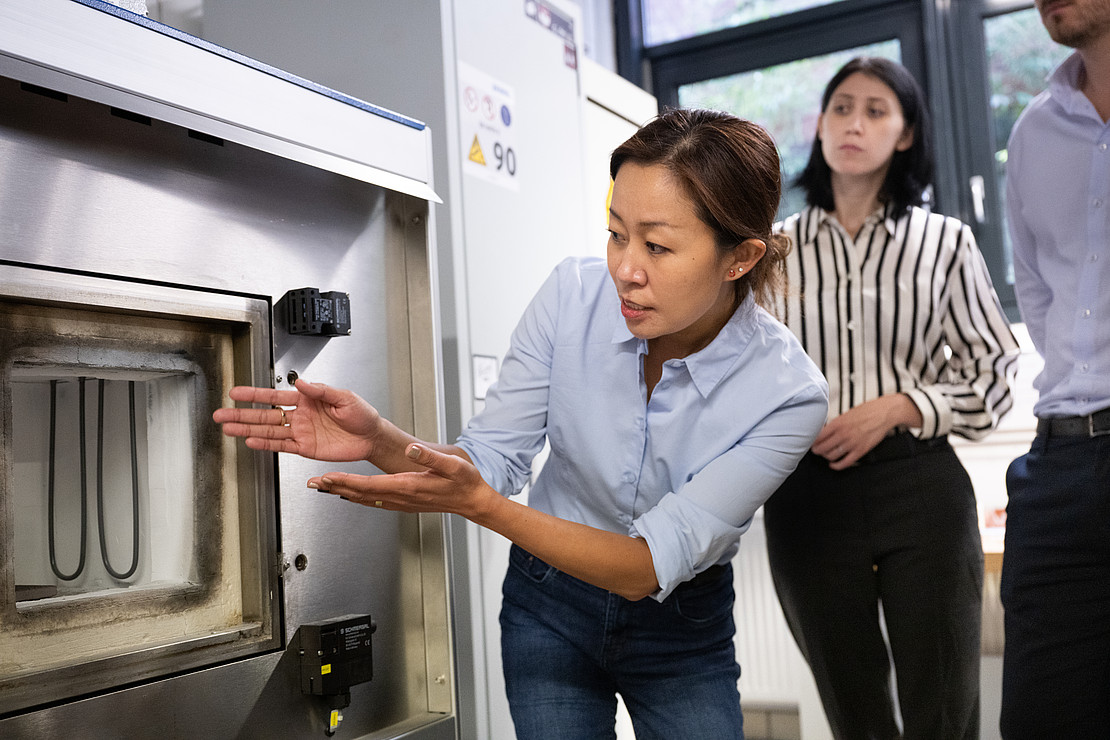 Image: Paavo Blåfield,
Kassel as a location for future materials
At the University of Kassel, Wenwen Song has found exactly the environment she needs for her work: a professorship in her specialist field, embedded in an interdisciplinary and application-oriented research environment. "There is great potential here to bring material innovations into practice together with other groups," she says. After all, the hydrogen economy of the future needs more than just visions - it needs precisely developed materials. From producing hydrogen to storing it in tanks, transporting it in pipelines and using it in fuel cells, the metals required must be able to withstand the highest demands. To achieve this, Song is developing materials that are not only powerful, but also recyclable, durable and energy-efficient. Her goal: to make the hydrogen economy of tomorrow safer and more sustainable.
This article appeared in the university magazine publik 2025/2. Text: Vanessa Laspe