
This page contains automatically translated content.
Europe-wide study: children underestimate the dangers of swimming
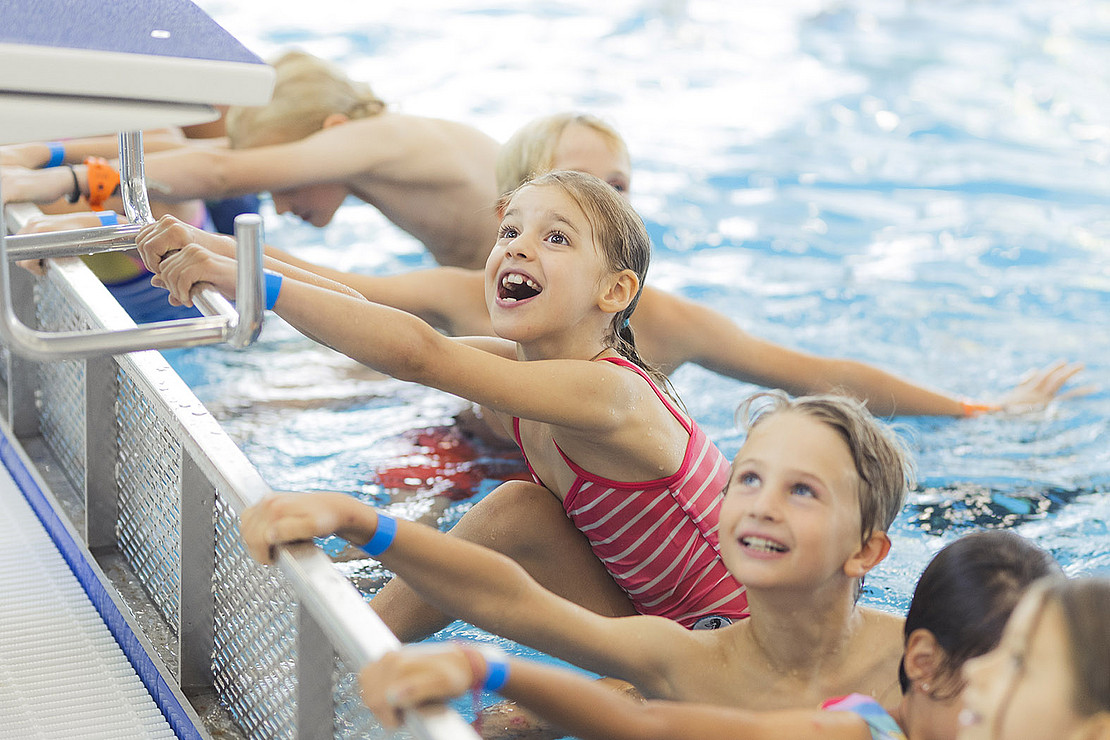 Image: DSHS.
The ALFAC project is based on data from Germany, Belgium, France, Lithuania, Norway, Poland and Portugal. In Germany, the surveys were carried out in Cologne, Kassel and Flensburg - by Dr. Sebastian Fischer (University of Kassel, Department of Training and Exercise), Dr. Ilka Staub and Prof. Dr. Tobias Vogt (German Sport University Cologne) and Dr. Nele Schlapkohl and Sarah Schmidt (European University of Flensburg). The study analyzes both basic swimming skills such as diving, breathing, floating and locomotion as well as more complex requirements, such as completing a swimming course. Psychosocial and cognitive aspects such as motivation, self-confidence and risk awareness in the water are also being investigated.
The initial results of the study, which is still ongoing, indicate that Germany performs well in an international comparison of swimming ability. In terms of age, older children have a higher level of basic and complex swimming ability. Children who are not yet able to swim at a basic level cannot dive, are less confident about jumping into the water with one foot and are less able to climb out. This confirms the importance of submersion in teaching swimming.
The underestimation of dangers is alarming. In Germany, 49% of children underestimate dangerous situations in swimming pools, compared to 44% in open water. The age of the children does not play a role in this assessment, but gender does: boys are more likely to underestimate dangers than girls.
In terms of motivation and self-confidence, children of all age groups are very motivated, with older children feeling more self-confident in the water than younger ones. Background (parents' level of education, parents' swimming ability and socio-economic status) has a significant effect on the learning level of swimming ability, especially in younger children. These factors influence the overall values determined by 33%, meaning that it is the environment that determines swimming ability. The effect decreases for older children. This suggests that the trend of declining swimming ability in Germany can be counteracted with structured measures at school.
The full Europe-wide results will be published at the final presentation in Brussels in fall 2025.
Registration for the final event in Brussels:
https://www.vub.be/en/event/alfac
Link to the presentation from June 24: https: //dshs-koeln.sciebo.de/s/CDlpHwDgXg2JRId
Contact:
Dr. Sebastian Fischer
University of Kassel
Institute of Sport and Sport Science
Phone+49 561 804-5238
e-mailsebastian.fischer[at]uni-kassel[dot]de