
This page contains automatically translated content.
Kassel project on sustainable water management receives LOEWE funding
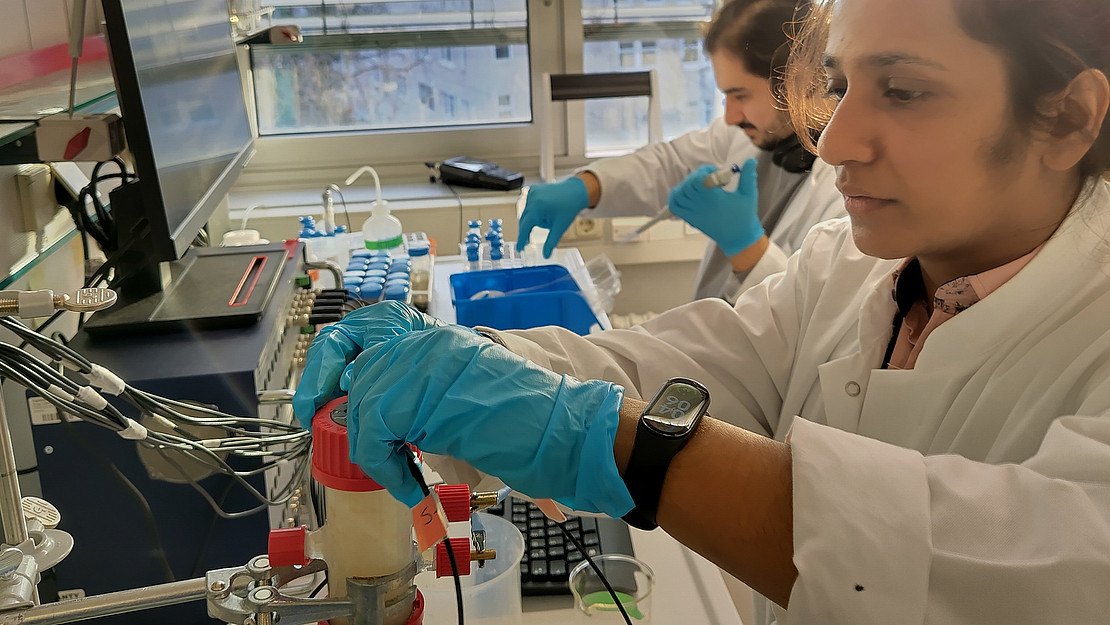 Image: Prof. Dr. Adrian Mellage
The University of Kassel is convinced that ADAPT, together with strong partners, will make a significant contribution to overcoming the consequences of climate change in Hesse and internationally. Prof. Dr. Ute Clement, President of the University of Kassel: "The ADAPT research project will further strengthen our expertise in sustainability research. ADAPT focuses specifically on dealing with the consequences of climate change. In view of the climate changes that citizens and the agricultural sector are now experiencing, this research is an example of how science and practice can be linked in the interests of sustainable development." Science Minister Timon Gremmels, who was able to distribute a total of 38 million euros in funding in the 18th funding phase, is also convinced of the social relevance of the project: "The researchers want to find out how alternative water sources, such as treated wastewater, can be used for agriculture without endangering the sensitive balance and buffer systems in surface, soil and groundwater through pollutant inputs. Their findings will provide important decision-making aids for politics, agriculture and water management - not only for Hesse, but nationwide. The LOEWE funding supports the development of urgently needed adaptation strategies in relation to the challenges of climate change."
With the research project "ADAPT - Adaptation to drought and extremes: The surface-soil-groundwater buffer under climate stress" , the University of Kassel is focusing on the current challenges of climate change in Central Europe - in particular the increasingly pronounced periods of drought. Prof. Dr. Adrian Mellage, Head of the Department of Hydrogeology at the University of Kassel and ADAPT project leader, explains: "We want to investigate whether and how landscape and water management in dry periods can be sustainably supported by the reuse of treated wastewater. Another aim is to investigate the extent to which water retention strategies can promote groundwater recharge in times of water surplus. The changed distribution of precipitation due to climate change - longer periods of drought and more frequent heavy rainfall events with a comparable amount of rainfall overall - has two effects: On the one hand, soils and aquifers are under pressure, and on the other, valuable water flows away unused during heavy rainfall without contributing to groundwater recharge. Agriculture in particular is significantly affected by this with its increasing irrigation requirements." According to the Hessian Water Plan for the Future, an expansion of irrigated agriculture is expected in Hesse, which will significantly increase the risk of negative water balances in drinking water catchment areas throughout Hesse in the future. At the same time, according to the water expert, the natural recharge of groundwater in Hesse is continuously declining. These changes are also noticeable throughout Germany. "Since 2000, the water surplus in Germany has decreased by 2.5 km3 of water per year, which is roughly equivalent to the amount of water in Lake Constance today."
The research project, which is funded by the LOEWE funding line, takes an interdisciplinary approach: in experiments and with the help of computer-aided modeling, the researchers are investigating how further processed wastewater from sewage treatment plants can be used as an alternative resource and what ecological opportunities and risks arise from this. They are paying particular attention to how soil and groundwater sediments remove pollutants from water and where the limits of this natural purification potential could lie in the future against the backdrop of climate-related changes. The results are intended to show ways in which responsible use of water resources can strengthen the resilience of our environment.
Background information on funding:
The LOEWE program is a Hessian state program for funding excellent scientific projects. In the current round of calls for proposals, one LOEWE center, four LOEWE focal points and ten exploration projects are being supported. Hesse's Science Minister Timon Gremmels emphasizes the particular importance of the range of content and the relevance of research to societal challenges.
Contact:
Prof. Dr. Adrian Mellage
Kurt-Wolters-Str. 3
E-mail: adrian.mellage@uni-kassel.de