
This page contains automatically translated content.
Study warns: agricultural models underestimate the consequences of waterlogging for yield and soil
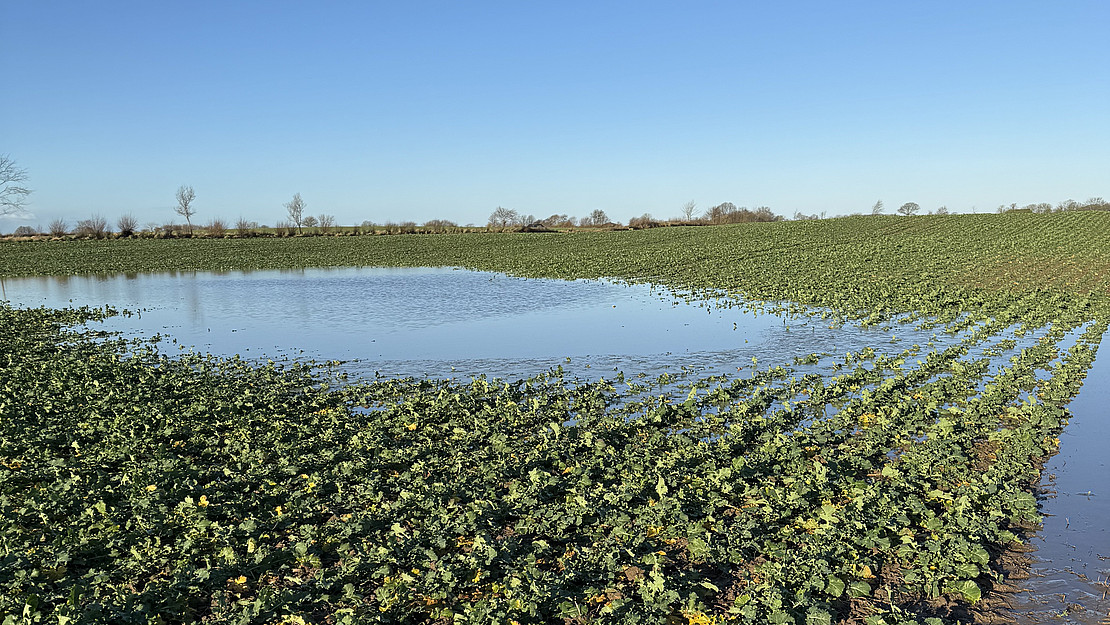 Image: University of Kassel.
In view of increasing extreme weather events in connection with climate change and because around 27 percent of the world's cultivated land is affected by waterlogging every year, an improvement in modeling is required in order to develop sound strategies for climate-resilient and sustainable agriculture. "Current models do not reliably depict the extent to which temporary flooding affects plant health, soil functions and yields. Especially in regions with high groundwater levels, this poses a real risk to food security," explains Prof. Dr. Tobias K. D. Weber, Head of the Department of Soil Science at the University of Kassel and one of the authors of the study.
As part of the international Agricultural Model Intercomparison and Improvement Project (AgMIP), the authors examined 21 widely used cereal models in order to assess the ability of these models to realistically depict waterlogging phenomena and simulate their consequences for yield formation, soil processes and plant health. The result: only 24 percent of the models examined realistically simulate water movement in the soil, for example by taking into account capillary rise, a crucial process for estimating the duration and intensity of stress phases.
Furthermore, many models do not adequately take into account key soil physical and biochemical processes. In most cases, for example, there is no realistic representation of soil salinization, aeration in the root zone or the mobilization of toxic elements under waterlogging conditions. Only a few models (e.g. APSIM, AquaCrop, SWAP) can simulate salt transport in the soil - which is essential because waterlogging is often accompanied by an accumulation of salts in the root zone. Another critical aspect that is often neglected is the simulation of lateral water movement and surface flooding. Only 29 percent of models fully capture these processes, while 71 percent do not due to the high complexity of two-dimensional soil water movement.
The plant physiological reactions to waterlogging are also only depicted to a limited extent in the models: While some consider the impact on biomass, others disregard important processes such as photosynthesis, transpiration or short-term adaptation mechanisms. Resilience mechanisms, such as the ability of plants to recover after water stress, are completely absent from the majority of models. "Our analysis clearly shows that many of these models fall short in their representation of critical processes. This makes it difficult to make reliable predictions and therefore also to develop suitable adaptation measures," says Weber. "Without more accurate models, there is a risk of systematic misjudgements, e.g. regarding crop losses, soil quality or the long-term carrying capacity of agricultural land."
In order to sustainably improve the quality of agricultural models, the researchers recommend closer interdisciplinary cooperation between plant physiology, hydrology, soil science and climate research. At the same time, a global observation network is needed, for example to record water levels, soil moisture or nutrient dynamics. Modern technologies such as remote sensing and machine learning should also be used in a more targeted manner in order to further develop models more quickly and reduce uncertainties.
"Without more precise simulations, we run the risk of systematically underestimating the impact of climate change on agriculture," warns Weber. "Reliable models are the only way to develop effective, sustainable strategies in good time - to protect yields, soils and water resources worldwide."
The study was published in the journal nature food and can be accessed at https://www.nature.com/articles/s43016-025-01179-y
Contact:
Prof. Dr. Tobias Weber
0561 804 1594
Tobias.weber@uni-kassel.de