
This page contains automatically translated content.
Urban waters important for food, income and community
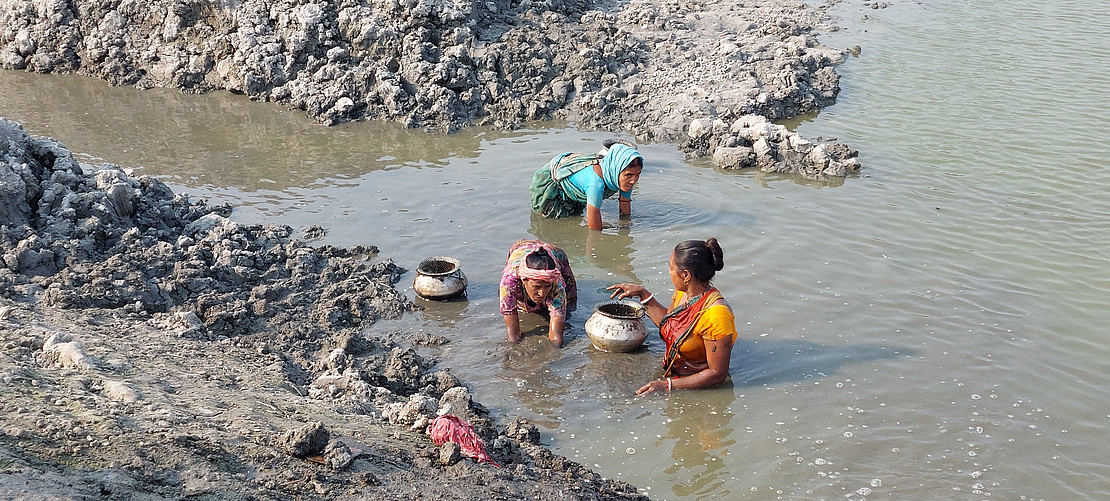 Image: Basu/University of Göttingen.
In four major Indian cities, the researchers interviewed people who collected food such as fish, crabs, mussels, plants, berries and mushrooms from bodies of water. The result: urban water bodies play a crucial role in food security and social inclusion. They should therefore become a greater focus of urban planning. The study was published in the journal Nature Cities.
The researchers surveyed a total of 1,200 people in Bengaluru, Mumbai, Kochi and Kolkata who they encountered foraging along rivers, canals, lakes or ponds. Based on the responses, they investigated the frequency, practices and purpose of the activity. According to the results, women, older people and people from marginalized groups most frequently collect food from urban waters. They particularly value the benefits for their diet and income, as well as the experience of cultural customs and connection to the community. According to the study, people who have access to gardens at home or in public spaces are occasionally encouraged to gather. For them, the connection to culture and nature is crucial. Many of those surveyed stated that they have a paid job and also use the harvest to feed their family. They share or sell surplus food.
"Our findings challenge conventional views on foraging in cities," explains Dr. Sukanya Basu, now a researcher at India's Azim Premji University. "Urban water bodies not only have ecological value. They provide food, livelihoods, well-being and community life. They are particularly vital for vulnerable groups," says Basu. She emphasizes: "Despite increasing pollution and degradation, water bodies in Indian cities continue to fulfill their role. Urban planning must go beyond restoring water quality. It must also consider how blue infrastructure can support sustainable nutrition and social inclusion."
For the first time, the study adds food security to the growing body of scientific evidence linking the value of urban water bodies to biodiversity, attractiveness, safety and infrastructure - all of which are important for people's health. With more commitment to blue infrastructure, urban planning would promote sustainable landscapes and support traditions and the social participation of marginalized groups, the researchers conclude. "Since the 1950s, rapid urban development, pollution and industrialization have led to the degradation of many rivers, lakes and canals in cities," says Tobias Plieninger, Professor of Social-Ecological Interactions in Agricultural Systems at the Universities of Göttingen and Kassel. "Our results show that water bodies must be recognized as a valuable asset in cities."
The study was funded by the German Research Foundation (DFG).
Original publication: Basu, S. et al. Widespread practices and sustainability benefits of foraging in urban blue spaces of India. Nature Cities (2025). DOI:10.1038/s44284-025-00337-4