
This page contains automatically translated content.
City in the face of climate change: University of Kassel launches climate measuring network
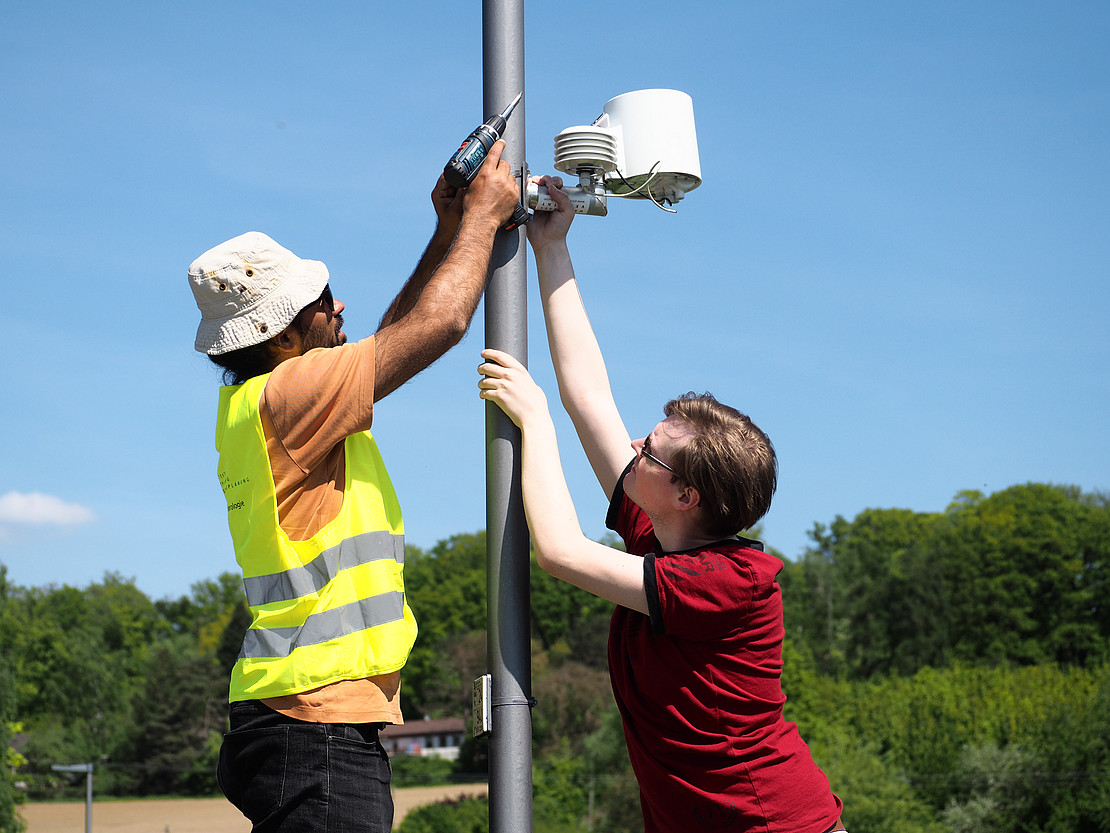 Image: University of Kassel.
The aim is to better understand the complex interactions between buildings, vegetation, relief and climatic conditions in the city. The measuring stations of the Kassel Urban Climate Observation Network (KUCON) are intended as a supplement to the existing weather and climate measurements of the city of Kassel, for example.
In Kassel - as in many other cities - climate change is becoming increasingly noticeable and is being exacerbated by the effect of the so-called urban heat island. The number of tropical nights, i.e. nights with temperatures above 20 degrees Celsius, has risen significantly in recent years. Particularly affected are densely built-up districts with little ventilation and few green spaces - such as the Vordere Westen or the city center.
"We are particularly interested in the spatial variability of the air temperature in the urban area," explains Prof. Dr. Britta Jänicke, Head of the Environmental Meteorology department. "The data obtained helps us to better understand the relationships and to test and further develop existing urban climate models." The measurements include air temperature, humidity and precipitation. The compact measuring devices are mainly installed on existing structures such as street lamps, in cooperation with the municipal utilities, the city of Kassel and KVG. The selection of locations is based on the concept of Local Climate Zones (LCZ), an internationally used classification system that differentiates urban areas according to use, building structure and vegetation types.
The measurement data is currently available to the research team and interested parties on request. In the future, they will also be made publicly accessible and made available for further research projects. The project is initially scheduled to run for five years, but should be made permanent if possible.
In addition to Britta Jänicke, the project team includes doctoral student Shakir Ahmed and student assistants Till Wiesehoff and Max Gaußmann. The aim is to contribute to a better understanding of the interactions between the city and the climate and thus provide further foundations for climate-resilient urban planning. Because one thing is clear: the number of hot days and other weather phenomena will increase - making it all the more important to know the city's local climate precisely and react to it in a targeted manner.
Further information on the project can be found at: www.uni-kassel.de/go/kucon
Contact:
Prof. Dr. Britta Jänicke
University of Kassel
Department of Environmental Meteorology
E-mail: britta.jaenicke[at]uni-kassel[dot]de