
Laser structuring makes paper-based fog collectors more efficient
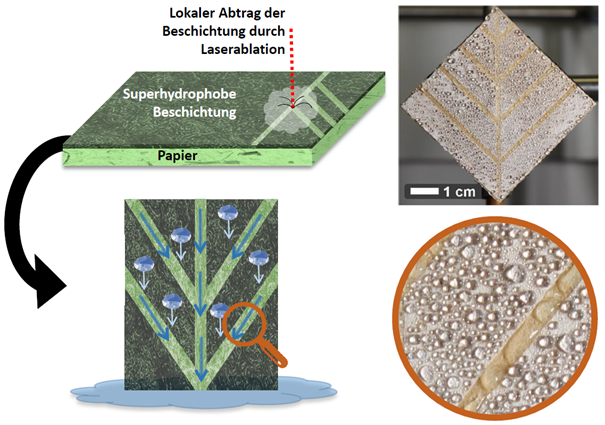 Image: University of Kassel.
The availability of clean drinking water is increasingly limited worldwide. Fog collectors are already being used in coastal and mountain regions with high levels of fog: fine-mesh nets separate droplets from the air, collect them and drain them away. Under favorable conditions, such systems deliver several liters per square meter per day - but some of the fog water is lost due to wind and insufficient adhesion.
This is where the research teams come in: Paper-based fog collectors developed at TU Darmstadt have been modified by the Kassel team using targeted ultrashort pulse laser ablation to increase their efficiency. The coated papers are lightweight, cost-effective, resource-saving and can be used over large areas. The localized ablation of the superhydrophobic - i.e. highly water-repellent - coating at the University of Kassel creates microscopically small collection points that bind the water and promote droplet growth. Together with specifically created flow paths, this enables controlled drainage. The aim is to achieve a more robust water yield in the face of wind and changing environmental conditions.
"For us, it is crucial that we maintain the stability of the paper and only specifically influence the wettability using ultrashort pulse laser ablation," emphasizes Prof. Dr. Camilo Florian-Baron, Head of the Extreme Light for Material Structures department. Laboratory tests with artificial fog prove the effectiveness of the approach: the yield of the treated paper collectors is over ten percent higher than with untreated reference samples - with only minimal impairment of the stability of the material. One advantage of the method is the precise structuring that can be achieved using ultra-short laser pulses: collection points can be created in different patterns and adapted to the climate and wind directions in order to optimize the yield.
"The advantages of laser ablation are that it enables localized and sharp-edged structuring. This means that the influence of different patterns on droplet formation and liquid transport can be specifically investigated," explains Dr. Martin Kahlmeyer, lead author of the study from the Department of Separating and Joining Manufacturing Processes (tff) at the University of Kassel.
"The material technology possibilities in light-based structuring significantly expand the property profile of the functional paper coatings we have developed. For the first time, a controlled transport of water in predefined channels on the surface of paper-based fog collectors is possible," adds Prof. Dr. Markus Biesalski, Head of the Department of Macromolecular Chemistry & Paper Chemistry at TU Darmstadt.
Future research work will test and further improve the technology under real environmental conditions in order to increase the efficiency and longevity of the collectors in the long term.
The study was published in the journal Advanced Materials Interfaces and can be accessed at https://advanced.onlinelibrary.wiley.com/doi/full/10.1002/admi.202500332.
Contact:
Dr.-Ing. Martin Kahlmeyer
E-Mail: m.kahlmeyer[at]uni-kassel[dot]de
Tel: +49 561 804 - 7567
Press contact:
Sebastian Mense
University of Kassel
Communication and Marketing
Tel: +49 561 804-1961
E-Mail :presse@uni-kassel.de
http://www.uni-kassel.de www.uni-kassel.de