
Student teachers in action at schools in Hessen
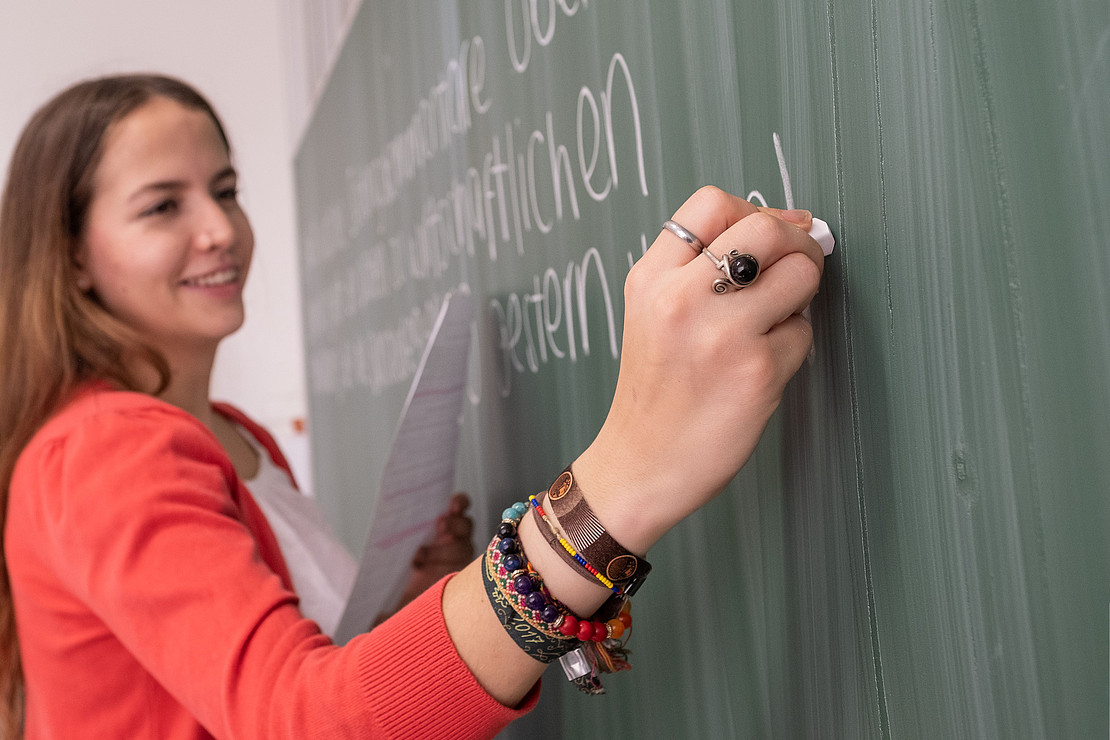 Image: Rolf K. Wegst
Half of the 5,000 or so student teachers surveyed in Hesse are already regularly in the classroom during their studies - where they also take on tasks that are the responsibility of fully qualified teachers. This is shown by the new Hesse-wide study LABORA-HE ("Lehramtsstudierende in Arbeit und Beruf: Organisation, Ressourcen, Aufgaben in Hessen"), which was conducted in the winter semester 2024/25 by the six teacher training universities in the state and is currently the largest survey on the subject in Germany.
A total of 50% of the students surveyed stated that they work either exclusively at a school (33%) or both at a school and in another area (17%) alongside their studies. This is particularly common among students studying to teach special needs education (58%) and elementary school (56%). On average, students work at schools for around nine hours per week, with the extent of their work at schools increasing as their studies progress. As many as 33% of students in their first year of study work at schools.
Broad responsibility in lessons and schools
Most of the students surveyed take on demanding tasks early on in their studies: 90% teach independently in class, 60% create teaching materials, over 50% supervise during breaks or conduct remedial teaching. Up to 20% of students are even responsible for assigning grades, leading classes or writing reports, in some cases as early as their first year of study.
High proportion of non-subject teaching
According to the study, only 58% of the students surveyed are employed in a way that matches their study profile and therefore teach at least one of their subjects in a type of school for which they are enrolled on the appropriate degree programme. This is not the case for 42% of students. This is particularly clear from the fact that in 24 out of 26 subjects, the majority of students teach outside of their subject area - only in German and Mathematics do the subject studied and the subject taught usually match. This shows that in many places, students often fill gaps in teaching provision beyond their desired qualifications.
Between practical experience and excessive demands
Even in their first semesters, students who work in schools consider themselves to be more competent and professionally established than their fellow students without this school experience. Based on the cross-sectional data of the study, it is not possible to determine whether the work at the school leads to this self-assessment of the students or whether more confident student teachers are more likely to decide to work in schools anyway. At the same time, students working at schools sometimes rate the academic content of their studies as less relevant. They also experience more frequent clashes between their studies and teaching practice. Institutionalized support via mentors or dedicated reflection opportunities are generally lacking at both schools and universities. Instead, most exchanges take place privately or informally.
Significance for teacher training and teaching quality
For the researchers involved, the results point to the area of tension of unaccompanied practice in the complex professional field of teaching and schools. The results of the study show that many of the students surveyed feel confirmed in their career goal. At the same time, however, there is a clear risk of de-professionalization, as without professional guidance, unsustainable attitudes can become entrenched early on in their studies due to unreflected practice. In addition, based on the findings of teaching research, it must be assumed that the quality of teaching suffers considerably due to the widespread use of student teachers from other subjects. This is worrying in view of recent findings on basic skills at primary and secondary level.
Cooperation between the universities in Hesse
LABORA-HE emerged from the PraxisFlex project at Philipps University Marburg, which was funded by the Hessian Ministry of Science and Research, Art and Culture, and was implemented in close cooperation with the teacher training universities - Justus Liebig University Giessen, Technical University Darmstadt, Goethe University Frankfurt, University of Kassel and Fulda University of Applied Sciences. Prof. Dr. Hans Peter Kuhn, Dr. Catrin Siedenbiedel, Dr. Franz Klingebiel and Johannes Osterberg were involved on the part of the University of Kassel. With a response rate of 27% of all student teachers in Hesse, the survey provides a solid empirical basis for future discussions on the role of students in safeguarding school teaching and all-day schooling.
This text is based on a press release from the University of Marburg.
Further information
Central results as well as their discussion and classification can be found in the results report of the LABORA-HE study: https://doi.org/10.17192/openumr/342