
Physics: Improved spectrometer helps to see tiny signals better
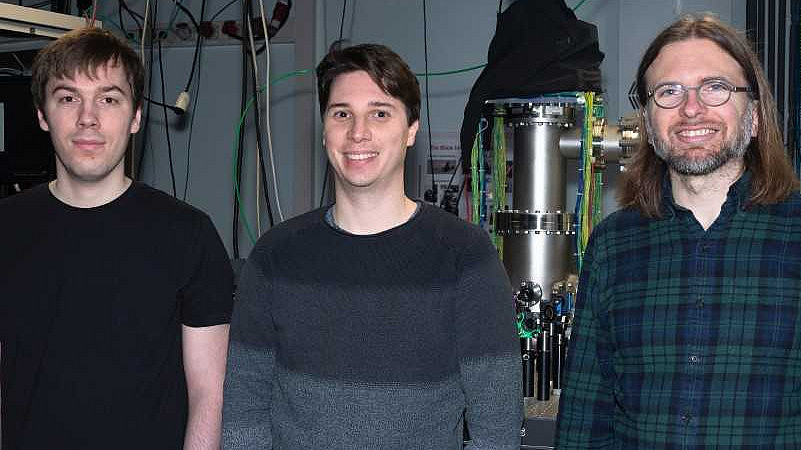
Velocity Map Imaging (VMI) enables researchers to precisely measure the momentum of charged particles such as atoms or molecules. This helps, for example, to understand how they react in collisions or how they break apart when exposed to light. At the University of Kassel, a laser beam is used for this purpose, which hits gas molecules and ionizes them, i.e. triggers electrically charged electrons. These are directed onto a detector by electric fields. This requires metallic rings that surround the laser beam.
A problem arises when very high-energy ultraviolet light (UV light) is used - as in many experiments. This is because the light is not only absorbed by the particles under investigation, but also by the metal rings. This produces electrons that are also charged - so many, in fact, that the actual signal that you want to measure is almost completely obscured.
To solve this problem, a group of Kassel scientists led by Dr. Arne Senftleben at the Institute of Physics (Department of Femtosecond Spectroscopy and Ultrafast Laser Control) have made several changes to their VMI device. Firstly, they have introduced stray light apertures. These ensure that stray light entering the vacuum chamber cannot hit the metal plates. The surface of the light scattering apertures must be extremely black, i.e. "swallow" light almost completely. As the researchers were working with invisible UV light, the apertures also had to be "black" in the UV, which works best with nanostructured surfaces. Images of these were taken at the SFN with their scanning electron microscope, which confirmed the successful nanostructuring.
The researchers also made the metal rings of the VMI device particularly thin. This means that less UV light hits the edge of the rings, where a large amount of background electrons were previously generated. They also used high-quality windows for the laser to enter the vacuum chamber, which let in light but hardly scatter it.
Overall, the researchers were able to reduce the interfering background signal by 99.9 percent without compromising the accuracy of the measurements.
"We hope that the spectrometer can be further adapted or improved to enable all types of measurements with deep ultraviolet laser light," says Nicolas Ladda, who implemented the improvements to the VMI device as part of his doctorate. He now wants to use it to study chiral molecules with UV light.
The research results are published here:
https://pubs.aip.org/aip/rsi/article/96/11/113304/3373072/
Contact:
Dr. Arne Senftleben
Research Associate, Institute of Physics
Phone: 0561-804-4294
Email: arne.senftleben[at]uni-kassel[dot]de