
Insects on your plate? Consumer study shows: Preferably without additives
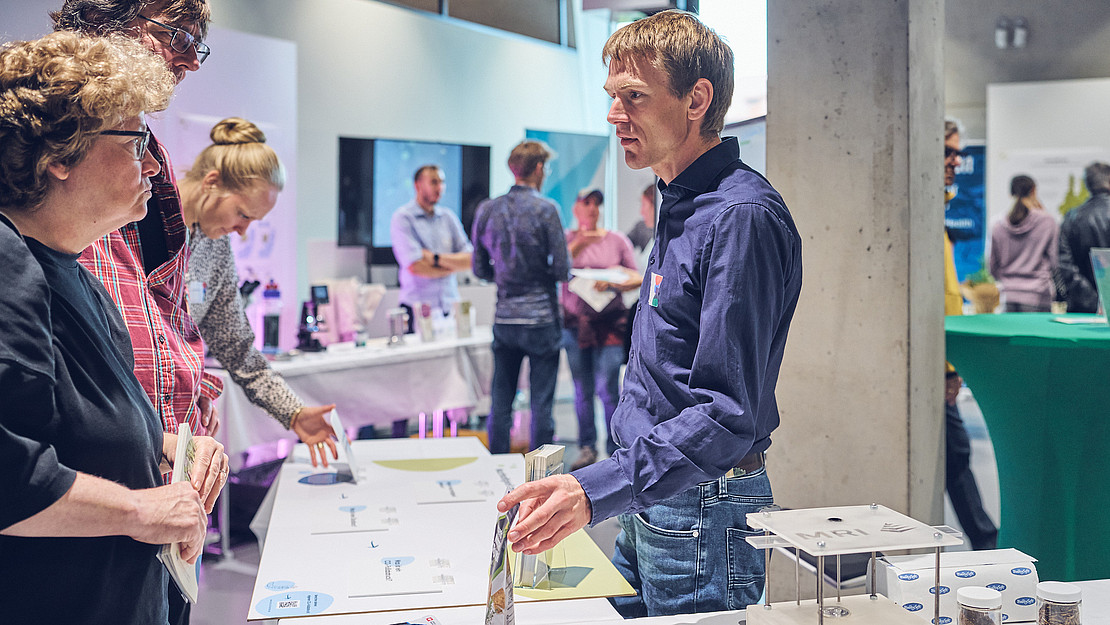 Image: Janosch Gruschczyk/Innovationsraum NewFoodSystems.
"We know that insects are nutritionally convincing and, to a large extent, more resource-efficient than traditional animal husbandry," says Dr. Benedikt Jahnke, research associate in the Department of Agricultural and Food Marketing at the University of Kassel and one of the Project Leaders. "However, the crucial question is: how can we communicate this potential in such a way that people will embrace it? This is exactly what we investigated in the 'Pr:Ins' project."
The Kassel research focused on two large-scale consumer studies that investigated how different communication messages, product features and packaging designs influence perception and willingness to buy. The results showed that references to naturalness and testing by an independent institution generate the greatest trust and have the strongest effect on acceptance. Sustainability arguments or references to nutritional information performed less well in comparison. The type of labeling also plays a key role. Clear but restrained information such as "with protein from insects" has a confidence-building effect, while too much emphasis tends to deter consumers. In addition, processed insects, i.e. as an "invisible ingredient", are much better accepted than whole insects. "For many people, it is important that food is as natural as possible, without long lists of ingredients or artificial additives," explains Jahnke. "This impression creates trust. Other messages cannot replace this."
But insects on the plate can do more: they provide high-quality protein, a complete amino acid profile as well as valuable fatty acids and vitamins, and the corresponding foods require little land, water and energy. In a study conducted in preparation for the online survey, around 44% of over 18,000 respondents stated that they were generally open to insect-based foods. However, this openness rarely leads to actual purchasing behavior. "There is a big hurdle between interest and actual tasting," says Jahnke.
In order to better capture real behavior, new product packaging for crackers and falafel-like balls with insect-based ingredients was developed and tested in supermarkets together with industry partners based on the findings from the consumer studies. The tests showed that skepticism often prevails before the first contact, but trial offers significantly lower these hurdles and regularly lead to aha-effects among consumers. "Those who can try things reduce reservations. Direct contact is one of the most effective ways to establish new products," says Jahnke.
This results in clear recommendations for action for the food industry: Processed insects have the greatest market opportunities, naturalness is the strongest message, packaging is a key element of trust and restrained, transparent labeling works best. Real tasting and sales tests accelerate market entry. "Insects can make an important contribution to sustainable food systems," summarizes Jahnke. "To do this, we need products that are suitable for everyday use and communication that creates trust."
In the joint project, the University of Kassel took the lead in researching consumer acceptance and, as overall coordinator, supported the work on quality and safety aspects as well as ecological sustainability assessment. In addition to Dr. Benedikt Jahnke, the project team included Berlianti Puteri, M.Sc. and Prof. Dr. Katrin Zander, Head of the Department of Agricultural and Food Marketing.
Further background information on the project
"Pr:Ins - Holistic evaluation of alternative protein sources with special consideration of insects" is part of the "NewFoodSystems" innovation area, which is funded as part of the "National Research Strategy BioEconomy 2030" of the Federal Ministry of Research, Technology and Space (BMFTR). The project ended in October 2025 after a duration of 3 years and 4 months. The project partners were the ifeu - Institute for Energy and Environmental Research Heidelberg gGmbH, the Max Rubner Institute and Südzucker AG. The consumer studies were based on (1) discrete choice experiments (DCEs) within an online survey in which 922 early adopters (2023, quota-controlled by gender, age and federal state) participated and (2) focus group discussions with 50 consumers in four German cities on the perception of the labeling of insect ingredients on product packaging. The evaluations were carried out using latent class conditional logit models and qualitative content analysis.
The scientific results were published as open access articles in two international journals: The study "Consumer perceptions of insect labeling on packaging" was published in 2025 in the journal Future Foods(https://doi.org/10.1016/j.fufo.2025.100705). The study "Communication and relevance of product characteristics of insect-based foods" was published in 2024 in the journal Food Research International(https://doi.org/10.1016/j.foodres.2024.114994).
In addition, a brochure with recommendations for the market launch of insect-based foods for practitioners and decision-makers was produced: https://www.uni-kassel.de/fb11agrar/index.php?eID=dumpFile&t=f&f=7666&token=922a420157ca13bb4170efcd7e0b681d7bb6afdd
More information on the joint project "NewFoodSystems ": https://www.uni-kassel.de/fb11agrar/fachgebiete-einrichtungen/agrar-und-lebensmittelmarketing/forschung/newfoodsystems.html
What does this mean in summary?
- Consumer studies by the University of Kassel show: The acceptance of insect-based foods is primarily influenced by confidence-building communication. The reference to naturalness and references to independent testing as a design element on the packaging are particularly effective; sustainability or nutritional value arguments have a much weaker effect.
- Processed insects as an "invisible ingredient" (e.g. in crackers or falafel) are much better accepted than whole insects; clear but restrained labeling ("with protein from insects") increases trust.
- Although around 44% of respondents are generally open to insect-based foods, the barrier to purchase remains high - tasting campaigns in stores significantly reduce reservations and encourage actual purchasing behavior.
Contact:
Dr. Benedikt Jahnke
Research assistant
Department of Agricultural and Food Marketing
University of Kassel
Phone: +49 5542 98-1331
E-mail: jahnke@uni-kassel.de