Study structure
This page contains automatically translated content.
The course has a modular structure. In the first year of study, students acquire basic knowledge of general Chemistry. Students are expected to acquire scientific discipline content as well as an understanding of the structure, history and practical application of chemistry. Course contents are:
- Familiarity with and critical appraisal of the approach and intellectual structure of an experimental natural science
- Understanding of simple chemical relationships through the application of basic principles and concepts
- Ability to independently acquire relevant encyclopedic knowledge on the basis of basic material knowledge in a situational context
- Ability to articulate subject-specific knowledge correctly
- Practical manual skills in the context of an experimental natural science (safe handling of standard laboratory equipment and chemicals within the framework of legal regulations)
- Ability to solve realistic technical problems
- Ability to engage in practice-related, subject-specific discourse - didactic approach relevant to teaching in the dimensions of knowledge reorganization and transfer with an emphasis on lateral networking
An internship is obligatory. The selection of topics in the practical course is also based on didactic aspects of chemistry and the feasibility of the experiments in schools.
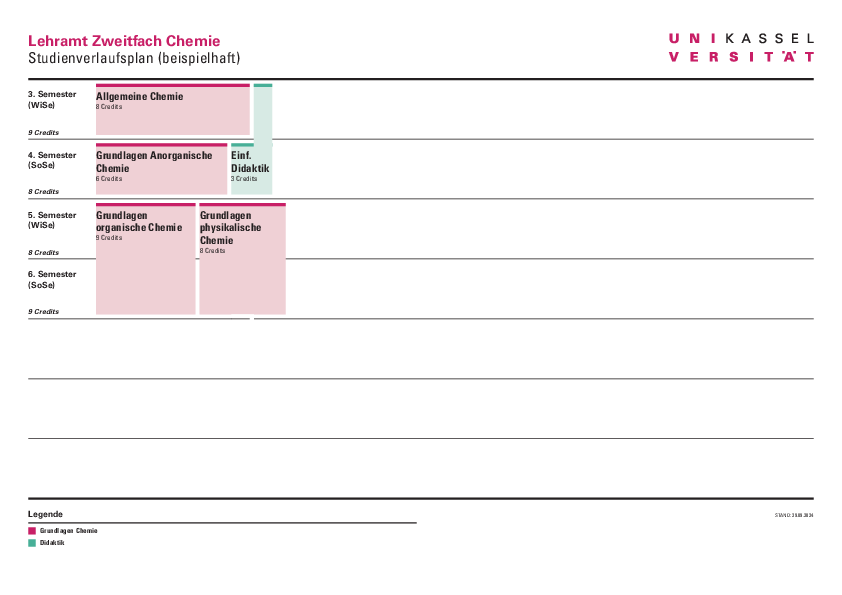
Study plans show at first glance when the compulsory and compulsory elective modules are to be completed. This sequence is not to be understood as a rigid structure; there is usually a certain degree of flexibility in the semester allocation. However, the completion of individual modules may depend on the prior successful completion of other modules.
Sample study plans
Chemistry (grammar school)

Chemistry (secondary school)

Chemistry (Business Education and Vocational Education)