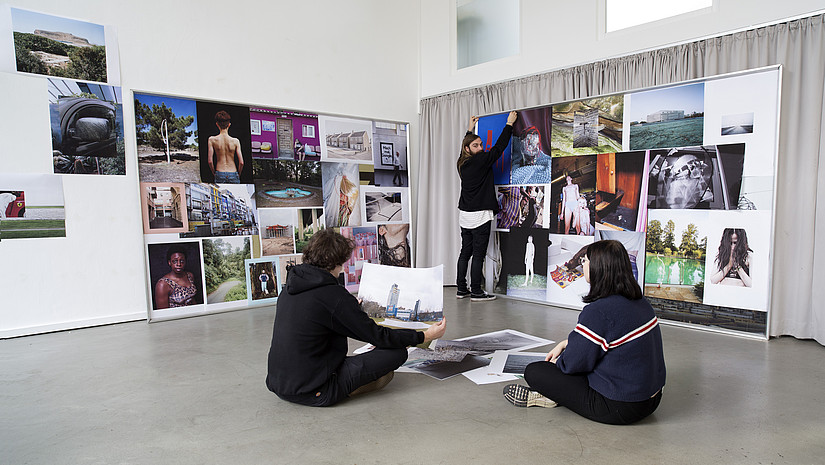
The Visual Communication degree course is organized as a project course to teach creative and artistic methods in various media fields.
It aims to enable students to develop significant contributions to the shaping of social reality by encouraging them to think practically, analytically and critically and to engage with the functions of art and culture, technology, science and the market. In a decidedly transdisciplinary study structure, the combination of theory and practice lays the foundation for new perspectives and approaches and promotes the development of an individual creative attitude and own working approaches.
In addition to subject-specific content and methods, the course places particular emphasis on developing the ability to work in a team beyond the boundaries of one's own subject and to integrate aspects of social responsibility into one's own projects. Collaborations and innovations are not only established between the specializations, but also across courses: interactive, diverse, exciting, not too much schooling, free and binding. A manageable number of students enables targeted and constructive criticism, which allows students' own work to grow. In the first year of study, students complete an interdisciplinary basic course that teaches them the design basics and techniques of various visual media. From the third semester onwards, students can choose their areas of specialization: Animation, Film and Moving Image, Film and Television, Photography, Games, Illustration and Comics, New Media, Editorial Design and Theory and Practice of Visual Communication.