Study structure
This page contains automatically translated content.
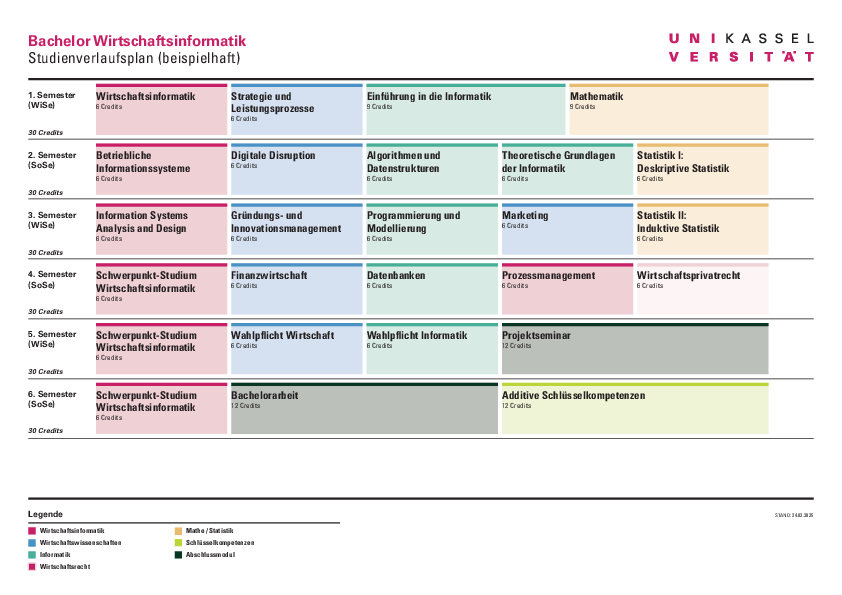
This is how your Business Informatics degree program is structured:
At the beginning of your studies, you will take compulsory modules in which you will learn the most important basics. This includes content from business informatics, economics (primarily business administration) and computer science. Mathematics, business law and scientific work are also on the agenda. This will prepare you well for the following semesters.
Later on, you will choose three specializations in business informatics. For example, you can focus on topics such as data analysis, management or IT systems. You also have the opportunity to take free elective modules from the fields of economics and computer science. In a project seminar, you will work with other students on a practical task.
You will also train important key skills such as teamwork, presentation techniques and time management. This allows you to tailor your studies to your interests and set your own priorities. At the end, you will write your Bachelor's thesis and successfully complete your studies.
Areas of study:
- Business informatics: Acquire extensive skills in the design and operation of information systems and digital technologies. Find out how people, machines and organizations interact effectively to create value.
- Economics: Immerse yourself in business management processes. From the management of a company, the management of innovations, to the marketing of your products and services.
- Computer science: Get an introduction to the world of computer science and new technologies. You will deal with topics such as algorithms, databases and programming. In other words, the basis for many digital applications.
- Mathematics: Develop your mathematical skills and learn how to apply them in business and technology. Contents include the basics of mathematics, financial mathematics and statistics.
- Key skills, business law and project seminars: Deepen and broaden your knowledge through complementary and interdisciplinary modules. For example, get to know the legal foundations of the economic system, learn new languages and tackle exciting IT projects together with other students.
- Bachelor's thesis: At the end of your studies, you will work on a practical or scientific topic. You collect data, evaluate it and document your results. You will be supported by your supervising teacher.
The study areas of the Business Informatics degree program in detail:
During your studies, you will learn how information systems are used in globally active companies. You will understand the demands that international markets place on IT-supported companies. You will learn how to plan, design, select and successfully introduce information systems. Another important part is understanding and classifying the effects of digitalization on companies. This will enable you to actively shape the digital transformation.
You will develop knowledge in the following areas:
- Planning, development, introduction, operation and use of complex information and communication systems,
- Designing digital business processes, IT projects and IT infrastructures,
- Developing strategies for the use of IT and digital technologies,
- Management of the IT function, e.g. in the organizational and operational structure of a company and
- Evaluating current trends and challenges of digitalization.
With this knowledge, you will be able to analyze and classify complex problems and develop suitable solutions. You will use modern methods, models, tools and technologies.
Compulsory modules:
- WiInf 1: Business Informatics (1st semester)
- WiInf 2: Business Information Systems (2nd semester)
- WiInf 3: Information Systems Analysis and Design (3rd semester)
- Wilnf 4: Process Management (4th semester)
Compulsory elective area: Your specialization in business informatics
In the Business Information Systems specialization, you will build on the foundations of the compulsory modules and deepen your knowledge in important application fields of Business Information Systems. You will deal intensively with current challenges and practical problems and learn how these can be mastered with modern IT solutions.
You will gain in-depth insights into selected subject areas, such as digital business models, data management, IT architectures and system integration. This will give you a deeper understanding of digital transformation in companies.
The range of modules in the Business Informatics specialization varies. These include, for example.
- Business analytics, data engineering and data management
- Information processing in service companies
- Management of information systems
- IT project management
- Internet-based applications in the business environment
The current module handbook provides information on valid courses.
In the field of economics, you will learn the central business fundamentals that are important in companies:
- You will learn how companies operate successfully on the market, set goals and design their processes so that they remain competitive.
- You will learn how digital technologies are changing existing business models and how companies can adapt to these changes.
- You will learn how to develop new ideas, drive innovation and successfully set up your own company.
- You will understand how products and services can be attractively designed and effectively placed on the market in order to win and retain customers.
- You will learn how companies manage their finances, plan investments and act in an economically sustainable manner.
In these modules, you will learn to understand economic relationships and make well-founded decisions. You will develop the ability to critically analyze and independently evaluate business management issues.
The content is based on the economics modules of the Bachelor of Science in Economics degree program at the University of Kassel and creates a solid foundation for your further studies.
Compulsory modules:
- Wiwi 2: Strategy and performance processes (1st semester)
- Wiwi 5: Digital Disruption (2nd semester)
- Wiwi 3: Start-up and Innovation Management (3rd semester)
- Wiwi 1: Marketing (3rd semester)
- Wiwi 4: Finance (4th semester)
Compulsory elective module:
In addition, you choose another module that matches your personal interests and goals. The range of elective modules in the specialization area is diverse and can vary depending on the semester. These include, for example
- Financial accounting
- Decision-oriented corporate accounting
- Micro- and macroeconomics
- Economic policy
- Business Psychology
The current module handbook provides information on valid courses.
In Computer Science, you will learn the basic principles and methods of computer science, which are important in many digital applications and systems:
- You will gain an initial overview of the exciting world of computer science, its concepts and fields of application.
- You will learn how efficient computer programs are structured, how problems are solved step by step and how data can be organized optimally.
- You will deal with the mathematical and logical principles that form the foundation of all digital technologies.
- You will learn how to develop software and create models that make complex systems understandable and manageable.
- You will learn how large amounts of data can be stored, managed and quickly retrieved.
Compulsory modules:
- Introduction to computer science (1st semester)
- Algorithms and data structures (2nd semester)
- Theoretical foundations of computer science (2nd semester)
- Programming and Modeling (3rd semester)
- Databases (4th semester)
Compulsory elective module:
In addition, you choose another module that matches your personal interests and goals. The range of elective modules in the Computer Science specialization is diverse and can vary depending on the semester. These include, for example
- Computer architecture
- Computer networks
- Design and analysis of efficient algorithms
- Data mining and machine learning lab
The current module handbook provides information on valid courses.
Business informatics is interdisciplinary. This is why you will also learn other fundamentals during your studies, particularly from mathematics and law.
Compulsory modules:
- Grdlg 1: Mathematics (1st semester)
- Grdlg 2: Statistics I: Descriptive statistics (2nd semester)
- Grdlg 3: Statistics II: Inductive Statistics (3rd semester)
- Grdlg 4: Private Business Law (4th semester)
In the project seminar, you will independently apply the knowledge you have acquired during your studies to a specific, application-related problem in business informatics. Ideally, you should take this seminar in the 5th semester.
The special thing about the project seminar is the close cooperation with real companies. This gives you exciting insights into current challenges and problems from practice. You often work directly with companies and can gain important experience that will make it easier for you to start your career.
During the seminar, you will learn how to work empirically: You will develop a research question, design a research model and prepare to conduct your own study. You will summarize your results in a scientific research report. In the seminar, you will combine theory and practice and be optimally prepared for the digital working world.
In the "Key Competencies" module, you will learn important skills for your future career. These primarily include communication, organizational and methodological skills as well as interdisciplinary knowledge. These skills will help you to make a successful start to your career and to continue your education independently later on.
As the key skills are diverse, you can acquire them in different ways. The module therefore offers a wide range of options to suit your individual interests and goals. These include
- Achievements that are considered additive key competencies according to the University of Kassel's framework.
- Student engagement in accordance with the above-mentioned framework.
- Language courses.
- Achievements from courses from all Bachelor's degree programs at the University of Kassel and other universities in Germany, provided they do not focus on business informatics.
- Credit from courses completed as part of a study abroad program. Courses that do not differ significantly in content from courses that the student has completed in other modules cannot be credited.
You should have successfully completed modules for key competencies during your studies, but no later than the 6th semester.
In your Bachelor's thesis, you will apply the knowledge you have acquired during your studies to a practical, business-related issue. You work on your topic independently and can either present your results in an accompanying seminar or defend them in the final colloquium.
The processing time for the Bachelor's thesis is 9 weeks. You can choose a topic as soon as you have successfully completed at least 132 credits from the compulsory and elective modules.
You can find current topics for theses on the websites of the Information Systems departments at the University of Kassel. If you have your own ideas, you are welcome to contact the departments directly and submit your suggestions.
Study plan (example)