Program structure
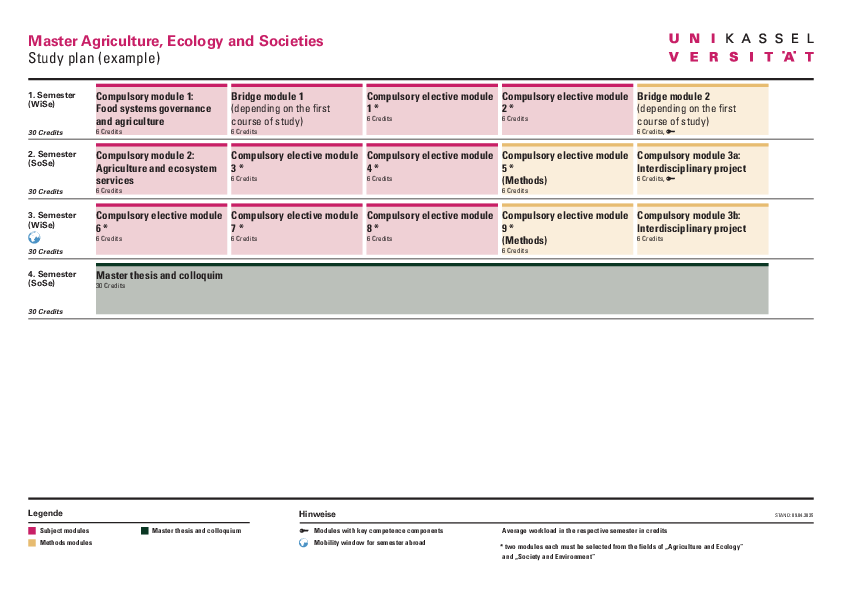
During the two years of the program, students will be required to complete 120 credits of coursework, which includes:
- Agriculture and ecosystem services
- Food systems governance and agriculture
Students with a life sciences background take:
- Research methods in social sciences
- History, societies and environment
Students with a social sciences background take:
- Research methods and data science in the life sciences, and
- either Priciples of organic farming or Soil and plant sciences or Organic livestock farming under temperate conditions
In small groups, students engage in research and/or transformation projects concerning food and agricultural systems and the role of Europe. Each project is supervised by two lecturers from different disciplines.
Different project topics and formats are offered every year. These can also be co-developed among students and lecturers. Some examples:
- Colonialism, food culture, history and sustainability of rice cultivation in Africa.
- What is 'sustainable'? Conceptual developments between cultural histories & the natural sciences
- Transformation(s) of animal husbandry and human-animal interactions
- Food culture, animal welfare and animal ethics in the Ahle Worscht cluster in North Hesse
- The thawing permafrost of Siberia: Potentials and risks of agricultural development
- Organic agriculture and agroecology in North Africa: From competition between cash crops and agroecology to compatible systems?
- Impact of the new European conformity rules on third countries in the context of the reform of the organic farming regulation
- The German Supply Chain Act and its impact on the Global South: The example of Indonesia
- Alternative food networks and local context: historical and socio-economic comparisons between the EU and North Africa.
- Agroecological innovation, power relations and international markets: Lessons from Latin America
Students can choose to specialise either in Agriculture and Ecology or Society and Environment. A wide variety of modules are offered in both areas each semester (see module handbook).
In their fourth semester, AGES students embark on an independent research project of their choice. In the thesis, they combine the theories, approaches and methods learned during their studies, document methodological confidence and reflection, generate independent theses and reflect on them against the background of the international research discourse. The Master theis is presented in a colloquium.
Given its broad spectrum, the AGES Master's programme offers students the opportunity to proactively develop their own professional profile. Possible thematic profiles include:
- Profile Management of transformation in the agricultural and food sector
In this area, students focus in particular on the motivations of private actors (farmers, processing companies, consumers) in the agricultural and food sector and the structures that determine their actions. The modules enable students to work in the sustainability- and transformation-oriented private sector of the food system as well as in the corresponding associations and cooperatives. Employers include suppliers of agricultural inputs, retailers, processors, NGOs and associations in the business sectors. - Profile Governance and transformation of the agricultural and food system
In this area, students focus in particular on the role of public policy and policymaking, as well as on public actors at various levels of social organisation in the agricultural and food system. The modules deal with how these actors shape the food system and what approaches and strategies they pursue for a comprehensive transformation of the food system, as well as the constraints they face. The modules qualify students in particular for positions in public administration and lobbying organisations at local, national or international level. - Profile Social Movements and Advocacy
In this module, students critically reflect on the current agricultural and food system and its influence on agriculture. Connections are made to political theory and historical and philosophical perspectives in order to create a basis for evaluating today's agricultural and food system and the role of agriculture within it. Indirectly, the modules prepare students for employment and engagement in social movements, non-governmental organisations, civil society organisations and relevant lobby groups. - Profile Sustainable Agricultural Ecosystems
In this area, students deal with crop production, livestock science and technical knowledge relevant to the development and transformation of sustainable agricultural and food systems in the Global South and North. The modules qualify students for work in companies, agricultural enterprises, think tanks and public institutions that deal with the production side of agriculture and its transformation towards greater sustainability, but also with how such technologies and methods can be embedded in specific socio-economic contexts. - Profile Innovation and Modelling of Agricultural Ecosystems in Transition
In this area, students engage with innovative approaches and technologies in agroecological management and apply this knowledge to modelling the future of agricultural ecosystems. The focus is particularly on system analysis and quantitative methods. The modules qualify students for positions in think tanks, specialised government agencies, or technical companies. - Profile Research and Teaching on Agriculture and Food Systems
Students who wish to work in research should contact scientists in their preferred field at the University of Kassel at an early stage to discuss their module selection. The choice of modules should be more strongly oriented towards the content in which they wish to continue their academic career.
Exemplary study plan