
Sustainability Economics and Management (Master)
The content on this page was translated automatically.
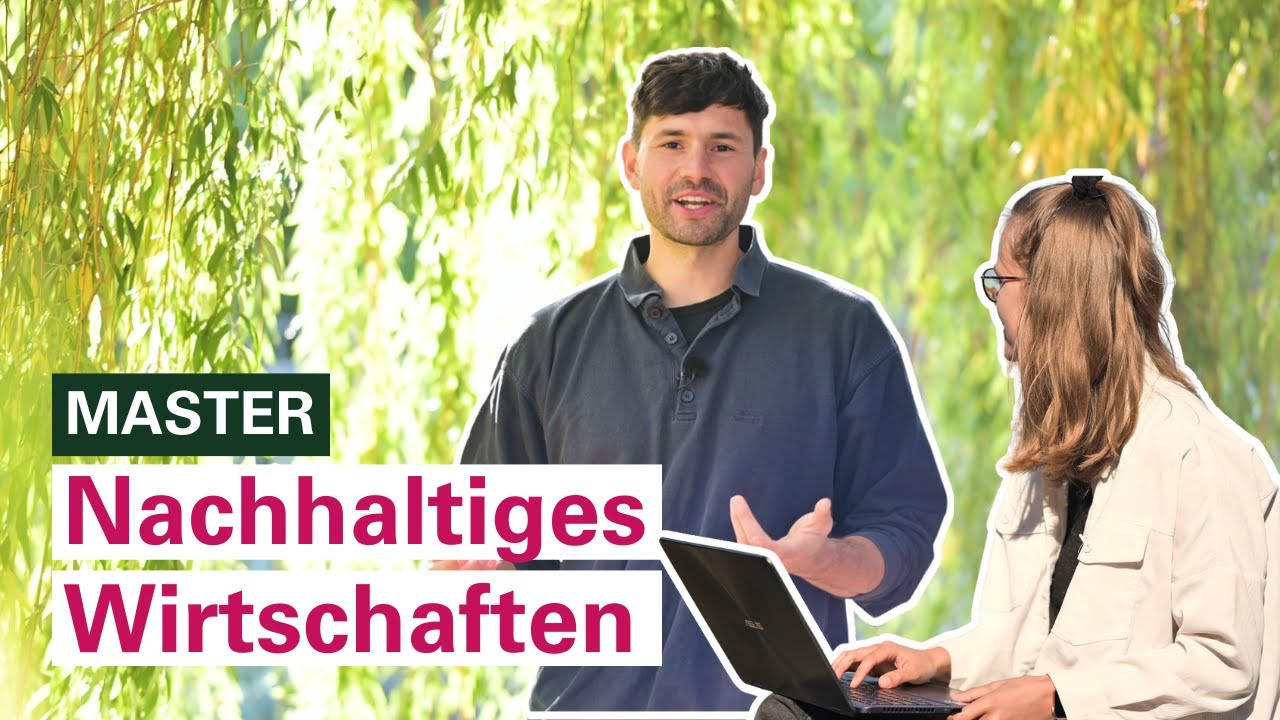
Sustainability is one of the key challenges of our time—for both companies and entire economies. At the same time, countries and organizations face the challenge of achieving economic success and positioning themselves for the future.
In the Master’s program Sustainable Business , you will develop the necessary skills to understand and successfully navigate these tensions: You will analyze complex interrelationships, assess economic and social impacts, and develop sustainable solutions for a sustainable economy.
At a Glance
About the Program
Sustainable business practices mean making economic decisions in a way that is environmentally sound, socially just, and economically viable in the long term.
In this master’s program, you will learn to understand and shape the complex interrelationships between the economy, society, and the environment. You will combine economic research with ecological, legal, and social perspectives to develop solutions for current challenges such as climate change, resource scarcity, biodiversity loss, and growing inequality.
Among other topics, you will explore:
- sustainable management throughout the entire supply chain and future-proof business models
- environmental economics and economic policy
- international environmental law and legal frameworks
- ecological processes and material cycles
There is a particular focus on methodological skills: You will learn to collect and analyze data, conduct scientific research, and formulate evidence-based recommendations for practical application. At the same time, you will develop the ability to integrate economic, technical, and societal perspectives to design sustainable solutions.
The master’s program in Sustainable Business in Kassel is one of the leading sustainability programs in the German-speaking world: Since its launch in 2008, the program has combined economic perspectives with current sustainability issues. Even back then, the University of Kassel was already focused on sustainability research, and the Department of Economics has a long tradition of hosting many scholars who study sustainable development and transformation processes in the economy and society.
In this program, you will specifically combine in-depth economic content with the natural sciences, engineering, and the social sciences, thereby developing a comprehensive understanding of sustainable transformations.
The program also thrives on diverse perspectives: students with different academic backgrounds work together on solutions—just as they will later in their professional lives.
What makes Kassel special: You’ll learn not only to understand sustainability theoretically but also to implement it practically and in an interdisciplinary manner. Thanks to the wide range of electives, you can also set your own areas of focus and tailor your academic profile specifically to your interests and career goals.
With a master’s degree in Sustainable Business, you’ll gain the qualifications needed for careers at the intersection of business, society, and the environment. You’ll work, for example, in companies, consulting, politics, or research, and help shape strategies, processes, and projects in the context of sustainable development.
Typical responsibilities include developing sustainability strategies, analyzing economic and environmental impacts, and supporting transformation processes.
Curious about specific job profiles and career paths?
Learn more on our page about career prospects.
The Master’s program in Sustainable Business combines academic content with practical applications. Alongside the research-oriented curriculum, projects and courses offer students the opportunity to gain practical experience and directly apply what they have learned:
- In the Solarcampus project-based course, for example, students work in interdisciplinary teams with companies and institutions from the region to develop sustainable solutions and financing options for transformation processes.
- Courses such as Communication Psychology or Sustainable Behavior and Social Norms address current challenges in sustainable development. Among other things, students learn how to design and communicate change processes within organizations, as well as how to empirically study and promote environmentally conscious behavior.
- Other components include regular guest lectures from industry professionals, which bring current insights from companies and organizations into your studies.
A semester abroad can be easily integrated into your course of study. The department maintains numerous international partnerships and supports students—for example, through the Erasmus program—in planning and financing their stay abroad. In doing so, you’ll benefit from international perspectives on sustainability and expand your professional and intercultural skills.
The Master’s program in Sustainable Business focuses on current issues in sustainable corporate management and the transformation of the economy and society. It examines how societies, companies, and political actors can integrate environmental and social requirements into their strategies and processes.
Here is a selection of research questions we are investigating:
From the field of economics:
- How successful is the Paris Climate Agreement?
- Are democracies more economically successful than other systems?
- Why are some countries rich and others poor?
- How do economic policy measures influence the level and distribution of wealth?
- How can we determine whether economic policy actually achieves its goals?
- How can the federal government, states, and local governments be financed sustainably?
- Are environmentally conscious people happier?
From the field of business administration:
- How can companies measure and strategically manage their sustainability?
- Why does sustainable business practice sometimes lead to competitive advantages for companies and sometimes not?
- How do we finance the transition to a climate-neutral economy?
- Is sustainability financially worthwhile for companies and investors?
- How can supply chains be made more sustainable and conflicting goals resolved?
- How can marketing and consumption be shaped for the future?
This research is closely linked to current developments in business and politics and offers a wide range of connections to topics such as climate change, corporate responsibility, and sustainable transformation.
Contact and Consultation
Go-Link of this page: www.uni-kassel.de/go/m_nawi/