How is the course structured?
This page contains automatically translated content.
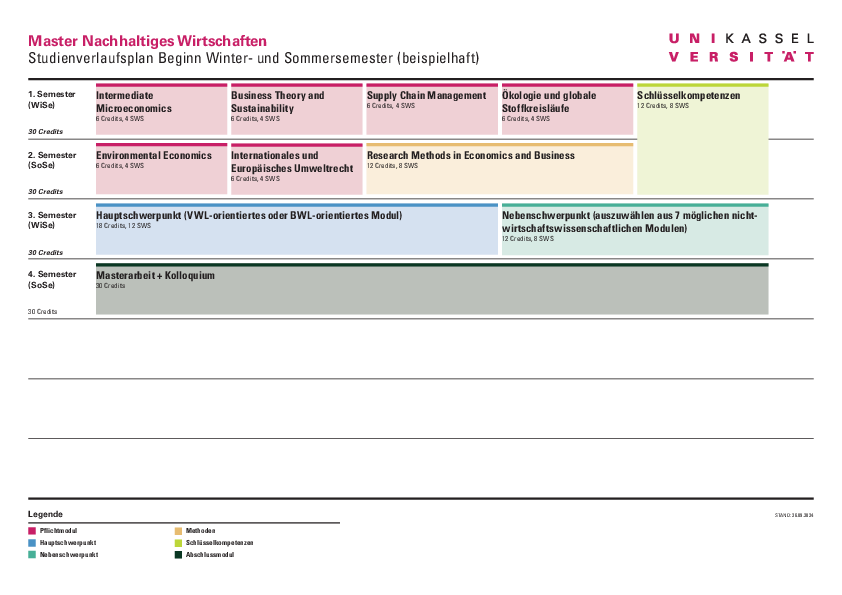
The Master's degree course in Sustainability Economics and Management can be completed after four semesters. Special attention is paid to interdisciplinary professional training:
Students choose between a major in economics or business administration and supplement this with a minor in politics, urban and landscape planning, agriculture and food management, environmental and energy technology or human-environment systems. It is explicitly desired that the students' different previous knowledge comes together and thus enriches the interdisciplinary professional training.
The program consists of the following compulsory modules :
- Environmental Economics
- Intermediate Microeconomics
- Supply Chain Management
- International and European Environmental Law
- Ecology and Material Flows
- Business Theory and Sustainability
In addition, 12 credits must be earned in economic research methods.
In the main focus , 18 credits are earned in one of the following two modules:
- Sustainable Behavior and Governance (economics-oriented)
- Sustainability Management (business-oriented)
In the minor specialization , 12 credits are earned in one of the following modules
- International Politics and Development
- Politics, Economics and Sustainability in Latin America
- Landscape Planning
- Sustainable agriculture and food industry
- Environmental Technology
- Renewable energies and energy efficiency
- Human-environment systems
In addition, 12 credits are acquired as a key competence . The final module (30 credits) consists of the Master's thesis and the associated colloquium.
Sample study plan