
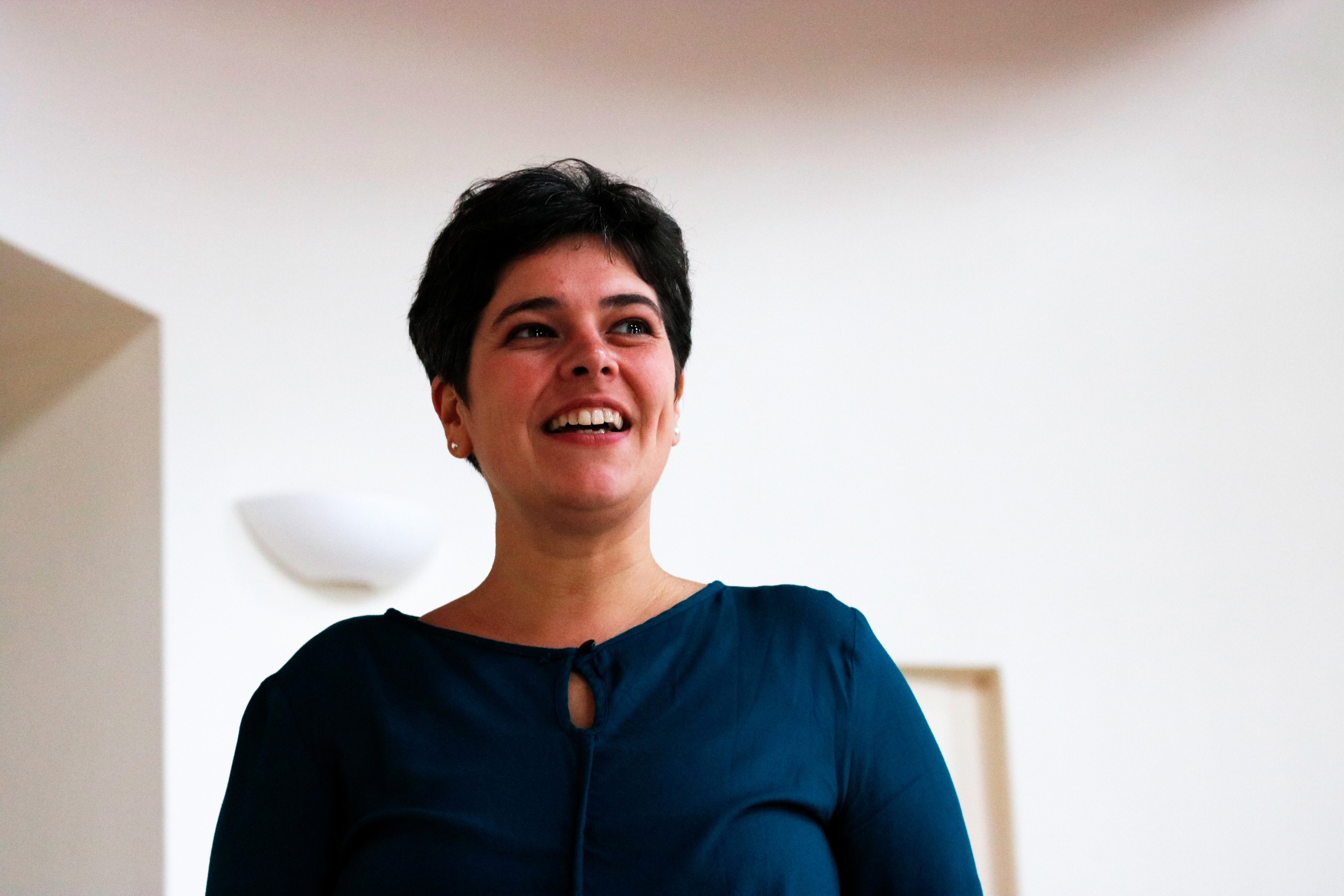
Prof. Dr. Anne Lisa Carstensen
With my focus on the global labor movement and issues of migration and gender equality, the Kassel Institute for Sustainability is the right place for me. I am firmly convinced that society can be changed and that it is worth thinking about alternatives, especially in times of crisis.
Interview
What exactly does your field of expertise research?
My field of expertise examines issues of power and politics in the global economy from a very specific perspective— namely, the perspective of labor. Politics, democracy, and economics do not only take place in the sphere of political institutions and companies; they also have a significant impact on where and under what conditions people work in a wide variety of fields. Through work and its products, we are all connected worldwide. Work is central to the production of resources, but also to social participation. Most people have to work – and under very different conditions. We are interested in what these conditions depend on, but also in how they can be changed. We take a “bottom-up” perspective and look at conflicts over transformation from the point of view of those most affected by them. That is why the topics of precarious work and migration are also at the center of our research. A particular focus is placed on a global perspective, as work can no longer be understood within the framework of national categories. It is also important to us not to limit our view to the field of wage labor, but to also consider the topic of social reproduction and the social and developmental policy framework conditions of work. From this perspective, it also becomes clear that social and ecological demands are rarely in conflict with each other, but usually complement each other well.
What specific issues or problems are you currently trying to solve?
A global perspective on society has always been central to me, and interacting with colleagues from all over the world is very important to me. That's why I'm completely in my element at the University of Kassel! My department is responsible for the Master's program in Labor Policies and Globalization (LPG). This is a one-year study program aimed at trade unionists from all over the world. Here, they learn and conduct research on topics related to politics, law, and economics. Precisely because the students already have a lot of practical experience, they contribute their own exciting perspectives and experiences. Together with the students and alumni of this program, we have created an exciting process of reflection on pressing challenges facing the trade union movement, such as climate change, migration, and the economic crisis. The program is part of the Global Labour University (GLU) international research and education network, which is closely linked to the global trade union movement. At a total of five locations (Brazil, India, South Africa, the Philippines, and Germany), my colleagues and I teach and conduct research on current issues in the field of globalized labor relations. The issues of social justice, socio-ecological transformation, and gender equality naturally play a major role in this context. In recent years, however, we have also been discussing more intensively how digitalization, global supply chains, migration, and the rise of authoritarian regimes are affecting working conditions and the scope for action available to trade unions. Especially in today's world, international cooperation in research and teaching, as well as exchange with practitioners, is extremely important.
Was ist Ihr aktuell wichtigstes Forschungsprojekt und warum?
For several years now, I have been exploring the role that time plays in the individual and collective perception of conflicts and social change. Specifically, I am interested in the significance of individual time horizons for how people perceive their work and what opportunities they see for changing their situation. But time is also of great importance when it comes to the experience and regulation of migration. Policies and organizational processes also always have their own temporal rationality. This is particularly central to the relationship between migration and work, because migration is often associated with the idea that it is a temporary phase, and migrants often have a special position in the labor market due to legal frameworks. Specifically, I am currently working with Dr. Maren Kirchhoff on a qualitative research project that examines the significance of time horizons for employees in different industries. We are conducting research on building cleaning and seasonal work in agriculture, i.e., in areas characterized by precarious work. This will hopefully give us a better understanding of how migration processes and labor relations are interdependent and help us better understand conflicts surrounding work.
What distinguishes sustainability research at the Kassel Institute for Sustainability?
It is clear to me that perspectives on sustainability cannot be developed behind closed doors and that socio-ecological transformation cannot be conceived by “experts” alone. Rather, discussions about sustainability must be broadly anchored in social debates and discourses. Recognizing diversity of perspectives and interdisciplinary cooperation help to advance the relevant debates. But I also find another thing important: The Kassel Institute for Sustainability focuses on a broad concept of sustainability. Sustainability is not limited to the question of technical innovations for reducing CO2 emissions, but includes a comprehensive perspective on social development. Questions of social justice and democratic negotiation mechanisms are also of great importance here. As a political scientist, I know that such questions are linked to power and interests – and that is precisely what makes them interesting.
If we want to understand transformation as a fundamental social change, then we must consider a variety of perspectives and, in doing so, raise fundamental and perhaps unexpected questions, identify conflicts of interest, and make objectives transparent. A good example is the question of whether more or less work and production is actually needed to address social crises.
With my focus on the global labor movement and issues of migration and gender equality, the Kassel Institute for Sustainability is the perfect place for me. I firmly believe that society can be changed and that it is worth thinking about alternatives, especially in times of crisis.