
"Cities must no longer grow outwards"
For example, the abandoned brick Kaufburg in Kassel's Friedrich-Ebert-Strasse: you haven't been able to buy anything there for several years. It is to be demolished to make way for a new building. Or the Salzmann-Areal in Bettenhausen, a listed building from the Wilhelminian era, where textiles were once manufactured. After several interim uses, the huge complex has been empty since 2012 and is rapidly falling into disrepair. By 2028, apartments, a retirement home, a supermarket and space for gastronomy and culture are finally to be built on the site. It will be interesting to see.
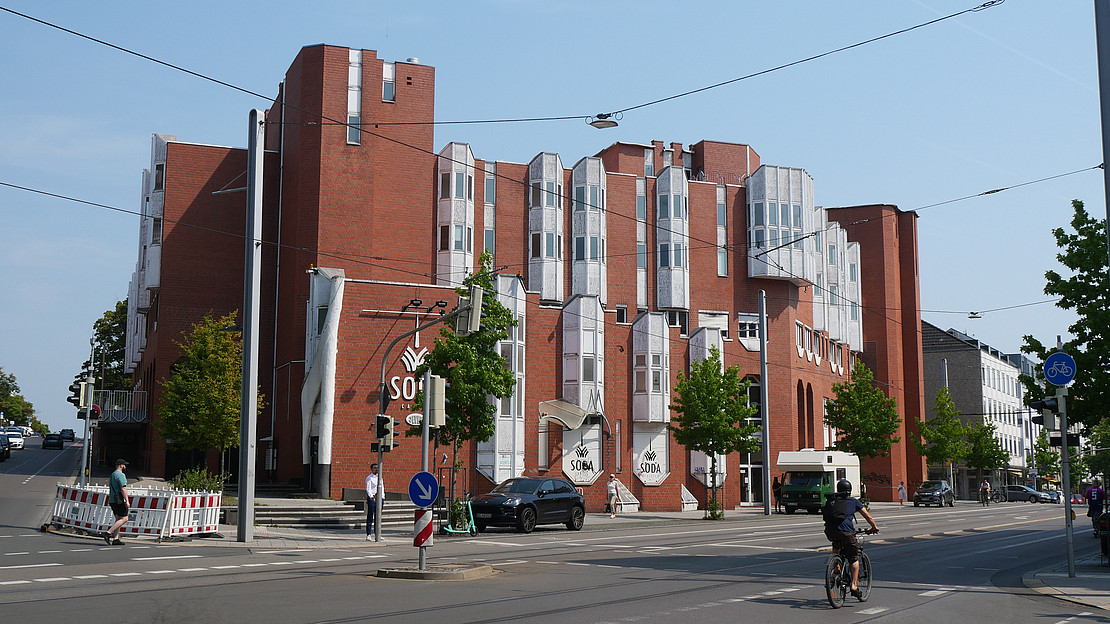 Image: Radish/Tastel.
And another look into the future: the university's Faculties of Natural Sciences are to move out of the AVZ in Oberzwehren and relocate to Holländischer Platz. What will become of the AVZ then? Tear it down and build a new one? "No," says Prof. Stefan Rettich, who heads the Department of Urban Planning at the University of Kassel, "a shell that is already standing is half the battle, regardless of how energy and material prices or the availability of skilled workers develop." In most cases, demolition is therefore not a good option. Circularity is the name of the game. You could also call it the circular economy. It has long been practiced in the waste sector: Waste paper becomes cardboard, disposed glass bottles become new glass bottles. Plastic film and packaging can be turned into textiles or everyday objects. In terms of architecture, it could mean that where people used to pray could now be an event center; unused office buildings, department stores and cinemas could be turned into apartments, educational institutions or cultural venues.
It is a misconception that in the past everything was preserved and hardly anything was wasted. Not only after wars, but also after other socio-economic upheavals, the architecture of a city was severely damaged, such as in Leipzig: in the late 19th century, when a change from a trade fair for goods to a sample fair became apparent, almost the entire baroque city was demolished.
 Image: Stoya.
Prof. Stefan Rettich was born in Ebingen / Zollernalbkreis in 1968. He studied architecture at the University of Karlsruhe. In 1999, he founded the architecture firm KARO* architekten Leipzig with colleagues. From 2005 to 2006, he was a deputy professor for urban redevelopment and urban renewal at the University of Kassel. From 2007 to 2011, he taught at the Bauhaus Kolleg, Bauhaus Dessau Foundation. After a professorship for theory and design at the University of Bremen, he has been Professor of Urban Design in Kassel since 2016. In 2022, he was appointed to the Expert Council for International Building Exhibitions by the Federal Ministry of Housing, Urban Development and Building.
Decarbonization, affordable housing rents, schools, transport justice, a focus on the common good or a social market economy - the land issue is the key to all of these and other central social issues.
The recently published, four-hundred-page scientific handbook "The Obsolete City - Paths to Circularity" describes such (necessary) transformation processes in detail and vividly. In a three-year research project, Rettich and his former colleague Prof. Sabine Tastel (now TH Köln) systematically, empirically and qualitatively investigated the potential of urban obsolescence, primarily using Hamburg as an example. Her analysis can certainly be applied to cities such as Kassel, as the conditions are often similar: "It becomes clear how strongly technical innovations and socio-economic megatrends predetermine the obsolescence of buildings and how little this has been examined in detail in urban studies to date," says the foreword. In addition to globalization, the team of authors has identified megatrends of urban obsolescence that will have a stronger impact in the future: digitalization, the transport revolution and changes in religiosity.
Whichever way you look at it, if we want to tackle climate change, urban growth must be consistently directed inwards.
Of course, cities are not becoming obsolete, i.e. redundant or "no longer in use" (Duden). But parts are. Cities have always changed - for different reasons, says Rettich. For example, in the 18th and 19th centuries, numerous city walls and fortifications were razed, which, like narrow belts, prevented cities from expanding. As the city was unbound, large civic parks, boulevards and wide ring roads were created. The growing self-confident bourgeoisie built prestigious houses and with industrialization came factories and commercial areas. At the same time, in many cities "the reconstruction of the ramparts was linked in time and space with the construction of the first railroad stations", which in turn ensured growing mobility and also fueled urban expansion. Rettich in the publik interview: "The initial thesis of our research was that cities today must not grow any larger, although many actually want to continue growing. We have to think about how we can develop them inwards." Fortunately, there is more space in cities than expected. "Under the megatrend of globalization, many types of inner-city buildings and spaces have fallen out of use in the past, e.g. Wilhelminian-style factories, slaughterhouses, wholesale market halls." In the future, it will be cinemas, churches, petrol stations, department stores and bank branches, among others, that will be "fundamentally challenged" by current "megatrends".
Rettich cites Campus North as a positive example: "In my view, it has developed magnificently. Globalization has freed up the old factory buildings here, then the knowledge society came and absorbed parts of it. In my opinion, this is a really successful transformation." The book invites us to think about the future of our cities - not least the future of Kassel.
Stefan Rettich, Sabine Tastel: The obsolete city - paths to circularity. Jovis publishing house 2025.
This article appeared in the university magazine publik 2025/3. Text: Andreas Gebhardt.