
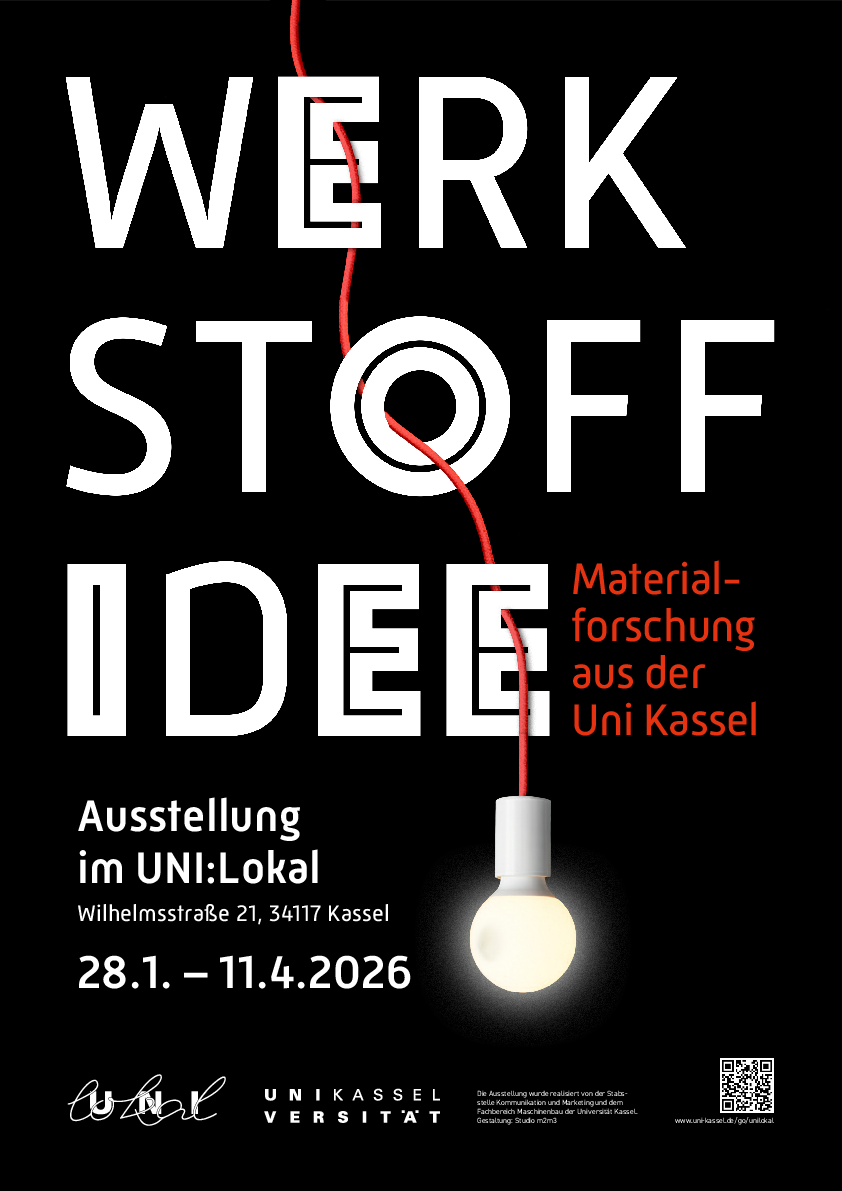
Exhibition „Work – Material – Idea“
This page contains automatically translated content.
Plastic
We are working on a process that uses enzymes to break down plastic films that are difficult to recycle and process them into high-quality new materials. The aim is to create a closed plastic cycle that conserves resources and avoids waste.
A lot of plastic packaging consists of several layers that can hardly be separated from each other. They protect food well, but are difficult to recycle, meaning that they can usually be incinerated or only recycled into inferior products.
We want to change that: We are developing a process in which enzymes - biological catalysts - specifically break down plastics such as PET (polyethylene terephthalate) and PE (polyethylene). To do this, we first examine existing waste streams in order to gain a precise understanding of the composition and properties of the films. On this basis, enzymes are selected that can break down PET or PE.
What's special: The recycled material can be turned back into plastic of almost its original quality - ready for a second life as high-quality packaging. This creates a sustainable material cycle that conserves resources, avoids waste and makes an important contribution to a sustainable plastics economy.
BioLoop: Micro-biologically enhanced material cycle for closing PE and PE-PET multilayer plastic foil loops
Project duration: 1.7.2025 - 30.6.2029
Departments involved:
University of Kassel:
Faculty of Civil and Environmental Engineering, Institute for Water, Waste, Environment, Department of Resource Management and Waste Technology (Prof. Dr. David Laner)
Department of Mechanical Engineering, Institute of Materials Engineering, Faculty of Plastics Engineering (Prof. Dr. Hans-Peter Heim)
University of Hamburg:
Institute of Plant Sciences and Microbiology, Department of Microbiology and Biotechnology (Prof. Dr. Wolfgang Streit)
Funding: Volkswagen Foundation
How can energy be generated from sunlight directly via windows? A new type of solar window for residential and office buildings uses nanoparticles (quantum dots) in a special film to conduct the energy to the edge of the window, where it is converted into electricity by photovoltaics and can be used.
Sunlight provides energy, but in normal windows it remains unused. A consortium of researchers and industry is developing a solar window that captures this energy. Tiny quantum dots in a special film guide the sun's energy to the edge of the window, where it is converted into electricity by photovoltaics.
The special feature: The window can be used in residential and office buildings without changing the appearance, offering a new way of supplying buildings with sustainable energy. The electricity generated can either be fed into the household electricity supply via cabling or, in conjunction with an integrated battery, passed on directly to the consumer, for example to the blinds. The technology for this takes up little space in the window frame.
CoSoWin - windows with integrated solar cells based on Luminescent Solar Concentrator (LSC) technology for energy supply
Project period: 1.12.2019 - 30.11.2023
Departments involved:
Faculty of Mechanical Engineering, Institute of Materials Engineering, Department of Plastics Engineering (Prof. Dr. Hans-Peter Heim)
Funding: Federal Ministry for Economic Affairs and Climate Protection
Project partners: Vonovia, Fraunhofer Institute for Solar Energy Systems ISE, Fraunhofer Institute for Applied Polymer Research IAP, Technoform Glass Insulation Holding, Walter Fenster und Türen, xCave Technology
Plastic is all around us - in appliances, packaging and furniture. But where does plastic actually come from and what is the difference between "normal" plastics and bioplastics? We are researching how bioplastics and biocomposites can be used and recycled in durable products.
The main component of plastic is carbon, which in the case of conventional plastics is obtained from crude oil and natural gas. These carbon sources serve as the starting point for the so-called monomers, which are combined into polymers through synthesis processes. If the polymers are combined with additives, a plastic granulate is produced, which can later be used to manufacture components with very specific properties. For this purpose, the granulate is melted, shaped and then cooled.
During their use, these components are exposed to various external influences. These include, for example, mechanical stress or UV radiation. These factors can significantly change the properties of the plastics, reduce their function and make recycling more difficult.
At the end of the use phase, there are various recycling routes for the plastic:
- Thermal recycling, in which plastic is incinerated and the resulting energy is used.
- Mechanical recycling, in which single-origin plastics are melted down again and processed into new products.
- Feedstock recycling, which includes microbial and chemical processes. In this process, the plastic is broken down into its starting materials so that new polymers can be produced from them. (You can see how such a recycling process works in the exhibition under the topic "When enzymes recycle plastic")
- Biodegradation is possible for some, but not all plastics. This degradation is not a universal process, but each material requires certain conditions in order to be degraded. Under controlled conditions, biodegradable plastics, e.g. PLA, are completely decomposed within a short time.
Bio-based plastics are obtained from renewable raw materials and are intended to help conserve fossil resources. It is often assumed that bio-based automatically means that the material is also biodegradable.
However, this is not true: "bio-based" only describes the origin of the carbon, not the behavior at the end of the life cycle. Many bio-based plastics are deliberately not biodegradable, but should - like conventional plastics - be as durable and easily recyclable as possible.
A research focus at the "Plastics Technology" department is working intensively on the durability of bioplastics and biocomposites in order to obtain reliable data for future material development.
BeBio2 - Resistance of bioplastics and biocomposites
Project duration: 1.10.2021 - 30.6.2025
Departments involved:
University of Kassel: Faculty of Mechanical Engineering, Institute of Materials Engineering, Department of Plastics Engineering (Prof. Dr. Hans-Peter Heim)
University of Stuttgart, Institute for Plastics Technology
Fraunhofer Institute for Applied Polymer Research (IAP)
Altair Engineering GmbH
Funding: Federal Ministry of Food and Agriculture, Fachagentur Nachwachsende Rohstoffe e.V. (FNR)
Further information
Lighting conditions are constantly changing. Whether outdoors during sport or in sensitive areas such as operating theaters. Researchers are developing transparent, darkenable films that are further processed into plastic lenses and visors. They adjust automatically in seconds or can be controlled manually - for clear vision, comfort and safety in all situations.
Strong sunlight, sudden shadows or changeable weather: our eyes have to constantly adapt. Eyewear supports the eye in this process. Conventional solutions such as interchangeable lenses or self-tinting (photochromic) coatings are often impractical. Researchers are therefore developing electrochromic plastic lenses whose tint can be actively and continuously adjusted at the touch of a button or even automatically controlled by sensors.
The special feature: The lenses contain a thin electrochromic film. This changes its light transmission as soon as a low electrical voltage is applied. The glass becomes lighter or darker in seconds and adapts flexibly to changing conditions.
The film is combined with transparent plastic in an injection molding process to create lightweight, 3D-shaped and cost-effective spectacle lenses or visors. The technology is energy self-sufficient, allows great design freedom and opens up new possibilities for sports and protective eyewear, helmets or medical applications.
EXIST research transfer: "Dimmable"
Project duration: 1.3.2025 - 31.8.2026
Departments involved:
Faculty of Mechanical Engineering, Institute of Materials Engineering, Department of Plastics Engineering (Prof. Dr. Hans-Peter Heim)
Funding: Federal Ministry for Economic Affairs and Energy (BMWE)
Further information
Press Release: Millions in funding for switchable glasses with dimmable plastic lenses
A band that can do more: Originally developed for fitness, here it controls a Carrera track. The conductive material in the band transforms movements into precise electrical signals. The smart band thus becomes an intuitive controller and shows how material innovation can make everyday objects usable in a completely new way.
At first glance, the STRAFFR sports band looks like an ordinary training band, but it conceals smart technology. Sensors measure strength, repetitions and speed and send the data to an app. This allows users to evaluate and customize their training. Incorporated conductive carbon black makes the plastic conductive and turns it into a multifunctional material.
This enables further applications, such as controlling a Carrera track. Here, movements are converted directly into electrical signals, without any additional joysticks. Functionalized plastics enable digital applications and can save resources.
Start up "STRAFFR"
Project duration: 1.12.2018 - 30.11.2019 with subsequent spin-off from the University of Kassel
Departments involved:
Faculty of Mechanical Engineering, Institute of Materials Engineering, Department of Plastics Engineering (Prof. Dr. Hans-Peter Heim)
Funding: Federal Ministry for Economic Affairs and Energy (BMWE), Project Management Jülich (PtJ)
Plastic and wood
A new material combines the best of both worlds: lightweight, robust plastic matrix meets flexible woven willow wood threads. The result is a sustainable composite that is weatherproof, malleable and versatile - for innovative façade elements, for example.
The new composite material combines two materials in an unusual way: Fine, woven willow wood threads from the fast-growing American willow and plastic films made of polypropylene are fused together using a hot pressing process. The plastic melts, flows around the wood structures and then hardens again. A special bonding agent ensures that the connection remains permanently stable.
The result is a lightweight, weather-resistant material that is both technically robust and versatile in terms of design. Different woven structures can be used to create façade modules that appear transparent, semi-transparent or opaque and create exciting visual effects depending on the incidence of light. In this way, the natural aesthetics of wood meet the durability of a modern technical material.
Numerous tests were carried out to check the suitability for everyday use, for example on strength or weather resistance. UV stabilizers were added to increase durability.
The results show: The combination of sustainable raw materials and modern plastics technology has the potential to create functional yet aesthetic components for outdoor use.
VOTO - Willow fabric-reinforced plastic with variable fabric density in textile timber construction
Project duration: 1.3.2021 - 31.12.2023
Departments involved:
Faculty of Mechanical Engineering, Department of Plastics Technology (Prof. Dr. Hans Peter Heim)
Faculty of Architecture - Urban Planning - Landscape Planning, Research Platform Building Art Invention (Prof. Heike Klussmann)
FRIMO Sontra GmbH, Research Association for Materials from Sustainable Raw Materials e.V. (WNR), Textile Research Board e.V. (FKT )
Funding: Federal Ministry of Economics and Climate Protection (BMWK) as part of the Industrial Collective Research Program (IGF)
Further information (in German)
@baukunsterfinden
Meldung: Neuer Verbundwerkstoff aus Kunststoff und Weidenholz
Wood
A traditional wood becomes a sustainable high-tech raw material. Textiles for architecture, furniture and design are made from willow wood. Willow bark provides natural ingredients for medical products. Cultivated in agroforestry systems, willows promote the climate, soil and biodiversity - and open up new opportunities for agriculture.
Shrub willow is a versatile and rapidly renewable raw material. Its material properties are already specifically controlled during cultivation. For example, straight shoots up to five meters long are already growing from light and flexible wood.
The willow provides two products. An endless willow wood thread is created from the wood. This is used to produce willow wood textiles for lightweight and aesthetic components in architecture, furniture construction and design, which can replace or optimize materials that were previously based on petroleum or slow-growing trunk wood. In addition, the bark provides natural salicylates for medicine and cosmetics. In this way, the entire plant is used.
In agroforestry systems, trees and shrubs are combined with arable farming or animal husbandry on the same area. Shrub willows grow there together with arable crops. Their deep roots protect the soil, store water and improve the microclimate. They bind carbon, promote biodiversity and manage with little or no fertilizer and pesticides. This opens up climate-friendly and economic opportunities for agricultural businesses.
SALIX AGROFORST model and demonstration project
Coordinator:
Faculty of Architecture - Urban Planning - Landscape Planning, Institute of Architecture, Research Platform Building Art Invention (Prof. Heike Klussmann, Steffi Silbermann)
Project duration: 1.10.2024 - 30.9.2027
Funding: FNR - Agency for Renewable Resources e.V.
Project partner:
University of Kassel:
Faculty of Organic Agricultural Sciences, Faculty of Organic Agriculture and Crop Production, Faculty of Business Administration
Faculty of Mechanical Engineering, Faculty of Separating and Joining Manufacturing Processes
Hof University of Applied Sciences, Institute of Materials Science
Leibniz Institute for Agricultural Engineering and Bioeconomy e.V
Dendroquant GmbH, Agricultural and Valuable Wood - Breeding and Certification
Heinrich Kuper GmbH
TRIEBWERK - Regenerative agriculture and agroforestry
The subject area "Experimental and digital design and construction" researches additive manufacturing processes to develop lightweight constructions made of veneer wood for the construction industry. These components are very resource-efficient and resilient. In future, they could be used as a sustainable alternative to concrete or steel systems.
Three-dimensional winding processes can be used to produce hollow components from veneer wood. To do this, veneer strips are wrapped around a rotating forming element using a robot. The strips used come from offcuts from veneer wood production, which are joined together to form continuous strips. After the production process, the internal forming element is removed to create a hollow wooden component. The molded element can be used again and again.
In this additive manufacturing process, the material is only applied where it is actually needed. In addition, the continuous strip can be laid down in different directions so that the natural grain direction of the wood is optimally utilized. This results in particularly resilient components with optimized mechanical properties.
At the same time, the hollow profile construction method enables extremely material-efficient and sustainable use of wood, a resource that is becoming increasingly scarce. The timber components produced in this way represent an environmentally friendly alternative to conventional solid wood products.
3DWoodWind | WoodWind+
Project duration: Development over several individual projects since 2021
Departments involved:
University of Kassel:
Faculty of Architecture - Urban Planning - Landscape Planning, Institute of Architecture,
Department of Experimental and Digital Design and Construction (Prof. Philipp Eversmann)
Department of Structural Design (Prof. Julian Lienhard)
Leibniz Universität Hannover, Department of Sustainable Building Systems (Prof. Dr. Philipp Geyer)
Scientific development:
Andreas Göbert, Georgia Margariti, Julian Ochs, Ole Weyhe, Felita Felita, Ueli Saluz, Andrea Rossi
Project participants:
Elias Arayess, Guido Brinkmann, Nils Eckhardt, Sebastian Körner, Ilija Majcen, Clemens Mostert, Seyed Mobin Moussavi, Björn Raschper, Moritz Reh
Funding:
Federal Institute for Research on Building, Urban Affairs and Spatial Development (BBSR), ZukunftBau, Michael Lautwein, Research project "3DWoodWind" / "BBSR Research Prototype"
Industry partner:
H. Heitz Furnierkantenwerk GmbH & Co KG, Jowat SE, OEST SYSTEMS GmbH & Co KG
In the "Formlagenholz Plus" research project, we are halving adhesive consumption when bonding layers of wood and at the same time making wood lighter, more flexible and more functional. In this way, a traditional material is being sustainably developed using modern technology.
Molded plywood consists of many thin layers of wood that were previously glued together completely. This requires a lot of glue, which is expensive and often contains harmful substances such as formaldehyde. In the "Molded plywood plus" project, the amount of adhesive used is reduced by more than 50%.
The innovation lies in targeted, partial bonding: adhesive is only applied in dots or strips where the component will later be subjected to stress. This creates a material with different properties within a single component. It can be stiff in one place and flexible in another. Molded plywood thus becomes a gradient material that is light and functional.
This technology opens up new applications: ergonomic seat shells, furniture parts with integrated spring or damping areas, wooden hinges without plastic or metal as well as lightweight components for vehicles. The reduced use of adhesives saves resources and reduces emissions and production costs. The beech wood used is indigenous and renewable.
Molded plywood plus
Project duration: 1.10.2022 - 30.3.2026
Departments involved:
Faculty of Architecture - Urban Planning - Landscape Planning, Research Platform Building Art Invention
School of Art and Design, Department of Furniture Design and Exhibition Architecture
Faculty of Mechanical Engineering, Department of Separating and Joining Manufacturing Processes
Funding: FNR - Fachagentur nachwachsende Rohstoffe e.V.
Concrete
What if we could turn organic waste into electricity and building materials for our cities? A combustion process converts organic waste into renewable energy. This leaves behind the carbon-rich solid biochar. In our project, this biochar is used as an important component in the production of concrete.
Every year, 30 billion tons of concrete are produced worldwide. Concrete production causes a high amount ofCO2 emissions and has a significant impact on the consumption of natural resources, e.g. natural sand. At the "Construction Materials and Chemistry" department, we are developing innovative ways of using biochar from organic waste as a substitute for sand in concrete.
Biochar is produced as a waste product when organic waste is incinerated in a low-oxygen process called pyrolysis. The process also produces pyrolysis oil and synthesis gas. These are used to generate electricity and usable heat.
The innovation of our project is to reuse biochar for the production of concrete and thus reduce theCO2 footprint of concrete. In this way, waste is converted into a resource and a sustainable concrete raw material is produced - both of which help to protect our climate.
CO2-neutral biomass-based particle interactions for NET-ZERO concretes (BIOMAC) - experiments and modeling
Project duration: 2024-2027
Departments involved:
University of Kassel, Faculty of Civil and Environmental Engineering, Institute of Structural Engineering, Department of Construction Materials and Construction Chemistry (Prof. Dr. Bernhard Middendorf, M.Sc. Mujeeb Latifi)
Technical University of Darmstadt, Institute for Materials in Civil Engineering (Prof. Eduardus Koenders, M.Sc. Maximilian Mayer)
Funding: German Research Foundation (DFG), Priority Program 2436 "Net-Zero Concrete"
Rapeseed protein
What if we could use plant proteins to produce high-performance adhesives and insulating materials for the construction industry? We convert rapeseed protein into renewable binders and lightweight foams and develop sustainable wood composites and innovative sandwich panels with a protein foam core.
Wood products and wood composites such as plywood and sandwich panels are essential components of modern construction. However, most of the adhesives used in this process come from resins, the production of which requires a lot of energy and causesCO2 emissions. At the "Separating and Joining Production Processes" department, we are researching innovative ways of using rapeseed protein as a renewable raw material for wood adhesives and foamed core layers. Rapeseed protein is a by-product of the cold pressing of rapeseed oil.
Here in the exhibition, we are showing a three-layer sandwich panel with a foam core made from rapeseed protein. This core is light, stable and offers promising insulation and soundproofing properties. Together with the wooden cover layers, a bio-based composite material is created that can replace fossil materials and open up new ways of using materials in a circular way.
Bio-based protein materials for sustainable wood composites
Faculties involved:
Faculty of Mechanical Engineering, Institute of Production Engineering and Logistics, Department of Separating and Joining Manufacturing Processes (Prof. Dr.-Ing. Prof. h.c. Stefan Böhm)
Project partners:
Georg-August-Universität Göttingen, Dreher Bio GmbH, ergopanel AG
Metal
At the Institute of Materials Technology, we are researching innovative ways to make additive manufacturing - especially metal 3D printing - more sustainable. One focus of our research is on the recycling process of the powder materials used in order to minimize the use of resources.
We use laser powder bed fusion, a 3D printing process for metal. In this process, components are built up layer by layer from metal powder. It is particularly suitable for complex components due to its high precision.
The process is considered to be particularly material-efficient because only the proportion of powder required for the component is melted. Although the surrounding residual powder remains unmelted, it loses quality and can therefore only be reused to a limited extent. In order to make the powder usable again, it must be mechanically processed and carefully tested.
A research team is working on closing this material cycle: By specifically processing and characterizing the powder particles, we aim to reduce resource consumption and increase the efficiency of the entire production process. In this way, we are making an important contribution to sustainable, future-oriented industrial production.
Powder materials for additive manufacturing processes - increasing resource and process efficiency through production-integrated recycling
Project duration: Since 2022
Departments involved:
Faculty of Mechanical Engineering, Institute of Materials Engineering, Department of Metallic Materials (Prof. Dr. Thomas Niendorf)
Funding: Alliance for Industry and Research
In the "Foundry Technology" department, we are researching innovative manufacturing processes for casting molds. One of these processes is the 3D printing of sand molds into which liquid and recycled metal is poured. This research has resulted in a cast bicycle frame.
Our project shows how a bicycle frame made of recycled aluminum can be cast in 3D-printed sand molds. Normally, bicycle frames are assembled from many welded aluminum tubes in a complex and time-consuming process. The 3D sand printer enables complex shapes to be produced quickly. A special, environmentally friendly bonding agent glues the grains of sand together, creating a precise mold. This reduces the number of subsequent processing steps, e.g. grinding and sawing.
Like dough in a baking pan, liquid metal is then poured into the sand mold, where the metal solidifies. The sand is reusable and the metal is obtained from old car tire rims, which saves energy and raw materials. Production takes just a few days, from computer design and strength analysis to casting. The method can easily be transferred to other industries where complex components need to be produced in low quantities, such as Mechanical Engineering and Aerospace.
Cast aluminum bicycle frame from a printed sand mold
Project duration: Since the beginning of 2023
Faculties involved:
Faculty of Mechanical Engineering, Institute of Production Engineering and Logistics, Foundry Technology (Prof. Dr. Martin Fehlbier)
Digital twin
At the Institute of Mathematics, we are developing a digital twin of the human eye. This enables us to help ophthalmologists understand diseases better and diagnose them more quickly. Therapies are adapted specifically for the patient and made more modern and sustainable. We can test medications on the computer without side effects for patients and in a resource-saving way.
The virtual eye enables research into eye diseases, the optimization of therapies, the development of drugs, the planning of operations and the professional training of students - completely simulation-based, resource-saving and without animal testing.
In the digital twin, we model the components of the human eye - cornea, iris, lens, ciliary body, vitreous body, retina, sclera and the optic nerve insertion - based on data using suitable Mathematics functions (e.g. ellipses, hyperbolas, limacons).
Physiological processes of the eye are described using complex systems of equations. On this basis, individual eye characteristics as well as diseases such as cataracts, glaucoma, age-related macular degeneration (AMD) and treatment options can be simulated.
The virtual eye
Project duration: 2015 to 2022, developed at the University of Heidelberg and the University of Kassel
Departments involved:
Faculty of Mathematics and Natural Sciences, Analysis and Applied Mathematics research group, Faculty of Numerics and Mathematical Modeling (Prof. Dr. Elfriede Friedmann)
Funding: Klaus Tschira Stiftung gGmbH
Further developments through Bachelor's and Master's theses at the University of Kassel