
Study structure
The content on this page was translated automatically.
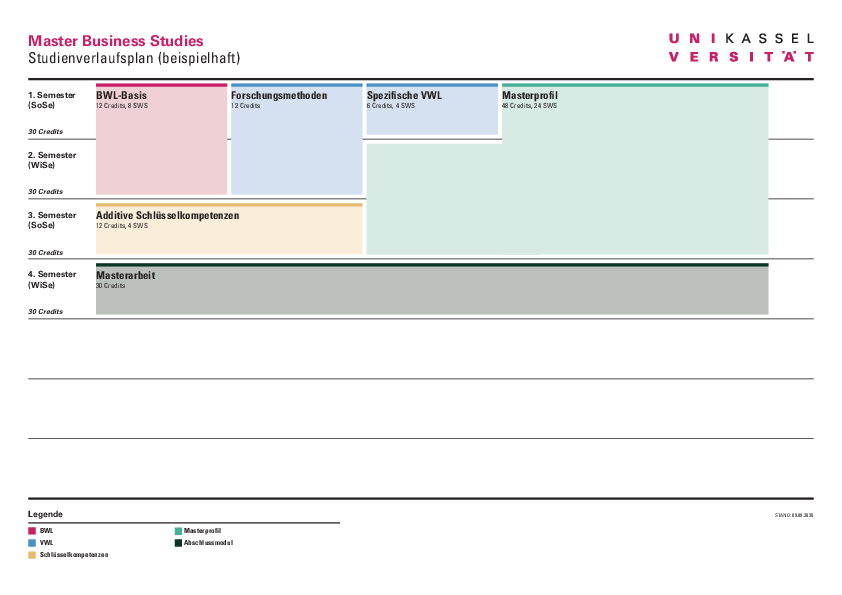
The Master's degree program in Business Studies can be completed after four semesters
Students must complete credits in six areas of study that build on existing specialist knowledge:
- Basic Business Studies (12 credits)
- Specific economics (6 credits)
- Research Methods (12 credits)
- Master's profile (48 credits)
- Additive key competencies (12 credits)
- Master's thesis (30 credits)
One focus of the courses taught in German and English is the examination of current research topics.
As part of the Business Administration module, which is independent of specialization, the courses "Information Management" and "Controlling and Corporate Governance" provide the necessary foundations for the degree course. In the economics module, one course is attended depending on the chosen specialization. Quantitative and qualitative methodological knowledge is deepened in the Research Methods module. The Master's profiles are divided into a compulsory and a compulsory elective area of 48 credits each. The corresponding modules are determined by the chosen specialization.
Presentation, organizational and communication skills are acquired in the individual modules in addition to the demanding specialist training.
Focus / Specialization
The following three modules must be completed in the compulsory area FACT :
- Group Accounting (6 credits)
- Taxation (6 credits)
- Finance (6 credits)
The compulsory module in specific economics is: Governance: Institutions and the Public Sector (6 credits/ 4 SWS)
In the compulsory elective area FACT , five modules totaling 30 credits must be completed. Freely assignable modules include:
- Sustainable Finance (6 credits)
- Value-based management accounting (6 credits)
- Pillars of Cost Accounting (6 credits)
- Balance sheet analysis/policy (6 credits)
- Business Valuation (6 credits)
- Strategic Controlling (6 credits)
- European and international corporate and business law (6 credits)
- Selected Topics in Taxation (6 credits)
- Risk Management (6 credits)
- Business simulation FACT (6 credits)
- Controlling & Management Research Seminar (6 credits)
The following three modules must be completed in the compulsory area MuM :
- Supply Chain Management (6 credits/ 4 SWS)
- Leadership & Change Management (6 credits/ 4 SWS)
- Sales & Customer Management (6 credits/ 4 SWS)
The compulsory module in specific economics is: Economic Behavior: Models (6 credits/ 4 SWS).
In the compulsory elective area MuM , five modules totaling 30 credits must be completed. Freely assignable courses include:
- Advanced Supply Chain Management (6 credits)
- Strategic Human Resource Management (6 credits)
- Contemporary Topics in Organizational Research (6 credits)
- Customer Experience Management (6 credits)
- Targeting (6 credits/ 4 SWS)
- Strategies and Approaches in International Direct Marketing (6 credits)
- Innovation Marketing (6 credits)
- Strategic Entrepreneurship (6 credits)
- Advances in Sustainable Marketing (6 credits)
- Managing Diversity, Equity, and Inclusion (6 credits)
The following three modules must be completed in the compulsory area DiB :
- Business Model Innovation (6 credits)
- Service Engineering & Management (6 credits)
- Digital Transformation (6 credits)
The compulsory module in specific economics is: Governance: Policy and Market Dynamics (6 credits/ 4 SWS).
In the compulsory elective area DiB , five modules totaling 30 credits must be completed. Freely assignable courses include:
- Cases of Digital Transformation (6 credits)
- Machine Learning in the Cases of Digital Transformation (6 credits)
- Internet Economics and Information Management (6 credits)
- Business Process Intelligence (6 credits)
- Creating Scalable Digital Businesses (B2B) (6 credits)
- Social and Ethical Implications of Digitalization (6 credits)
- Collaborative Development of Conversational Agents (6 credits)
- New Product Development (6 credits)
- Guided Research on Selected Topics in Information Systems (6 credits)
- Business Processes and Information Technology (6 credits)
Sample study plan
Download
Course structure at the start of the summer semester 2025
The Master's degree course in Business Studies can be completed after three semesters. The special feature: Students can design their studies according to their interests and preferences and choose between the following specializations:
- Finance, Accounting, Controlling and Taxation (FACT)
- Management and Marketing (MUM)
- Digital Business (DiB)
Students must complete courses in six areas of study that build on existing specialist knowledge:
- Basic Business Administration (12 credits)
- Specific economics (6 credits)
- Research Methods (6 credits)
- Master's profile (36 credits)
- Project seminar (6 credits)
- Master's thesis (24 credits)
One focus of the German- and English-language courses is the examination of current research topics.
As part of the Business Administration module, which is independent of specialization, the courses "Information Management" and "Controlling and Corporate Governance" provide the necessary foundations for the degree course. In the economics module, one course is attended depending on the chosen specialization. Quantitative and qualitative methodological knowledge is deepened in the Research Methods module. The Master's profiles are divided into a compulsory and a compulsory elective area of 18 credits each. The corresponding modules are determined by the chosen specialization. The project seminar associated with the Master's profile covers various interdisciplinary issues and prepares students for the final Master's thesis. In addition to the demanding specialist training, they acquire presentation, organizational and communication skills in the individual modules.
Depending on the chosen specialization (FACT, MuM or DiB), the following modules must be completed for the Master's examination:
No. | Module | Credits |
| BUSINESS ADMINISTRATION B1 | Information Management | 6 |
| BUSINESS ADMINISTRATION B2 | Controlling and Corporate Governance | 6 |
| VWL-FACT | Governance: Institutions and the Public Sector | 6 |
| METHOD | Research Methods | 6 |
| FACT-P1 | Group Accounting | 6 |
| FACT-P2 | Taxation | 6 |
| FACT-P3 | Finance | 6 |
| FACT-W1 | FACT - compulsory elective | 6 |
| FACT-W2 | FACT - compulsory elective | 6 |
| FACT-W3 | FACT - compulsory elective | 6 |
| FACT-PS | FACT - Project seminar | 6 |
| MASTER | Master thesis | 24 |
No. | Module | Credits |
| BUSINESS ADMINISTRATION B1 | Information Management | 6 |
| BUSINESS ADMINISTRATION B2 | Controlling and Corporate Governance | 6 |
| Economics-MuM | Economic Behavior: Models | 6 |
| METHOD | Research Methods | 6 |
| MuM-P1 | Supply Chain Management | 6 |
| MuM-P2 | Leadership & Change Management | 6 |
| MuM-P3 | Sales and Customer Management | 6 |
| MuM-W1 | MuM - compulsory elective | 6 |
| MuM-W2 | MuM - compulsory elective | 6 |
| MuM-W3 | MuM - compulsory elective | 6 |
| MuM-PS | MuM - Project Seminar | 6 |
| MASTER | Master thesis | 24 |
No. | Module | Credits |
| BUSINESS ADMINISTRATION B1 | Information Management | 6 |
| BUSINESS ADMINISTRATION B2 | Controlling and Corporate Governance | 6 |
| VWL-DiB | Governance: Policy and Market Dynamics | 6 |
| METHOD | Research Methods | 6 |
| DiB-P1 | Digital Transformation | 6 |
| DiB-P2 | Business Model Innovation | 6 |
| DiB-P3 | Service Engineering and Management | 6 |
| DiB-W1 | DiB - compulsory elective | 6 |
| DiB-W2 | DiB - compulsory elective | 6 |
| DiB-W3 | DiB - compulsory elective | 6 |
| DiB-PS | DiB - Project seminar | 6 |
| MASTER | Master thesis | 24 |
Students who wish to change the Business Studies examination regulations must complete the following application in full and send it to the Business Studies program coordinator(business-studies[at]uni-kassel[dot]de) together with the necessary materials.