How is the teaching degree program for secondary modern schools structured?
The content on this page was translated automatically.

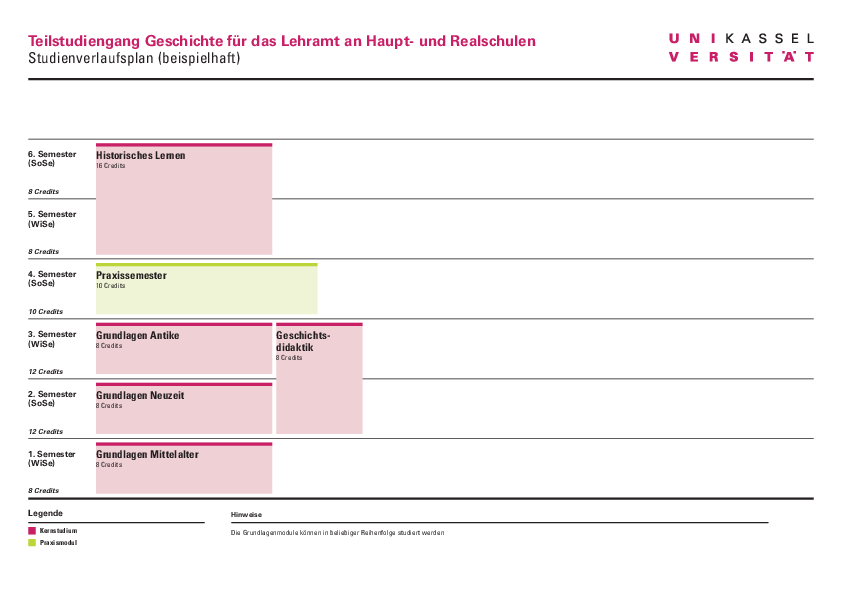
In the foundation modules, you will be familiarized with the most important epoch-specific reference works and collections of sources. Using specialist academic literature, you will become familiar with the main features of different forms and theories of historiography, such as structural and cultural history. In the application-oriented components of the module, you will practise the independent reproduction and correct citation of academic literature and historical sources and target-oriented bibliography. This will enable you to develop a historical question and to evaluate and critically question sources and literature with regard to this question.
Information on current courses in the foundation modules:

In Module 4, you will learn about fundamental questions and categories of history didactics such as "historical consciousness" and "historical culture". You will work with relevant didactic questions and categories using selected examples and develop the ability to (de)construct and criticize historical meanings. You will deal with current research controversies in historical science and didactics and reflect on the extent to which dealing with the past and its representations plays a role in lifeworld orientation. You will learn to question how history can be instrumentalized for current (political) perspectives.
In Module 5, you will deal in depth with epoch-specific and cross-epochal problems and reflect on the possibilities and limits of communicating historical knowledge. In this context, you will grasp the significance of history for the present and thus develop a deeper understanding of the continuity and discontinuity of historical processes and problems. You will use problem-oriented didactic and epoch-specific questions to expand your competence in the scientific examination of questions of historical learning and thinking. You will review, analyze and interpret relevant sources as well as subject-specific and subject-didactic research literature and develop the state of the academic research discussion on specific topics. Using specialized, epoch-specific and cross-epochal research problems, you will explore the conditions of past and present judgement formation.
The "practical semester" introduces you to school practice from a teacher's perspective. Through observation and theory, you will learn how to design, plan and implement your own lessons. You will get to know and practice selected methods. You will not only acquire teaching and educational skills, but will also be confronted with your own strengths and weaknesses, which you will reflect on and identify together with mentors and teaching staff. In addition, you will acquire the skills to recognize the learning processes and learning outcomes of students in their diversity. The process of "becoming a teacher" is at the center of the practical semester and takes place in interaction between theory and practice, which is why you will attend accompanying and flanking events in addition to participating in and conducting school lessons.
Information on current courses in module 6
Further information on the course of the practical semester
As part of this module, you will gain your first practical experience (Practical School Studies II) as a prospective teacher. During one semester, you will take part in two to three hours of history lessons at a school assigned to you. At the same time, you will attend an accompanying seminar in which you will reflect on your experiences and learn about the relevance of theory and practice. You will gain an insight into the complexity of lesson preparation and design, an insight into the possibilities and limitations of conveying historical knowledge and a deeper understanding of the interaction of academic, didactic and pedagogical aspects in the classroom. They will learn about the theory-based planning, design, implementation and evaluation of historical learning and will also deal with (self-)images with regard to the role of the teacher.
Practice and mobility
As part of your teacher training course, you must complete various internships, although the formats depend on the respective teacher training course. If you opt for an L2 course, you are currently taking part in the so-called "Praxissemester", a pilot project of the state of Hesse, and do not have to complete an orientation or company internship.
Further information on internships can be found on the websites of the Hessian Teachers' Academy and the Department for Practical School Studies at the University of Kassel
As part of your teacher training program, you have various opportunities to complete parts of your studies abroad. You can acquire organizational, personal and intercultural skills during an internship (orientation internship, work placement or practical school studies), a study visit abroad or as a foreign language assistant. You can also deepen the focus of your studies. There are numerous ways to go abroad: for example, you can take advantage of existing Erasmus+ cooperations of the History department or gain practical experience at schools abroad through the DAAD exchange service.
Notes on your academic achievements
The core course in education and social sciences is a compulsory subject for all teacher training courses at the University of Kassel, parallel to the chosen teaching subjects. It provides basic knowledge of childhood and youth, school and teaching and their development. It also addresses the overarching political, historical, cultural and philosophical aspects of teaching. The main aim of the core study program is to enable students to reflect and act in the pedagogical practice field of school and teaching. The core study program offers historical, pedagogical, political science, psychoanalytical, psychological and sociological approaches and reflections related to the activities of teachers.
You can find further information on the core study program here
The coursework to be completed in the teacher training program can "classically" consist of a presentation, thesis paper, a review, participation in student projects, group leadership, a written exam and similar. However, they can also include new audiovisual and digital formats such as podcasts, posters or blogs. As part of your practical school studies, you will also be given observation tasks and create observation protocols, lesson plans, your own teaching experiments, learning diaries and similar. Your examinations will primarily take the form of homework, practical reports and evaluations of lesson observations. However, creative performance assessments, such as the portfolio, are also used here to prepare you for your future work as a history teacher in a practice-oriented manner.
The standard period of study for the teaching degree at Hauptschulen and Realschulen (L2) is three and a half years, including an examination semester. It is completed with the First State Examination, the overall grade of which is made up of an academic paper as well as oral and written examinations. Admission to the First State Examination can be applied for if the required achievements, which are specified in the module examination regulations, are proven.
Further information can be found on the website of the Hessian Teachers' Academy.
Seminars offered by the chairs of "Didactics of History", "History of Great Britain and North America" and "History of Western Europe" are sometimes held in English or French, so that you can acquire and develop not only content-related but also language skills. This opens up the prospect of teaching bilingually in your future teaching career. In particular, you can participate in the interdisciplinary project BIKA (Bilingual Kassel) and acquire a corresponding certificate.
Sample study plan