How is the course structured?
This page contains automatically translated content.
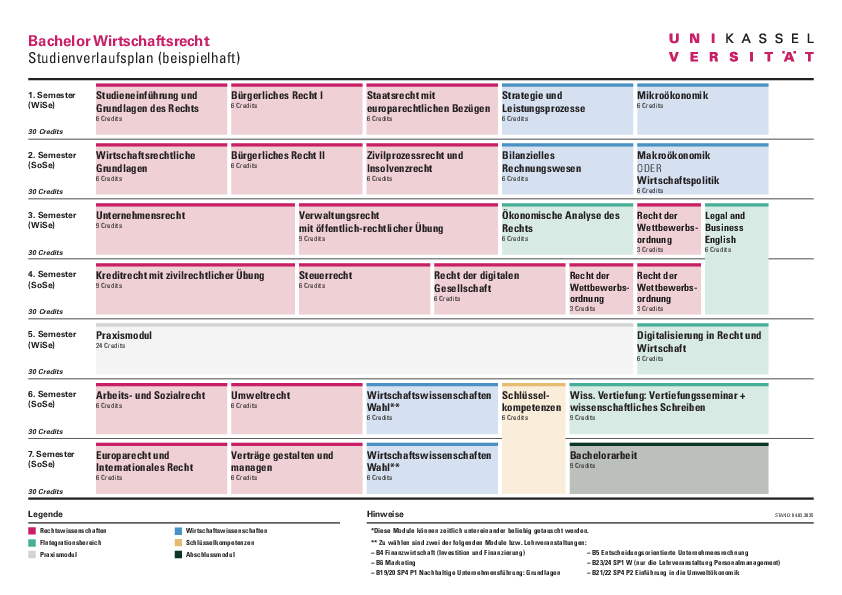
The standard period of study for the Bachelor's degree course in Economic Law is seven semesters. In the first three semesters, you will learn the basics of business law in the basic modules - for example, civil law, labor and social law, commercial and corporate law. At the same time, you will study the basics of business administration, economics and accounting in the economics courses.
You will learn interdisciplinary methods of scientific work and be trained in management techniques, mediation and procedural law. It is also important to have sound subject-specific foreign language skills: as part of the "Legal and Business English" module, you will familiarize yourself with English specialist terminology, and later you will deepen your use of it in the "International Aspects of Law" module.
The specialization phase lasts four semesters and concludes with the Bachelor's thesis. The seven profiles (Labor and Social Affairs, Environment, Law of the Digital Society, Taxation, Credit, Business and Competition and Economic Analysis of Law) in the specialization phase give you a broad range of knowledge. In addition, you will learn to analyze your own strengths and develop individual learning strategies as well as systematically develop your professional and personal skills. The twenty-week compulsory internship provides you with an initial intensive practical experience.
The content of the modules is taught according to international standards in the form of lectures, exercises, tutorials and seminars. The corresponding examinations consist of written examinations, oral examinations, presentations and assignments or a combination of these forms of examination.
(Kopie 2)
The Economic Law degree programme is designed according to a credit system. This is intended to ensure the compatibility of academic achievements in a national and international context. The credit system on which the degree program is based is based on the European Credit Transfer System (ECTS) and, like the ECTS, only measures the workload resulting from the completion of sub-components of the study program. The credit system cannot be used to assess the quality of completed coursework or module examinations. As with the ECTS program, approximately 30 credits per semester are assumed.
The academic degree "Bachelor of Laws" (LL.B.) is awarded for the first professionally qualifying degree. For this, students must have successfully completed all module examinations and the practical module and finally have passed the Bachelor's thesis. The module examinations consist of written examinations, oral examinations, presentations, term papers or a combination of these forms of examination, depending on the nature of the module in question and as determined by the respective examiners.
The basics of business law and economics are taught in the foundation course phase. The business law courses primarily cover private business law (civil law, labor and social law, commercial and corporate law, credit law and electronic commerce law). In addition, there is business administrative law with references to environmental law and a module on the fundamentals of law, which covers legal history and legal philosophy in particular. The economics courses cover the basics of business administration, economics and accounting.
The first three semesters also include courses dedicated to interdisciplinary qualifications. Here, students learn about the methodology of scientific work, management techniques, mediation and procedural law. Students also have the opportunity to choose foreign language courses (business English, business French).
The specialization phase comprises four semesters of study and concludes with the completion of the Bachelor's thesis. The seven profiles listed below are planned for the specialization phase, each of which contains a legal and economic module component, with the seventh, "Economic Analysis of Law", being an integration module.
- 1. labor and social affairs
- 2. environment
- 3. electronic legal transactions
- 4. taxes
- 5. credit
- 6. competition
- 7. economic analysis of law
The seven profiles must be completed equally by all students. It is therefore neither possible nor intended to specialize or focus on a particular field of study.
An essential element of the degree program in Economic Law at the University of Kassel is the practical module, which lasts 20 weeks and can be completed after the third semester. The practical work is intended to promote and help develop students' ability to successfully implement academic knowledge and methods in concrete practical situations, to contribute to the intensive integration of theory and practice in professional training and to provide an insight into the desired job profile. The practical module can be completed in public authorities, companies, tax consultants' offices, law firms or similar.
Duration and structure of the practical module
The Business Law degree programme generally requires a practical phase of 20 weeks in a practical field of business law. Students can choose whether to complete the practical module in one go or in various practical blocks, which can also take place during the lecture-free period. However, they can choose a maximum of three practical placements, whereby a practical block should not be less than six weeks. The practical module can also be completed during the semester break by splitting it into several practical blocks. The practical phase can also take place abroad.
The practical module can be completed at the earliest after the lecture period of the third semester and proof of the module examinations listed in Annex 1 of the Examination Regulations 2011 & Annex 1 of the Examination Regulations 2018 . It can also be completed during the lecture-free period.
Practical placement
The student is responsible for choosing a suitable practical placement; no assignment is made. At the student's request, the Examination Board will decide on the suitability of the internship site in good time before the start of the internship module on the basis of the internship regulations. The application must be submitted in writing to the Examination Board.
Aim of the internship
The aim of the internship is to establish a close connection between the theoretical training within the university and the professional practice of business lawyers. It is intended to introduce students to application-oriented activities. During their studies, students are given the opportunity to apply the knowledge and skills acquired in various disciplines to complex practical problems under supervision. Students should become familiar with various aspects of operational decision-making processes and their interaction during their studies and gain in-depth insights into the organizational, economic, legal and social contexts of business operations.
The practical work experience is intended to promote and help develop students' ability to successfully implement scientific knowledge and methods in concrete practical situations, to contribute to a more intensive integration of theory and practice in professional training and to provide an insight into the desired career profile.
Internships
...can be found in the JobPortal of the University of Kassel!
Internship regulations
The Bachelor's thesis can be issued after passing all module examinations in the sixth semester at the earliest or after completion of the module examinations specified in the examination regulations for the degree program in Economic Law and proof of at least 150 credits. This is intended to make it possible for the topic of the Bachelor's thesis to be completed during the course of study. The Bachelor's thesis, which is awarded nine credits, takes eight weeks to complete.
Information will be processed. If you have any questions about studying abroad, please contact the IWR student advisory service or have a look at the IWR forum.
Sample study plan