
Course structure until SoSe 2022
The content on this page was translated automatically.
After seven semesters, students on the Bachelor's degree course in Business and Economics receive their degree. In the first three semesters, they acquire basic knowledge of business administration and economics. Methodological foundations such as business mathematics, statistics and knowledge from related disciplines (e.g. law) complement their broad economic knowledge. These basic modules are carried out in the form of lectures, exercises and tutorials, in line with international standards.
In the specialization course, you can choose two of the five specializations for your specialization:
- Finance, Accounting, Controlling and Taxation
- Management and Marketing
- Business informatics, supply chain and innovation management
- Environment and Sustainability
- Economic Behavior and Governance.
Through the minor specialization, the elective modules and courses from the field of business psychology and business ethics, you will learn to look at economic issues from different perspectives.
In addition to the content-related training, your language and communication skills will also be strengthened through courses taught in English. Presentations and group work in seminars promote your organizational and presentation skills and prepare you optimally for your future career. The nine-week compulsory internship also builds on this, giving you an initial intensive practical experience in your chosen specialization.
You will complete your Bachelor's degree with the successful completion of your Bachelor's thesis and the associated colloquium (oral examination).
Study structure
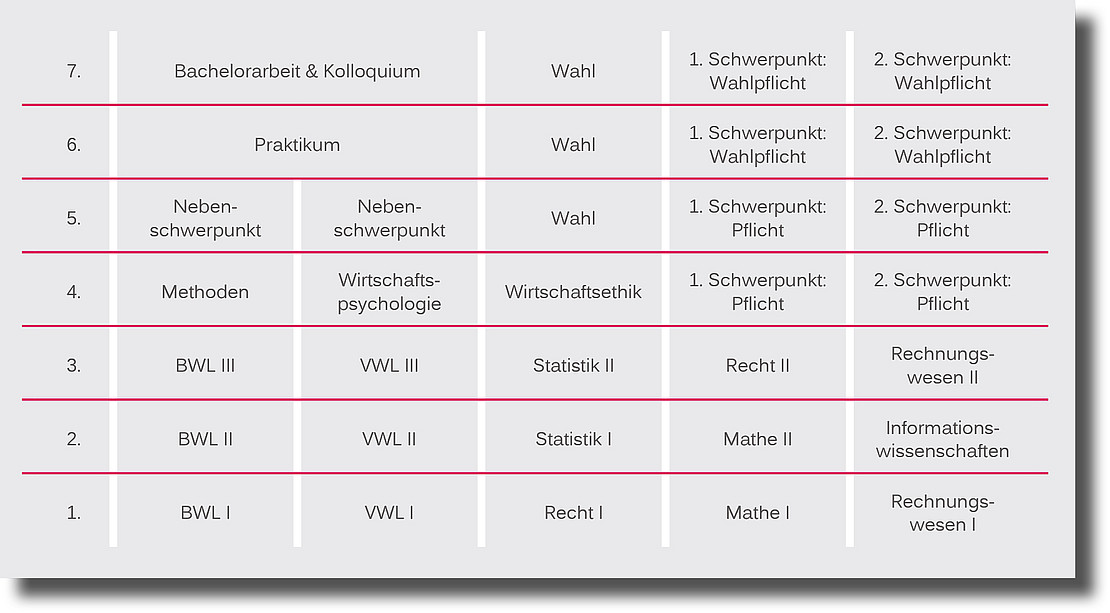
The Bachelor's degree initially consists of a three-semester compulsory program comprising 15 modules with a total of 90 credits, in which basic specialist and key skills are taught (foundation modules). The following modules must be completed as part of this program:
- 3 modules in business administration totaling 12 SWS
(BWL I, II and III with 6 cp each) - 3 modules in economics totaling 12 SWS
(VWL I, II and III with 6 cp each) - 2 modules in law totaling 8 SWS
(Law I and II with 6 cp each) - 2 modules in accounting totaling 8 SWS
(Accounting I and II with 6 cp each) - 2 modules in business mathematics totaling 8 SWS
(Math I and II with 6 cp each) - 2 modules in statistics totaling 8 SWS
(Statistics I and II with 6 cp each) - 1 module in Information Systems totaling 4 SWS
(Information Sciences I)
The courses of the basic modules usually take place with an attendance time of 4 SWS (semester hours per week = the hours that are offered per week in the subject over the current semester). In addition, tutorials of 2 SWS (occasionally also intensive tutorials of 4 SWS) are offered as support in the basic modules.
Assessment:
Each grade of a foundation module is included in the overall grade of the foundation modules to the same extent. The overall grade of the foundation modules is included in the final grade as an arithmetic mean of 20%.
The second study phase comprises a further four semesters (4th-7th semester) with a total workload of 120 credits. The specialization, which accounts for 60 credits of the second phase, provides a broad qualification profile in three subject categories. The specialization is supplemented by a practical module worth 12 credits. In addition, 18 credits must be earned in a further elective area, in the course of which interdisciplinary key skills are to be acquired and methodological and specialist knowledge can be expanded and individually supplemented. In the second study phase, particular emphasis is therefore placed on teaching key skills through interdisciplinary modules and deepening methodological skills.
In the specialization phase, students must choose three areas of specialization and maintain these throughout their studies. Two major fields of study (each worth 24 credits) and one minor field of study (worth 12 credits) must be taken. Two compulsory modules (each worth 6 credits) and one compulsory elective module (worth 12 credits) must be successfully completed in each of the chosen major fields of study. A compulsory elective module worth 12 credits must be completed in the chosen minor specialization.
The three specializations are chosen from the following range, whereby specialization 5 must be chosen as (one) major or minor specialization:
- SP 1 Finance, Accounting, Controlling and Taxation
- SP 2 Management and Marketing
- SP 3 Business Informatics, Supply Chain and Innovation Management
- SP 4 Environment and Sustainability
- SP 5 Economic Behavior and Governance
Specialization achievements:
a) Examinations
- 2 compulsory modules in the first chosen major field of study
(a total of 2 x 4 SWS = 2 x 6 credits) - 2 compulsory modules in the second chosen major field of study
(total of 2 x 4 SWS = 2 x 6 credits) - 1 compulsory elective module in the first chosen major field of study
(total of 8 SWS = 12 credits) - 1 compulsory elective module in the second chosen major field of study
(total of 8 SWS = 12 credits) - 1 compulsory elective module in the selected minor field of study
(total of 8 SWS = 12 credits) - 1 module Methods
(total of 4 SWS = 6 credits) - 1 module Business Ethics
(total of 4 SWS = 6 credits) - 1 Business Psychology module
(total of 4 SWS = 6 credits)
b) Study achievements (i.e. achievements that are not included in the final grade)
- 1 elective module, in particular for acquiring interdisciplinary skills (total of 12 SWS = 18 credits, whereby at least 6 credits must be earned in interdisciplinary key competencies)
Assessment:
To calculate the overall grade of the advanced modules, an arithmetic mean of the examination results is calculated, whereby the grade of each individual examination result is weighted with the credits awarded for this result. The overall grade of the advanced modules is included in the final grade as an arithmetic mean of 60%.
A total of 18 CP must be earned as part of module B23. These are made up of 12 CP in the elective area and 6 CP in the area of key competencies. The 12 CP in the elective area can be achieved through all Bachelor's courses at the University of Kassel. The 6 CP in the area of key competencies are to be achieved through modules with interdisciplinary content and opportunities to acquire key competencies. This means that the key competencies must be acquired in modules that are NOT related to economics in terms of their subject focus. The framework requirements for key competencies can be used as a guide.
An exemplary list of possible key competencies can be found here.
For the recognition of modules completed at other universities, the recommendations of the respective subject examiners and the examination board are decisive, whereby the examination board decides on the formal recognition. The responsibilities of the subject examiners for the individual modules are as follows.
Modules | Subject examiners |
Business administration modules | Eberl |
Accounting 1 and 2 | Motzko |
Economics modules | Frank |
Modules with methodological content | Voßkamp |
Modules in business informatics | Leimeister |
Law modules | Kuhn |
Elective modules and additional services | Bischoff |
Modules in the area of additive | Frank |
For recognition, the form for the "Recommendation for recognition of an externally completed course" must be completed separately in duplicate for each course to be recognized. A description of the work to be recognized must also be enclosed for recognition. Further information can be found in the information sheet on the recognition of work completed abroad.
- At least one module or partial module examination in the form of a seminar must be completed as part of the modules in semesters 4 to 7. A seminar is characterized in particular by active participation in discussion and the type of examination, i.e. a presentation with a written paper.
- At least 6 CP of the basic and advanced modules must be completed in English. If specialization 5 is chosen as the main focus, 12 CP must be completed in English.
- A maximum of one module or partial module examination from modules B16 - B22 can be subsequently transferred to module B23. A reverse transfer is not possible.
The practical module comprises subject-related internships totaling 360 hours of full-time work and a practical report. The internships can be completed in up to 2 parts in different organizations. However, each of the two parts must last at least one month. The internship module comprises 12 credits.
Subject-related internships or completed apprenticeships (vocational training) can be recognized upon application with up to 180 hours. At least 3 years of professional experience in a prominent or managerial position can be recognized upon application with up to 360 hours. In this case, the practical report must still be prepared.
The practical report is reviewed by the supervisor and assessed as "passed" or "failed".
Assessment:
The practical module is not included in the final grade, but is a prerequisite for obtaining the Bachelor's degree.
- The Bachelor's thesis and the oral colloquium totaling 12 credits form the final module.
- The Bachelor's thesis can be started at the earliest after completion of all 15 foundation modules and proof of 150 credits.
- The topic is assigned in the 5th semester at the earliest. The processing time is 8 weeks from the date of notification.
- The submission deadline can be extended by a maximum of 4 weeks.
- The thesis must be submitted to the examination board in two bound written copies and one electronic copy.
- The thesis can be written in English or another language by arrangement.
- The Bachelor's thesis must be presented and defended in a colloquium. The colloquium should take place no later than 10 weeks after submission. The candidate is admitted if the written Bachelor's thesis has been assessed as at least "sufficient". The duration of the colloquium is 30 to a maximum of 60 minutes. A colloquium assessed as "insufficient" can only be repeated once. The final module is deemed to have been passed if both parts have been assessed as at least "sufficient".
Assessment:
The result of the Bachelor's thesis accounts for 75% and the result of the colloquium for 25% of the final module grade. The overall grade of the final module accounts for 20% of the final grade.
The growing internationalization of the professional field of economists is taken into account by the Economics course at the University of Kassel through a variety of opportunities to complete parts of the course abroad. The Department of Economics maintains more than 40 Erasmus partnerships in 18 countries of the European Union. A semester or a whole year abroad must be planned carefully and for the long term. There are various ways to study abroad.
- Free Mover = University abroad of your choice independent of the relationship with the University of Kassel.
(possibilities of cooperation, funding and recognition of achievements may be omitted) - Partner university abroad
(depending on the relationship with the University of Kassel, benefits and funding are made possible; an example would be a partner university outside the department). - University cooperation abroad
(the partnership agreement usually means that tuition fees are waived; an example is the exchange program in the USA with Wisconsin and Maryland). - Erasmus program, guaranteed ECTS participation and waiver of tuition fees. The Erasmus program in particular offers students a stay abroad with decisive advantages:
- Study at a partner university, no tuition fees
- ECTS participants, European Credit Transfer System enables credits to be recognized abroad,
- one semester or two semester-long stays,
- existing cooperations offer existing experience and opportunities (e.g. housing market),
- In addition, it is possible to take a leave of absence during the semester abroad (the stay abroad has no disadvantage for the period of study, i.e. the number of semesters is stopped during the leave of absence)
Depending on the country and language, different departmental coordinators (Erasmus coordinators) are available as contact persons:
- English-speaking: Prof. Dr. Bischoff
Numerous other offers are available independently of the department at the International Office. This is the first point of contact to get an overview of different countries, universities and programs: International Office -Study and internship abroad
For further information on cooperation with the Department of Economics, please contact Erasmus Coordinator Prof. Dr. Ivo Bischoff.