
AI and testing
The content on this page was translated automatically.
 Image: Created with Canva AI
AI can support you in the creation and assessment of exams, for example, or even be part of your teaching and learning objectives and therefore relevant to exams.
The following questions can be helpful impulses for reflecting on the possibilities of using AI in your examinations:
- What regulations are in place at my institution regarding the use of AI tools in examinations and coursework?
- For which learning objectives of my course is it sensible and permitted to allow the use of AI tools and where should it not be permitted?
- Where do I want to and can I make the use of AI tools mandatory for an examination/study achievement? If this is possible from an institutional perspective, do all students have equal access to the AI tool(s) I want to make mandatory and, if applicable, to training on these AI tools?
- Do I want my students to use AI tools
- for brainstorming,
- for formulating a research question.
- for research work,
- for text generation,
- for creating an outline, structuring,
- for content revision & feedback,
- as a tool for creating an image, video or other digital artwork?
Testing under uncontrolled conditions
For examination performance under uncontrolled conditions, such as term papers, practical or artistic work, it must be determined whether and which AI tools may be used for the examination or coursework and how the use should be documented.
With regard to term papers, for example, there is much to be said for the position that "Written statements are now the results of co-creative collaboration with AI tools". (Weßels, 2022)
 Image: Created with Canva AI
Adapt declarations of independence
You decide on the use of AI tools in accordance with the applicable examination regulations. This results in the need to adapt the declaration of independence that your students submit together with the examination or coursework.
The three most common cases are
Basic idea:
Students are allowed to use AI systems to create their examination, document their approach and describe the knowledge gained in the process. For example, students should compare the quality of the output of AI tools with conventional literature or with the output of specialist databases.
For this purpose, it is necessary to define the permitted tools in advance, i.e:
- All tools are allowed. [or]
- Restricted, explicit list of tools that may be used, all others are not permitted. [or]
- Explicit list of prohibited tools. All other tools are permitted. Legal recommendation: Option three is problematic, as teachers may not know all the tools: Development is so fast that a complete overview is hardly possible.
Declaration of independence:
"I have only used the permitted and documented tools. I assure you that the labeling of the AI use is complete and I have listed the AI tools used with their product names in the "Overview of tools used" directory.
In the appendix I have
- listed the prompts I used, [or]
- listed all AI-generated outputs individually [e.g. links to prompt histories], [or]
- documented the use of the AI tools [see example on the following page],
that were relevant to the task."
Example documentation of the use of AI tools:
| AI tool | Used for | Why | When |
|---|---|---|---|
| Elicit | Find an introduction to the topic | Find relevant papers for my research question | First literature search |
| DeepL | Translation of abstracts of English-language articles | Deciding which articles I want to use | in the literature review and selection |
| ChatGPT | Have concept XY explained | Clarification of comprehension questions about... | when working on the theoretical part of my term paper |
Source: dghd - Suggestions for declarations of independence for the possible use of AI tools
Basic idea:
The basic technical, writing and tool skills of the students are already present in this scenario. The work is assessed as a result of the use of different methods and independent thinking.
Declaration of independence:
"I have only used the permitted and documented tools. I am fully responsible for the selection, adoption and all results of the AI-generated output I used. In the list "Overview of tools used" I have named all AI tools used with their product name [and as required by the teacher] and in the appendix the prompts I used in my work.
- the prompts I used in the work.
[and/or] - all AI-generated outputs used in the work are listed individually [e.g. links to prompt histories]."
Sample documentation of the use of AI tools incl. prompts used:
| AI tool | Used for | Why | When | Prompts used |
|---|---|---|---|---|
| Elicit | Find an introduction to the topic | Find relevant papers for my research question | First literature search | Complete documentation of the process incl. report or link to the review |
| DeepL | Translation of abstracts of English-language articles | Deciding which articles I would like to use | during the literature review and selection | Original text, selected language, outcome |
| ChatGPT | Have concept XY explained | Clarification of comprehension questions about... | when working on the theory part of my term paper | Complete documentation of the prompt process or link to prompt process |
| Sora 2 | Generating short video clips from text prompts | Part of the task | Ongoing in the process | Complete documentation of the prompt history or link to prompt history |
Basic idea:
Do not initially allow AI tools and emphasize the importance of professionally verified and relevant sources.
Declaration of independence:
"I have not used any outputs from [text, image, or code-generating] AI tools in the elaboration."
Testing under controlled conditions
Examinations under controlled conditions
are, for example
- oral examinations,
- practical examinations,
- paper-based written examinations or
- e-exams in the e-assessment center.
AI tools are deactivated by default in the e-assessment center of the Teaching Service Center. We are currently working on ways to allow the controlled use of AI and to document its use by students in a legally secure manner. If you are interested in developing and testing this together with us, please contact us: www.uni-kassel.de/go/scl
Assessing term papers
Your AI assistant can analyze the structure of the paper, the correctness of the content or the use of scientific language, for example, according to predefined criteria and provide suggestions for feedback. The results serve as a suggestion and must always be critically scrutinized by you. The final decision lies with you as the examiner.
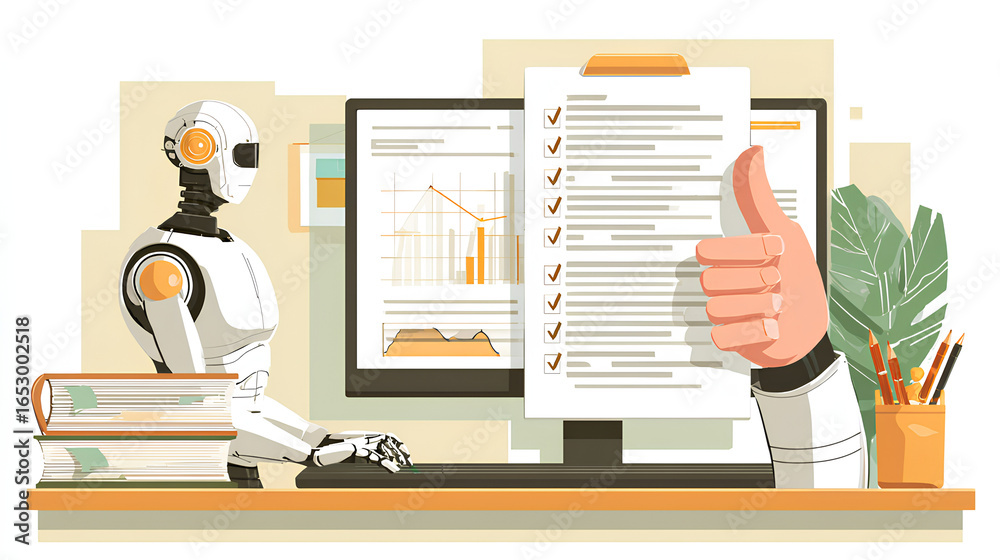 Image: Adobe Stock
Preparation for oral examinations in the role of examiner or examinee
Students can use a digital avatar to prepare for an oral examination.
As an examiner, you receive a good basis for reflection on your own exam behavior.
 Image: Created with Canva AI