Study structure
The content on this page was translated automatically.
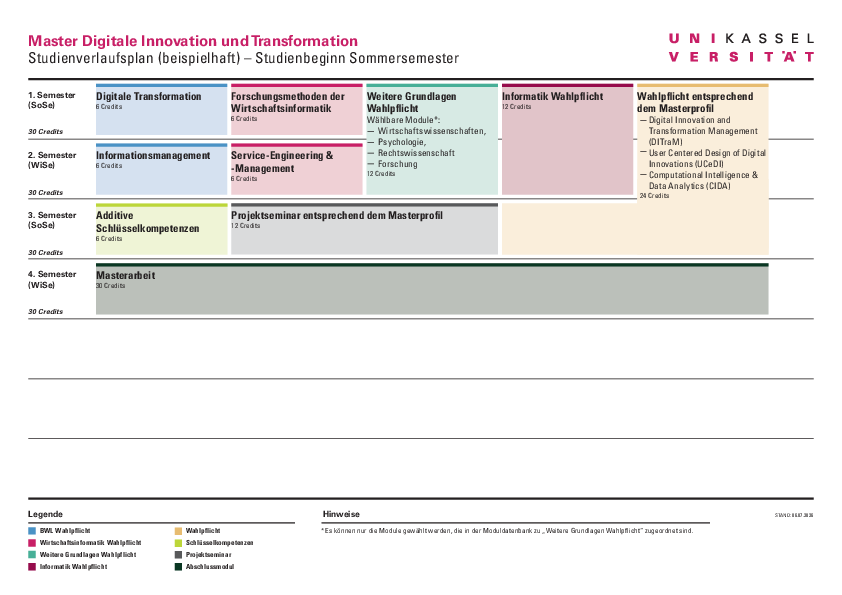
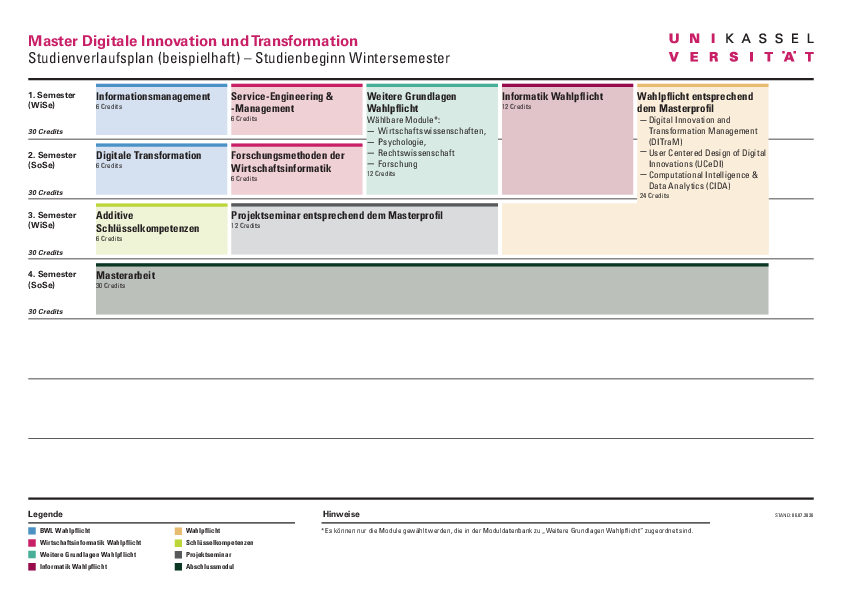
This is how your studies at the University of Kassel are structured:
At the beginning of the degree program, students must complete compulsory modules in the fields of business informatics, business administration and computer science, each worth 12 credits. These serve to deepen your basic knowledge.
In addition, you will choose various foundation courses from a wide range of subjects offered by the University of Kassel for 12 credits. This includes content from the fields of statistics and mathematics, ethics and sustainability, behavioral science fundamentals and legal framework conditions. This means that your Master's degree can be individually designed and its content accentuated. In addition, a key skills module (6 credits) promotes interdisciplinary skills such as teamwork, presentation techniques and time management.
A central component of the Digital Innovation and Transformation degree program at the University of Kassel is the choice of a Master's profile, which defines the personal focus of study. Within this profile, 24 credits must be earned. It must be ensured that there is no overlap in content with the basic or compulsory elective modules already selected. A project-oriented seminar (12 credits), in which you work on an application-oriented task in groups, completes your profile.
The following Master's profiles are offered:
- User Centered Design of Digital Innovations (Business Informatics): This profile focuses on the user-centered design of digital technologies and systems. Students acquire in-depth knowledge of human-machine interaction, information systems and practice-oriented research into the design of innovative applications.
- Digital Innovation and Transformation Management (Business Administration): The profile prepares students for the management of digital innovation and transformation processes. The focus is on project management, business model development, digitalization in business areas and the social impact of digitalization.
- Computational Intelligence & Data Analytics (Computer Science): This profile focuses on data-driven methods of artificial intelligence and machine learning. Students learn to analyze large amounts of data, develop intelligent systems and support data-based decision-making processes.
The course concludes with the completion of the Master's thesis (30 credits), which combines the knowledge acquired in an independent research project.
The study areas of the Digital Innovation and Transformation degree program in detail:
As part of your Master's degree, you will acquire in-depth knowledge in the three central disciplines of the course: business informatics, business administration and computer science. These form the professional basis for the focus of your studies.
You will develop knowledge in the following areas, among others:
- The business informatics foundation modules teach central concepts and methods for the design of digital services and the scientific analysis of digital systems.
- The business fundamentals strengthen your understanding of strategic and organizational aspects of digital transformation.
- In computer science, you can choose from a wide range of modules from artificial intelligence to software development and network technologies.
These foundation courses enable you to deepen your technical skills individually and dovetail them with your future Master's profile.
Compulsory modules in Information Systems (12 credits):
- WI-P1: Service Engineering & Management (1st semester)
- WI-P2: Research Methods in Information Systems (2nd semester)
Compulsory modules in Business Administration (12 credits):
- BWL-P1: Digital Transformation (1st semester)
- Business Administration-P2: Information Management (2nd semester)
Compulsory elective modules in Computer Science (12 credits):
You can choose different courses. Please note that there is no overlap with the Master's profile "Computational Intelligence and Data Analytics".
- WAHL-1: Pattern Recognition and Machine Learning I
- WAHL-2: Pattern Recognition and Machine Learning II
- WAHL-3: Innovating Smart Things for the Home
- WAHL-4: Laboratory Deep Learning
- WAHL-5: Internet Measurements
- WAHL-6: Temporal and Spatial Data Mining
- WAHL-7: Agent-Based Modeling Lab
- WAHL-8: Begriffliche Datenanalyse / Conceptual Data Analysis
- WAHL-9: Experimentation and Evaluation in Machine Learning
- WAHL-10: Functional Programming
- WAHL-11: Lab Grand Challenges of Machine Learning
- WAHL-12: Intelligent Robots Lab
- WAHL-13: Networks Lab
- WAHL-14: Qualitative Data Analysis Lab
- WAHL-15: Parallel Algorithms
- WAHL-16: Parallel Programming
- WAHL-17: Software Verification
- WAHL-18: Software Quality
- WAHL-19: Soziale Netzwerkanalyse / Social Network Analysis
The current module handbook provides information about valid offers.
The Master's profile User Centered Design of Digital Innovations is aimed at students who want to analyze, design and evaluate digital systems specifically from the perspective of their users. The focus is on the user-centered development of digital innovations that combine technological feasibility with practical applicability and social relevance.
The Master's profile corresponds in particular to the teaching content of business informatics, but is also supplemented by courses from computer science and business administration. As part of the profile, you will acquire knowledge in the conception and evaluation of information systems, learn the basics of human-machine interaction and methods for designing intelligent systems. You will also deal with trends in information systems, project work and current topics such as the integration of generative AI in design processes or the development of scalable digital business models.
The combination of theoretical foundation and application prepares you to systematically and purposefully design digital innovations. The Master's profile is particularly suitable for students who want to develop an interdisciplinary perspective on technology, user orientation and digital value creation.
Compulsory elective modules:
- WAHL-3: Innovating Smart Things for the Home
- WAHL-39: Introduction to project work
- WAHL-41: Human-Machine Systems 1
- WAHL-41: Master's thesis preparation seminar, business informatics and system development
- WAHL-42: Assistance systems
- WAHL-43: Information Systems
- WAHL-44: Human-Machine Systems 2
- WAHL-45: Practical course in human-machine interaction
- WAHL-46: Seminar Automation
- WAHL-47: Research under supervision on selected topics in business informatics
- WAHL-58: Applied Research
- WAHL-59: Prompt Engineering: Innovation Through Generative AI
- WAHL-60: Founding scalable digital companies (B2B)
The current module handbook provides information about valid offers.
The Master's profile in Digital Innovation and Transformation Management is aimed at students who want to strategically shape and manage digital transformation processes in companies. The focus is on the systematic examination of the management of digital innovations as well as the organizational, technological and social prerequisites for their successful implementation.
The Master's profile corresponds in particular to the teaching content of business administration, but is also supplemented by courses from business informatics and computer science. As part of the profile, you will acquire in-depth knowledge in central management areas such as project, innovation and business model management. Topics such as Business Model Innovation, Strategic Project Management or Customer Experience Management illustrate the interdisciplinary orientation of the profile. The programme is complemented by modules on digitalization in production and logistics, the ethical and social implications of digitalization and data-based decision support systems.
Special attention is paid to the analysis and design of complex change processes in digital contexts. Research methods, case studies and practice-oriented seminars prepare students for demanding roles in management, consulting or research. The profile is ideal for students who want to develop sound analytical, creative and strategic skills for the digital transformation of business and society.
Compulsory elective modules:
- WAHL-20: Decision support tools in sustainability management
- WAHL-21: Project management 1: Introduction and basics
- WAHL-22: Project management 2: Digital change through projects
- WAHL-23: Strategic Project Management
- WAHL-24: Management of Interorganizational Relationships
- WAHL-25: Cases and Debates in Project Management and Transformation
- WAHL-26: Research Seminar: Project Management in the Digital Transformation
- WAHL-27: Research Methods and Analytics in Project Studies
- WAHL-28: Selected Topics on Digitalization in Production and Logistics
- WAHL-29: Business Model Innovation
- WAHL-30: Computing & Society
- WAHL-31: Selected topics in technology and innovation management and entrepreneurship
- WAHL-32: Customer Experience Management
- WAHL-33: Marketing Intelligence
- WAHL-34: Digital Business
- WAHL-35: Cases of Digital Transformation
- WAHL-36: Machine Learning in the Context of Digital Transformation
- CHOICE-37: Social and Ethical Implications of Digitalization
- WAHL-38: Selected Issues of Digital Transformation
- WAHL-56: Software and Internet Economics
- WAHL-57: Advanced Supply Chain Management
The current module handbook provides information about valid offers.
The Master's profile in Computational Intelligence & Data Analytics offers in-depth training in data-driven analysis methods and intelligent systems. It is aimed at students who want to develop a sound understanding of modern methods of machine learning, data analysis and artificial intelligence and apply them in practice.
The Master's profile corresponds in particular to the teaching content of computer science, but can also be supplemented by content from business informatics and business administration by the lecturers. The focus is on theoretical and application-oriented approaches to the analysis of structured and unstructured data. Modules such as Pattern Recognition and Machine Learning, Conceptual Data Analysis and Social Network Analysis teach basic and advanced concepts of data-based decision support. The Master's profile is complemented by practice-oriented laboratory courses on deep learning, intelligent robots, networks and qualitative data analysis. You will also deal with methodical modeling, experimental evaluation and interdisciplinary challenges of intelligent systems.
The Master's profile qualifies you for challenging activities in data-driven areas of business, science and public administration. In particular, it prepares you for roles in the research, development and application of analytical systems and provides you with the technical skills to responsibly shape data-based innovations.
- Compulsory elective modules:
- WAHL-1: Pattern Recognition and Machine Learning I
- WAHL-2: Pattern Recognition and Machine Learning II
- WAHL-4: Laboratory Deep Learning
- WAHL-8: Begriffliche Datenanalyse / Conceptual Data Analysis
- WAHL-9: Experimentation and Evaluation in Machine Learning
- WAHL-11: Lab Grand Challenges of Machine Learning
- WAHL-12: Intelligent Robots Lab
- WAHL-13: Lab Networks
- WAHL-14: Qualitative Data Analysis Lab
- WAHL-19: Soziale Netzwerkanalyse / Social Network Analysis
The current module handbook provides information about valid offers.
As an expert:in digital transformation, you must be able to work in an interdisciplinary manner. This is why you will also learn other basic principles, e.g. from law, during your studies. A total of 12 credits must be earned.
Compulsory elective modules:
- WAHL-48: Legal foundations for business informatics
- WAHL-49: Introduction to Behavioral Economics
- WAHL-50: Environmental Economics
- WAHL-51: Leadership & Change Management
- WAHL-52: Environmental Psychology
- WAHL-53: Sustainable Corporate Management: Fundamentals
- WAHL-54: Work and Organizational Psychology 1
- WAHL-55: Work and Organizational Psychology 2
- WAHL-58: Applied Research
The current module handbook provides information on valid courses.
In the project seminar, you will apply the knowledge you have acquired during your studies to a practical issue in the context of digital innovation and transformation. Collaboration with corporate partners provides you with in-depth insights into real challenges in digital practice.
As part of the seminar, basic skills in scientific work are deepened. These include the development of a research question, the design of a suitable research model and the preparation and implementation of an empirical study. The results are documented in a scientific report. The project seminar thus combines theoretical knowledge with practical application and prepares students specifically for challenging tasks in the digital professional world.
In the "Key Competencies" module, you will acquire key skills for a successful entry into professional life and for independent further development in a professional context. A total of 6 credits must be earned. The focus is on skills in the areas of communication, organization, methodology and interdisciplinary research.
Due to the wide range of requirements in the digital working world, the module has a flexible structure. You can choose from a wide range of courses that cover different learning formats and content and thus take individual interests and professional objectives into account. These include
- Achievements that are considered additive key competencies according to the University of Kassel's framework.
- Student engagement in accordance with the above-mentioned framework.
- Language courses.
- Achievements from courses from all Master's degree programs at the University of Kassel and other universities in Germany, provided they do not focus on content from the Digital Innovation and Transformation degree program.
- Credit from courses completed as part of a study abroad program. Courses that do not differ significantly in content from courses that the student has completed in other modules may not be credited.
In the Master's thesis, you will deal independently with an economic issue and apply the knowledge you have acquired during your studies to a practical topic. The results of the thesis are either presented in an accompanying seminar or defended in the final colloquium. A total of 30 credits are awarded for the Master's degree module.
The processing time is 24 weeks. Topics can be assigned as soon as at least 84 credits have been successfully completed during the course of study.
Current calls for theses are published on the websites of the departments at the University of Kassel. Your own topic suggestions can be coordinated directly with the respective departments.
Sample study plan