
Study structure
This page contains automatically translated content.
Course content at a glance
Sample study plan
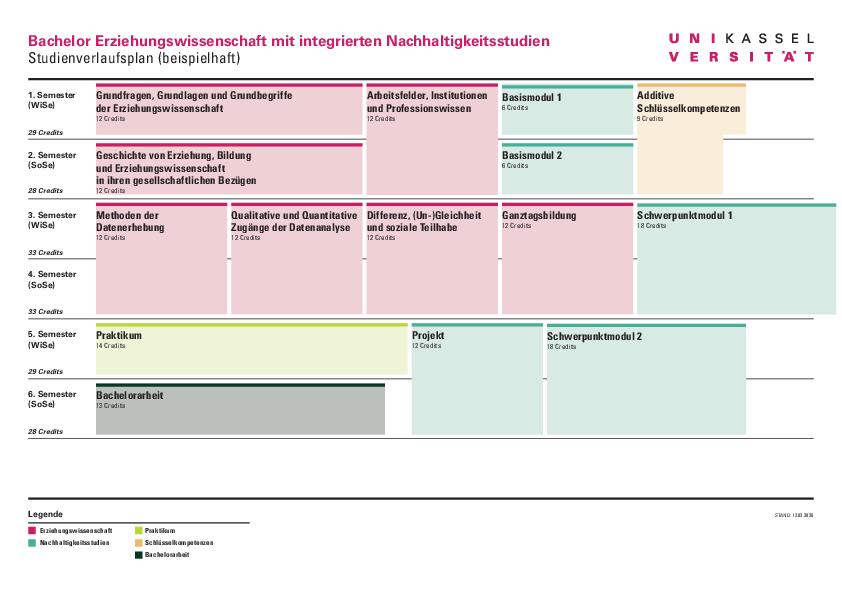
In addition to the diagram shown above, an interactive view of the curriculum is available in the University of Kassel's module database.
Download
Educational science modules
Basic questions, fundamentals and basic concepts of educational science
This module introduces you to the central questions and concepts of educational science. You will receive an introduction to:
- basic theories and concepts of upbringing, education, socialization, teaching and learning,
- educational science approaches in the context of social power relations and transformations,
- scientific theoretical approaches and methods of scientific work,
- the connection between educational science concepts and questions of sustainability.
History of upbringing, education and educational science in their social context
This module introduces you to historical educational research and examines upbringing and education in their historical development. You will deal with:
- Continuity and change in education and upbringing from the perspective of the history of ideas, social history and cultural history,
- the history of the education system, youth cultures and social movements as well as marginalized groups,
- the history of educational science as a discipline and its transnational references,
- social orders and inequality relations in the context of their historical development.
Methods of data collection
This module teaches the basics of social science methodology and the connection between theory and empiricism. You will:
- become familiar with qualitative and quantitative data collection methods, research procedures and sampling strategies,
- learn to formulate research questions and hypotheses and weigh up different research designs against each other,
- systematically plan your own empirical research and carry it out appropriately,
- reflect on research ethical challenges and measures to ensure high data quality.
Qualitative and quantitative approaches to data analysis
This module provides an in-depth look at the analysis of research data using qualitative and quantitative methods. You will learn
- apply qualitative approaches to data analysis and their scientific-theoretical and methodological foundations,
- apply methods of descriptive statistics and inferential statistics and interpret their results,
- explain and differentiate between qualitative and quantitative approaches and their fields of application.
The internship module serves as career orientation and provides a systematic insight into professional practice. The internship is completed in a practical institution in Germany or abroad or as a research internship. You develop the ability to
- Formulate expectations of the field of practice and reflect on your own experience aspirations,
- reflect on your own professional activities in a theory-based manner,
- describe specific requirements and challenges and link them to academic discourse,
- relate educational science experiences to topics in sustainability studies.
The Additive Key Competencies module promotes interdisciplinary skills in three areas:
- Communication competence: ability to deal with conflict and criticism, self-reflection, empathy and teamwork skills, intercultural awareness and foreign language skills,
- Organizational skills: self-management, time management, stress management, project management, institutional and administrative skills,
- Methodological competence: text work techniques, presentation techniques, literature research, academic writing and argumentation.
- In addition, there is the opportunity to take on responsibility in tutorials, first semester orientation, student advisory services or the student bodies.
The Bachelor's degree module forms the academic conclusion of the degree program. You work independently on an educational research question and present your results in the Bachelor's degree colloquium. In doing so, you show that you:
- can work independently on a relevant question within a set deadline,
- take critical note of key literature, present it appropriately and relate it to one another,
- can justify and apply suitable methods for dealing with the topic in a theory-based manner.
Sustainability modules
The basic modules teach fundamental theoretical and methodological knowledge about sustainability. You will receive an introduction to:
- central terms, theories and concepts of sustainability science,
- basic methods of interdisciplinary and transdisciplinary sustainability research,
- social conflicts and legal disputes in the field of sustainability,
- the connection between sustainability and transformation processes.
- Students will also learn the techniques of scientific work.
Students can choose two specializations from a total of 31.
Two focus modules that show you how differently sustainability can be thought of and shaped - technically, socially, scientifically, legally, creatively or politically.
Whether it's urban planning, biodiversity, climate change, digitalization or issues of justice: you decide for yourself which topics are important to you. This will give you well-founded professional insights and teach you to understand complex challenges from different perspectives and actively help shape them.
Discover over 30 exciting focus areas - and find your own approach to sustainable transformation. We recommend that you click on some of the focus areas to get a better idea of them.
- Human scientific prerequisites for sustainable development
- Human-nature relationships (philosophy)
- Sustainability communication and social participation
- Sustainability communication in crisis discourses
- Sustainability communication on cultural norms and values
- Genesis and structures: sustainability concepts and nature relations
- Processes and consequences: Diversity, globalization and solidarity
- Actors and practices of socio-ecological transformations
- Sustainable, energy-efficient buildings
- The green, climate-friendly city
- Socially just urban development
- Biological principles of sustainability - molecular biology
- Biological principles of sustainability - ecology & botany
- Mathematics for SDG considerations
- Sustainability in chemical-physical applications
- Ecological agricultural systems
- Organic agriculture and society
- Mobility and transportation
- Water management
- Sustainable material cycles and product life cycles
- Environmental economics
- Sustainability management
- Environmental sustainability law
- Social sustainability law
- Sustainability studies on electrical energy technology
- Computer science: people and society
- Artificial intelligence and data science
- Computer Science: Safety and Reliability
- Critical Sustainability in Art and Design
- Transformative project management
- Sustainability discourses and fields of action
The practice-oriented project module allows you to apply the knowledge you have learned in interdisciplinary teams. You will work on sustainability-related issues and develop solutions for current challenges of socio-ecological transformation. You will learn
- interdisciplinary project work and methods of sustainability research,
- develop practical solutions for real-world problems,
- get to know career prospects in the field of sustainability.
- In addition, students present the project results to specialist groups and the public.
