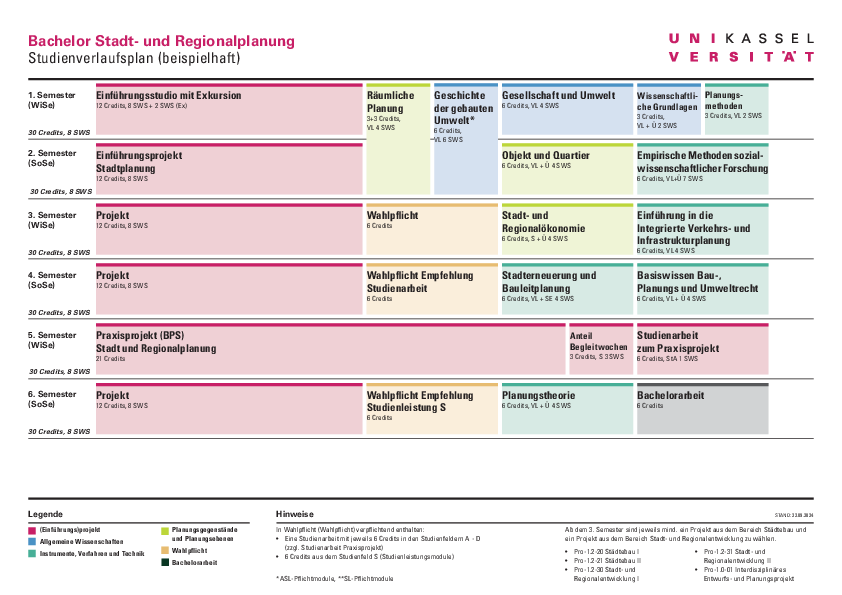
Study structure
This page contains automatically translated content.
The Urban and Regional Planning degree course in Faculty 06 I ASL is interdisciplinary and linked to the two faculty degree courses in Architecture and Landscape Planning & Landscape Architecture, thus creating a basis for interdisciplinary thinking and action. This meets today's requirements for the profession, which is characterized by broadly diversified, interdisciplinary and constantly changing tasks.
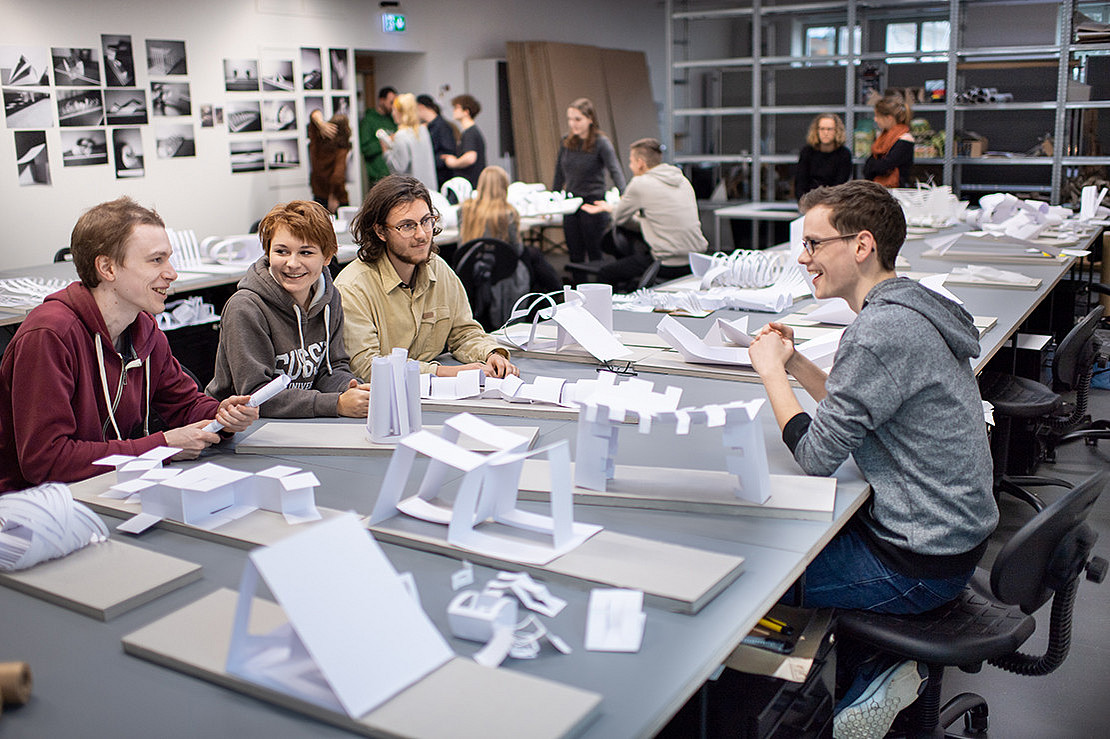

Basic skills are learned that are a prerequisite for planning and designing:
understanding spatial thinking and causal relationships,
the design of spaces and processes,
the use of technical and communicative instruments, whether by hand, computer or model making
as well as the successful presentation of their own work.
The introductory studios and project modules teach essential key skills:
- the ability to work in a team and manage time,
- the ability to work conceptually, creatively and scientifically,
- communication, integration and presentation skills
At the same time, a broad, ASL-spanning basic education in the four fields of study takes place:
- General sciences
- Fine arts, design and performance
- Instruments, processes and technology
- Planning objects and planning levels
Fundamental subject-specific knowledge in the two areas of urban and regional planning required in professional practice is built up continuously:
- the planning-conceptual and planning-scientific orientation of the planning (urban and regional development)
- the design-related, creative orientation (urban development)
While the theoretical-systematic courses offered in the first three semesters of study are predominantly compulsory, an increased proportion of compulsory elective modules after the third semester of the Bachelor's degree makes it possible to specify the course content with individually chosen areas of interest.
The interdisciplinary introductory studio in the first semester serves as an introduction to the basics and diversity of planning and design. The studio work focuses on conceptual and creative thinking, design and presentation as well as communication within the team and with the outside world.
The aim of the introduction is to teach the common content-related basics and initial methodological knowledge - such as perspective drawing or the basics of computer work in CAD or layout programs - for the three disciplines of architecture, urban planning and landscape planning.
The introductory project in the 2nd semester expands the skills learned on the basis of a subject-related task with comparatively simple structural-spatial or conceptual contexts.
In the 3rd-6th semester, project modules are offered in the compulsory elective area, which combine the learning objective of design and planning skills with various subject-related focal points.
A practical project module with accompanying seminars is integrated into the 5th semester of the Bachelor's degree course, which serves to combine theory and practice and a personal analysis of strengths and weaknesses. It is organized and supervised by the department. In this module, students get to know the demands of practice by working in an office and can make valuable contacts for the time after graduation.
At this point, students have the experience and knowledge gained during four semesters of study at their disposal and can therefore also be entrusted with independent tasks at the practice locations. Subsequently, as part of the Bachelor's thesis, there is the opportunity to specifically expand on the interests, deficits and potentials identified in the practical project.
The project module in the 6th semester usually prepares students specifically for the topic of their final thesis (Bachelor's thesis). The further course of study and the final Bachelor's thesis are designed in such a way that the interests developed in the practical project at the latest can be intensified.
Sample study plan