
Sustainability A-Z
The content on this page was translated automatically.

Waste

A total of twelve deposit rings have been installed at selected waste garbage cans on campus (mainly at Hopla). The deposit rings are intended to make it easier to leave deposit bottles, reduce residual waste and make it easier for those in need to collect them. What began as a three-month pilot project at the canteen in April 2024 was expanded due to the positive response. The aim is to make not only an ecological but also a social contribution.
Recyclable and residual materials are collected separately at the university and recycled or disposed of depending on the type of waste. Various disposal methods are available for separate collection and disposal.
Waste separation: A color-coded system makes it easier to separate and assign the different waste fractions: Paper (blue), light packaging (yellow), organic waste (brown) and residual waste (black) .
In the offices
- The paper bins in the offices are only intended for waste paper. They are emptied weekly as part of the cleaning process.
In the tea kitchens
- There are bins for lightweight packaging (DSD/green dot), organic waste and residual waste. They are emptied daily as part of the cleaning process.
In the copy rooms
- Larger bins for waste paper are available here. They are emptied daily by the cleaning service provider.
Building entrances/foyers
- Triple collection systems for paper, lightweight packaging (DSD/green dot) and residual waste are available in the foyers and entrance areas of buildings with high fluctuation.
Outdoor areas
- Residual waste containers are available throughout the outdoor area. Bins for lightweight packaging (DSD/green dot) and waste paper are also provided near cafés and lecture halls.
Building

Procurement

A sharepoint has been set up for obsolete, functional or repairable equipment and items (e.g. PCs, printers, toner, office furniture, etc.). Items and equipment can be posted here with a photo for further use within the university. Registration takes place via the university account.
The “allerleih” association offers the opportunity to borrow everyday items and tools free of charge—true to the motto “share instead of own”! Until now, there was a lending location at the city library and another at the “Bauteilbörse Hafen.” In collaboration with the AStA at the University of Kassel, the association has now set up another lending location in the student center right on campus. The lending service is available to all students, employees, and visitors to the student center. The lending service is open on Thursdays from 5:00 p.m. to 7:45 p.m.
The University of Kassel takes part in the university competition Papieratlas and used 29.72% recycled paper with the Blue Angel in the administration in 2021 and 47.03% in 2022. In the future, the University of Kassel plans to further increase the proportion of recycled paper overall and achieve at least 95% recycled paper by 2025. In addition, printed university publications are to be increasingly replaced by digital versions.
Reduction measures for paper (UBA, 2020):
- Digitization of documents and scan-to-e-mail save paper and archive space.
- Information on the Internet makes some archiving superfluous.
- Take waste paper to its destination on foot or by bike and save additional costs, e.g. by transporting it by car.
- The same applies to recycled paper: use it sparingly.
- If you have a printer, use the duplex function (double-sided printing) and the reduce function (print 2 pages on 1 page).
- Green printing software removes blank pages and unnecessary information from the file to be printed.
In addition:
- Look out for seals such as Blue Angel for recycled paper
- Use public bookcases
Campus development - Biodiversity

Energy

Saving energy
Together, we reduced our electricity consumption by 6% and our heat consumption by 22% in the winter of 2022/2023 through energy-saving behaviour and targeted technical and organizational measures. We therefore exceeded our savings targets and also made an important contribution to climate protection.
The following checklists and information show how everyone can not only save electricity (e.g. in the office, kitchenette or lecture hall), but also heat, e.g. through correct ventilation. They also show how to make your own mobility more sustainable and thus save energy.
Lunch break

Mobility
In cooperation with the AStA and "KARLA - KAsseleR LAstenrad " there is a cargo bike on the North Campus in front of the student house.
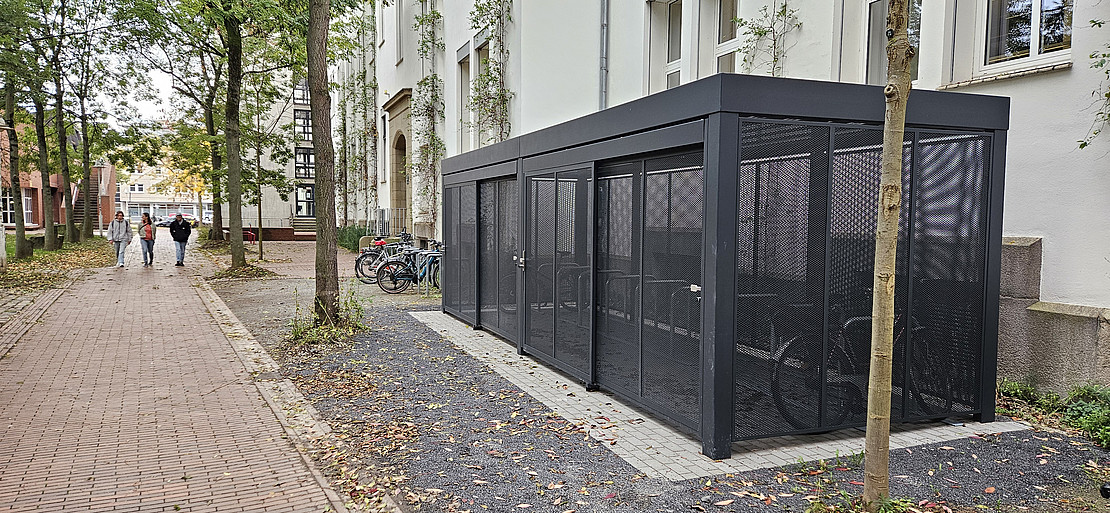
There are three places on campus where you can park your bike safely. The bicycle parking facilities are located in the underground parking garage of the library (access via Georg-Forster-Straße). A fourth parking facility has been set up for employees in front of the administration building at Mönchebergstraße 19. The facilities work with an electronic door lock system, which allows access via the campus card. The campus card can be activated for the respective bicycle parking facility in the key depot without an application.
For the time being, three bicycle boxes have been completed at Hopla; these are located at the Institute of Music, the Engineering Sciences I building and the K10 building. A further box will be installed in Georg-Foster-Straße once the construction work has been completed. In addition, another lockable area is to be set up in Arnold-Bode-Straße, between WiSO C and the Campus Center, by the end of October. Further bicycle boxes are already being planned for all other locations (Kunsthochschule, AVZ, Damaschkestraße, Witzenhausen Steinstraße, Wilhelmshöher Allee).
The bike boxes can be used via the Campus Card, which must be activated at the key depot. No application is required for activation.
Bicycle repair stations have been set up at every university location.
- Give preference to climate-friendly means of transportation (buses and trains are superior to cars and domestic flights in terms of their carbon footprint)
- Prefer telephone and video conferences to business trips
The AStA also has a wide range of offers:
Use nextbike and borrow a bike free of charge for 60 minutes.
Location Witzenhausen:
Furniture exchange

Material exchange "remnant"

Sustainable catering
Unishop

University workshops

The workshops develop, manufacture and maintain devices and equipment and offer services in electronics, media technology, mechanics and carpentry. The focus is on sustainability - repair, refurbishment and reuse instead of buying new, resource-saving and cost-efficient. In addition to quick repairs, the university workshops provide support with technical advice, prototype construction and new and further developments.
events

Water

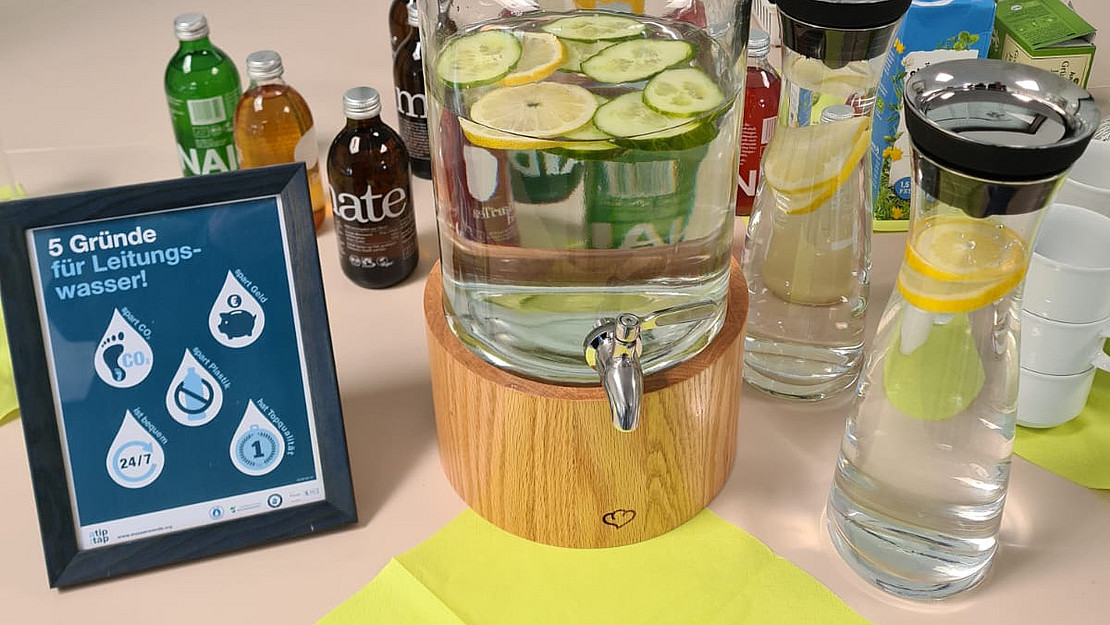
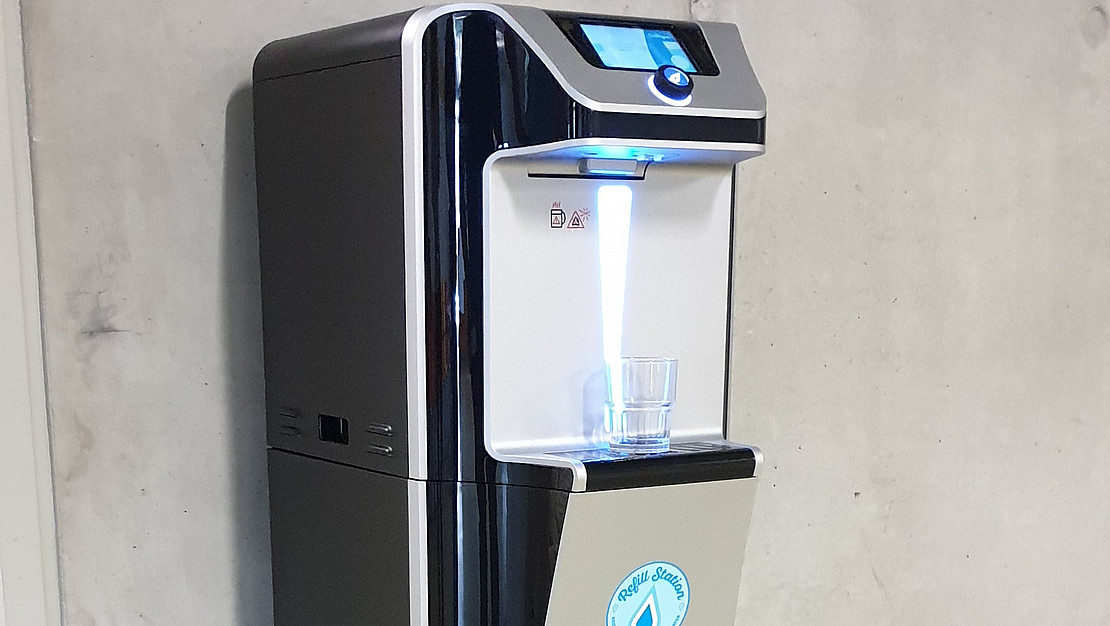
The idea of installing drinking water dispensers at the University of Kassel has been around for some time. In February 2023, interested employees and students came together at the Green Office's Idea Challenge to drive the issue forward. The tap water in Kassel is of very good quality and is checked regularly. It also saves waste and CO2 when water comes directly from the tap and does not have to be transported far. Since then, 5 public drinking water dispensers have been installed at 3 different university locations.
The drinking water dispensers are listed as official refill stations. The Green Office has also been recognized by a tip:tap e.V. as a "tap water-friendly office" . Tap water is also served in meetings and at Green Office events.
- University news on the first drinking water dispenser installed in July 2023
- A look back: Water Day in the Campus Center in October 2023
- Water dispenser in the campus library in January 2024
Save water and conserve resources, e.g. by drinking tap water instead of buying bottled water and using our drinking water dispensers.