
How is the course structured?
The content on this page was translated automatically.
After six semesters of standard study time, you will receive a Bachelor's degree. Depending on your specialization, you will study the corresponding engineering modules in either the Mechanical Engineering or Electrical Engineering department. You will need the technical didactic skills to be able to successfully teach the learning fields and content of your specialization in vocational lessons.
The second teaching subject, including the associated subject didactics, completes your professional profile. You can choose between the subjects chemistry, German, English, French, mathematics, politics, physics, religion, Spanish and sport. Modules in vocational and business education are also integrated into the interdisciplinary educational and social science core study program. You will acquire the basic educational and vocational pedagogical knowledge required to work as a teacher at vocational schools. You will complete your Bachelor's degree with the successful completion of your Bachelor's thesis.
Sample study plans
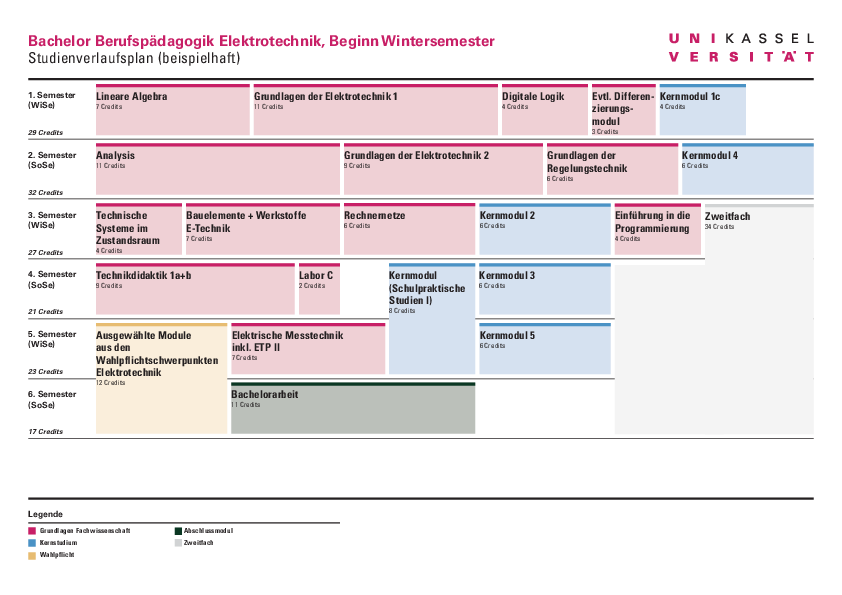
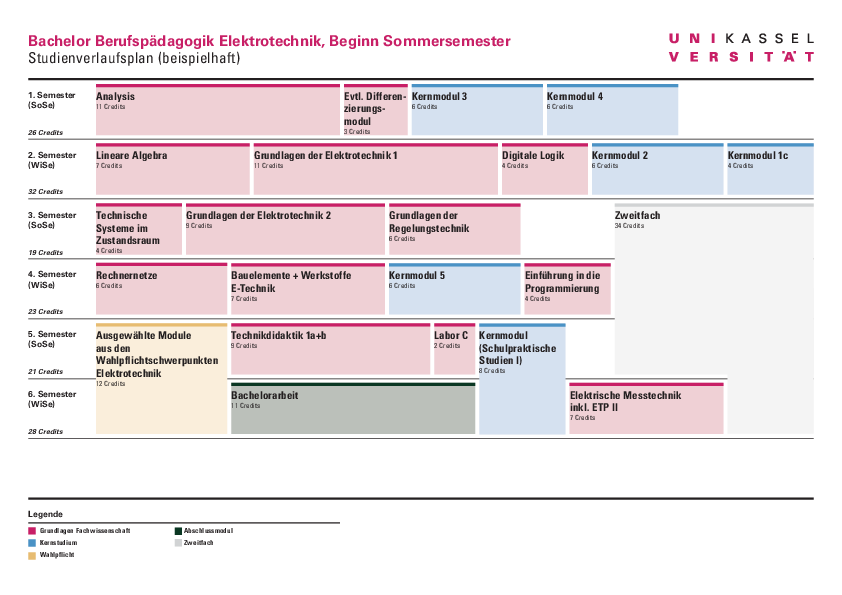
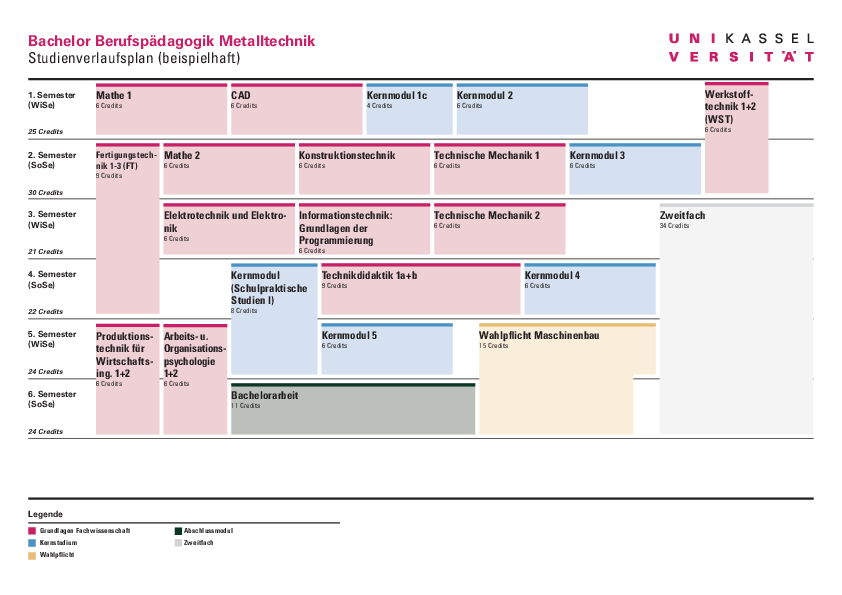
Download
The Vocational Education specializing in Electrical Engineering qualifies students primarily for teaching at vocational schools that have trainees in the vocational field of electrical engineering (e.g. electronics technicians for industrial engineering, electronics technicians for energy and building technology, information electronics technicians) or corresponding full-time school types (e.g. technical secondary schools, vocational schools, technical colleges, vocational grammar schools). The subject-specific study components are offered by the Department of Electrical Engineering. The Department of Vocational Education with a focus on technology didactics, headed by Prof. Dr.-Ing. Matthias Haack, is responsible for the vocational education course with a focus on electrical engineering and for the didactic study components.
The Department of Vocational Education with a focus on the didactics of technology is located on the Holländischer Platz campus (Henschelstraße 2). You can reach the following contact persons there in building K10:
Student Advisory Service for Electrical Engineering
Ana V. Molina Fuentes (LL.M.)
Office of the Department of Vocational Education with a Focus on Technology Didactics
M. A. Nancy Zschocke
Head of the Department of Vocational Education with a Focus on Technology Didactics
Prof. Dr.-Ing.
The Vocational Education course with a specialization in metal technology qualifies students primarily for teaching at vocational schools that have trainees in the vocational field of metal technology (e.g. industrial mechanics, cutting machine operators, metalworkers, plant mechanics, automotive mechatronics technicians) or corresponding full-time school types (e.g. technical secondary school, vocational school, technical college, vocational grammar school). The subject-specific study components are offered by the Department of Mechanical Engineering. The Department of Mechanical Engineering is responsible for the vocational education course specializing in metal technology and for the subject-specific didactic study components.Matthias Haack with a focus on the didactics of technology.
The Department of Vocational Education and Technology Education is located on the Holländischer Platz campus (Henschelstraße 2). You can reach the following contact persons there in building K10:
Student Advisory Service for Metal Technology
Ana V. Molina Fuentes (LL.M.)
Office of the Department of Vocational Education with a Focus on Technology Didactics
M. A. Nancy Zschocke
Head of the Department of Vocational Education with a Focus on Technology Didactics
Prof. Dr.-Ing.
The didactics of electrical engineering and metal technology (technology didactics) combines the engineering and educational science components of the course. The aim of didactics in electrical engineering and metal technology is to enable student teachers to analyze, design, reflect on and innovate vocational education processes. The Department of Vocational Education with a focus on the didactics of technology offers the following modules in the Bachelor's degree program:
- Module Technical Didactics 1 (9 ECTS, 4 SWS)
- Module Practical School Studies 1 (8 ECTS, 4 SWS)
A detailed description of the modules can be found in the examination regulations and the module handbook.
In addition to one of the two subject areas, you will study a second subject on the teacher training course. The teaching subject is particularly important for your later work as a teacher in full-time schools. Information on the second subjects can be found on the websites of the relevant subject areas.
The core study program in education and social sciences lays the general foundations for the teaching profession and is offered on an interdisciplinary basis by the disciplines of educational science, philosophy, political science, psychology, psychoanalysis, sociology and vocational education. A detailed description of the core study modules can be found in the examination regulations and the module handbook.
Further information on the core study program can be found on the website.
General objectives
- To initiate and develop the first steps towards pedagogically well thought-out and responsible teaching and school activities.
- Gaining experience of teaching, school and the teaching profession.
- Getting to know different classroom settings through observations.
- Reflecting on experiences and own ideas.
- Creating a basis for an in-depth examination of the educational and social science, general didactic, subject-specific didactic and subject-specific scientific aspects of school and teaching.
The practical school studies SPS 1 (in the Bachelor's degree program) and SPS 2a (in the Master's degree program) are offered by the Department of Vocational Education with a focus on the didactics of technology. Detailed information can be found on the department's website.
For later employment as a vocational school teacher in the fields of metal or electrical engineering, it is essential to have basic practical skills in relevant professions and to have experienced typical operational work processes in different work situations (industrial production, workshop work, construction site work).
For this reason, a 48-week work placement in a metal or electrical engineering profession must be completed before registering for the Bachelor's thesis (6th semester). Relevant vocational training is generally recognized. The examination and degree program coordinator Ana V. Molina Fuentes is responsible for the recognition of internships and vocational training.