
Study structure
The content on this page was translated automatically.
Study plan
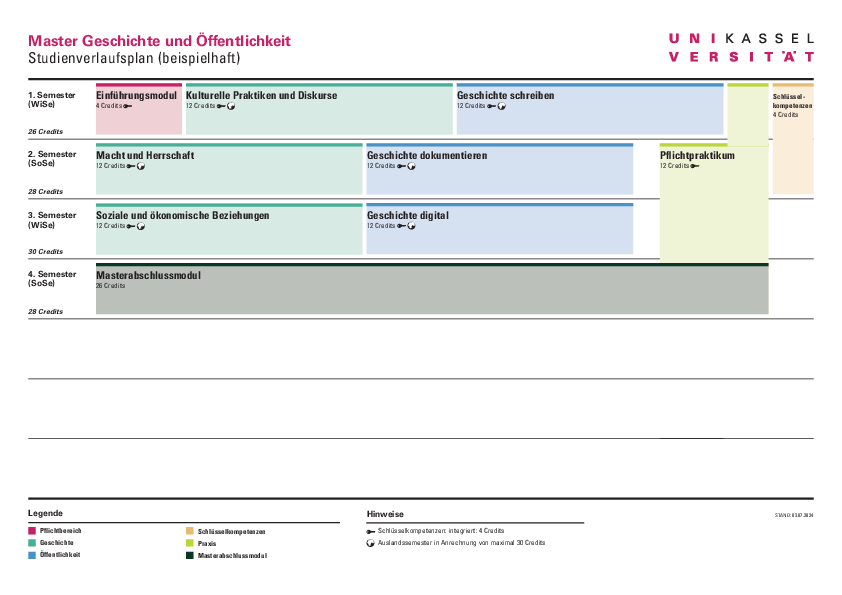
Module A1 "Cultural Practices and Methods" introduces you to cultural-historical methods and theory formation. You will learn to reconstruct and critically examine cultural contexts of meaning on a practical, discursive and material level and to apply the central research categories of cultural history (gender, class, status, race, ethnicity, religion, region, species, etc.) appropriately. Furthermore, you will be offered larger contexts of cultural history across epochs and regional, transfer-historical or global contexts.
Module A2 "Power and Domination" builds on cultural-historical theory. Here you will be able to formulate multi-perspective explanations of the causes for the development of historical practices of domination. You will learn to identify differences in the understanding of power and rule and to explain them from the respective historical context. You will also learn to what extent history and historical culture are themselves constructed, are not free of power relations and therefore themselves require deconstruction.
Finally, in Module A3 "Social and Economic Relations", you will gain an in-depth insight into social and economic historical structures and processes based on exemplary topics. These include the history of economic systems and economic institutions, production methods and consumption patterns as well as questions of demography, migration and social inequality and the history of groups, classes and genders in general. You will be trained in the use of quantitative and qualitative methods of analysis in social and economic history.

Module B1 "Writing History" familiarizes you with the main features of media-historical change and the essential concepts for describing it. You will learn to analyze changes in journalistic practice on a national, inter- and transnational level and to embed them in their respective contexts. You will put into practice the knowledge you have acquired regarding the different media formats and audience-related representations by writing a variety of texts which, depending on the focus, are aimed more at a specialist audience or the general public.
Module B2 "Documenting History" deepens your knowledge in dealing with sources and research literature and enables you to critically assess historical material and prepare it for a suitable form of presentation and documentation. To this end, you will research published and unpublished sources and learn to analyze them using historical and cultural studies methods. You will also examine forms of presenting and documenting history and critically scrutinize the chosen narratives. In cooperation with our local partners, you will have the opportunity to apply your knowledge and will be able to create independent projects to mediate between science and the public.
Module B3 "Digital History" provides you with basic knowledge of digital historiography and knowledge about the possibilities and limitations of using digital and virtual media and tools for historical practice and presentation. You will learn to understand the creation and processing of digital data and to conduct well-founded information criticism in the sense of digital hermeneutics. This will enable you to prepare historical content virtually for different target groups.
Practice and mobility
The compulsory internship gives you an insight into the national and international professional world. You will gain experience of everyday processes in institutions that deal with historical reappraisal or mediation in very different ways. You will learn how to familiarize yourself with unfamiliar fields of work, qualify for teamwork and practice working independently in a professional environment.
The compulsory internship can be completed either in Germany or abroad. You can choose between an eight-week internship or two six-week internships. This choice gives you flexibility when planning your Master's degree course. The History department maintains contacts with various archives, museums and institutions that are closely associated with historical work and supports you in choosing your internship. Ultimately, however, you decide on the choice of your internship and your non-university focus.
During an internship or a study visit abroad, you will acquire organizational, personal and intercultural skills. You can also deepen the geographical focus you have set in your studies. There are numerous opportunities that allow you to go abroad. For example, you can take advantage of existing Erasmus+ partnerships with the History department and obtain detailed advice. The International Office can also help you here. The Career Service can also help you find and apply for internships abroad (also in English).
Notes on your academic achievements
The coursework to be completed in the Master's in History and the Public Sphere can consist of a "classic" presentation, leading a discussion, moderating a seminar session or lecture event, organizing a panel discussion, a lecture event, a scientific workshop, an excursion program, participation in student projects, questionnaire development, interviews, event conception, group leadership, etc.. However, they can also include new audiovisual and digital formats such as podcasts, posters or blogs. The same applies to examinations. Here, classic performance assessments such as term papers are just as important as creative, practice-oriented forms of exercises such as essays, exhibition catalogs or event and project concepts.
As part of the Master's degree in History and the Public Sphere, you will acquire important key skills. The term key competencies includes communication, organizational and methodological skills. Proof of key competencies is provided as coursework within modules A1-A3 and B1-B3. These prepare you for lifelong learning and promote your chances on the job market, for example through your ability to adapt, your social communication skills and efficiency-oriented problem-solving behavior.