
Competence Center for Gender Studies in Transformation
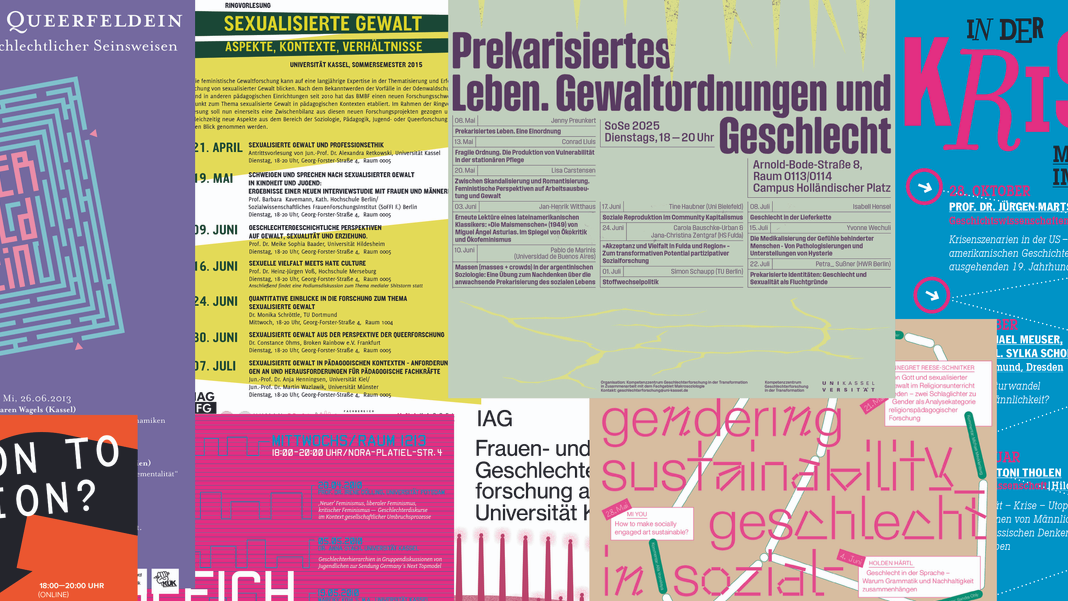
Interdisciplinary - Intersectional - International
The Center of Excellence “Gender Studies in Transformation” (GETRA) serves as a forum for discourse and a research network where scholars from various disciplines collaborate. Its mission is to consolidate, strengthen networking, continue, and—in particular—expand existing research initiatives in the field of interdisciplinary, intersectional, and international gender, diversity, and queer studies. Drawing on a wide range of disciplinary as well as multi- and interdisciplinary methodological and theoretical approaches, the center not only examines gender from multiple perspectives, at various levels, and through both contemporary and historical analysis; at the same time, the Center contributes to the further development of research and continuously reflects on and revises its own theoretical approaches and epistemological self-understanding.
The Center’s activities are organized into three research clusters: “Socio-Ecological Transformation and Gender Relations,” “Precarized Lives and Relations of Violence,” and “Representation and Reproduction of Gender.” The spectrum ranges from the analysis of social, economic, spatial, and political inequalities to the study of the intersections of structural power relations—such as racism, sexism, ableism, and nationalism—to the examination of knowledge systems, the representation of gender, and its role in processes of production and reproduction.
In addition, the center incorporates an interdisciplinary study program and provides targeted support for graduate students within its structures to strengthen academic training and guidance in the field of gender, diversity, and queer studies.
The name “Gender Studies in Transformation” underscores, on the one hand, the center’s focus on gender relations in processes of social transformation as well as on the transformation of gender itself. On the other hand, it refers to the interdisciplinary and consistently reflexive field of gender studies, which is constantly evolving—both in terms of its research questions and its methodological approaches. Third, the term “transformation” establishes a connection to the University of Kassel’s profile in the field of sustainability debates and highlights that gender studies and transformation studies are closely interrelated.
What sets the Center of Excellence “Gender Studies in Transformation” (GETRA) at the University of Kassel apart is its close integration of gender studies with various interdisciplinary research fields—including disability studies, mobility studies, feminist STS, post-/decolonial studies, eco-feminist studies, digital studies, human-animal studies, childhood studies, and legal gender studies—as well as with educational research, migration and racism studies, urban and spatial studies, and, last but not least, sustainability and transformation studies.
Research clusters
Socio-ecological transformation and gender relations
The cluster examines structures that create precarity and inequalities, focusing on social, economic, political and cultural factors and their gender-specific effects and mechanisms of gendering.
Socio-ecological transformation and gender relations: More about this research cluster
Precarious lives and violent relationships
The research cluster focuses on the relationship between production and reproduction, the associated power structures and the tensions between democracy, property and social inequality.
Precarious lives and violent relationships: More about this research cluster
Representation and reproduction of gender
The cluster is dedicated to the question of how gender and its characteristics are expressed and passed on, i.e. reproduced, in different social and cultural settings.
Representation and reproduction of gender: More about this research cluster
Activities and structure
Board of Directors and organizational structure
Gender Studies Program
Certification program for students and doctoral candidates