How is the course structured?
This page contains automatically translated content.
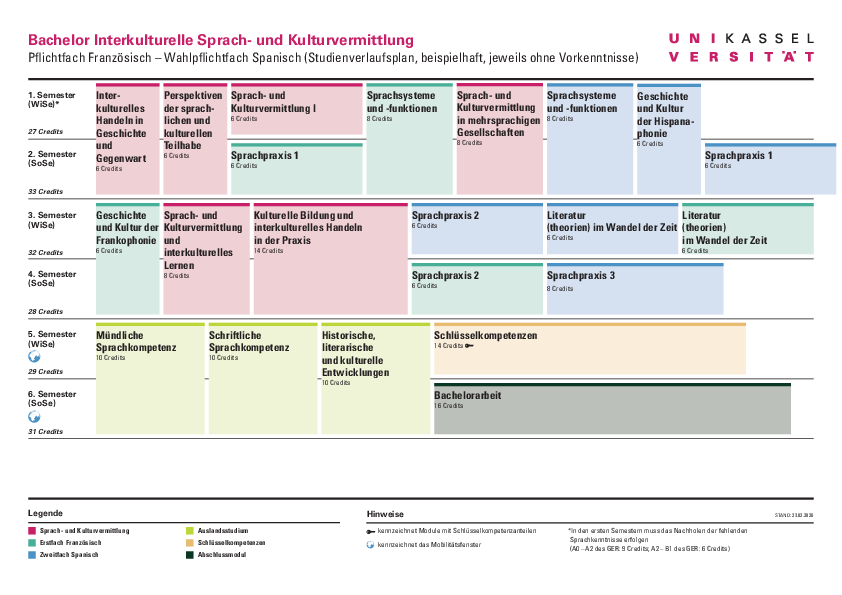
The Bachelor's degree program in International Language and Cultural Mediation consists of a compulsory area, a first subject and a second subject. The compulsory area of language and cultural mediation is completed either with the first subject French in combination with one of the second subjects Spanish, English or German or with the first subject Spanish in combination with one of the second subjects French, English or German.
Focus of the degree program
A total of six modules dealing with intercultural action in the past and present, perspectives on linguistic and cultural participation, language and cultural mediation in multilingual societies, intercultural learning and cultural education and intercultural action in practice.
A total of 6 modules in which students deal with Francophone linguistics, literature and cultural studies and receive in-depth practical language training from native speakers.
A total of 6 modules in which students deal with Hispanophone linguistics, literature and cultural studies and receive in-depth practical language training from native speakers.
Four modules that deal with deepening and expanding practical language skills, the basics of the subject sciences and linguistic and cultural teaching and learning processes.
Four modules covering, among other things, the basics and consolidation of linguistics and literary studies as well as text competence.
Six modules that offer students comprehensive practical language training by native speakers, an introduction to and in-depth study of the subject areas (linguistics and literature) as well as the history and culture of the chosen language area.
As a rule, students complete a stay abroad at a university in a French- or Spanish-speaking country in their fifth semester. The University of Kassel offers students a wide range of options thanks to its extensive network of partnerships.
The topic of the Bachelor's thesis is issued at the beginning of the sixth semester at the earliest if the requirements specified in the examination regulations are met. The topic is chosen according to the student's own research interests and in close consultation with the chosen examiner. The thesis can be written in either German or French.
Key competencies enable students to acquire or deepen skills that are not directly related to the subject in order to complement their own profile. This can include intramural and/or extramural commitment, but also separate and designated courses at the University of Kassel, e.g. practical coordination workshops on project management or web editing.
Sample study plan